

ABOUT ECOLAB
Ecolab, Purolite™ Resins is a global leader in ion exchange, adsorbent, and separation resin technologies, delivering high‑performance solutions for demanding industrial applications. As part of Ecolab’s Purification Technologies portfolio, Purolite Resins supports customers across power generation, chemical processing, hydrometallurgy, water treatment, microelectronics, carbon capture, and other critical industrial markets.
Purolite Resins are engineered to optimize purification, separation, and recovery processes - helping industrial operators improve reliability and efficiency. With one of the industry’s broadest resin portfolios, Ecolab offers solutions designed for a wide range of feedwaters, operating conditions, and purity requirements, from general industrial systems to high‑performance and mission‑critical applications.
Backed by a global manufacturing footprint, deep application expertise, and technical service capabilities, Ecolab enables customers to reduce operational risk, extend system life, and achieve consistent, high‑quality performance. From process optimization and contamination control to resource recovery and emissions reduction, Ecolab partners with industrial customers to solve complex challenges and support long‑term operational success.
FEATURED ARTICLES

Tighter PFAS limits demand reliable, compact treatment. Learn how selective ion exchange and smart pretreatment help hit low targets while extending resin life.

Purification suppliers now face a harder test than lab performance: delivering identical outcomes in every plant, every quarter. Seven factors separate a product vendor from a partner when processes cannot stop.

Traditional ion exchange media can disrupt water chemistry and increase pipe corrosion risks during startup. Buffered treatment solutions stabilize pH and mineral ratios immediately, delivering consistent, safe performance across intermittent residential usage.

Effective PFAS remediation demands precise prefiltration, controlled hydraulics, and optimized vessel configurations to prevent media fouling and premature contaminant breakthrough. Read the guide to implement best practices for maximum treatment efficiency.

Achieving reliable drinking water decontamination using selective single-use ion exchange media requires careful hydraulic management, targeted prefiltration, and proper lead-lag vessel engineering to protect media integrity, prevent premature breakthrough, and maintain consistent effluent quality.

Operational drift in demineralizer systems often leads to hidden chemical and water waste. By re-establishing precise performance baselines and refining operational practices, facilities can significantly lower annual chemical spend, reduce water consumption, and recover valuable operating time.

The best reverse osmosis (RO) programs are guided by a defined set of operating principles that provides operators with clear performance standards and a consistent framework for decisions.

As fossil power units shift to flexible, grid-balancing roles, frequent cycling destabilizes condensate chemistry. Discover how optimized water treatment and high-capacity resin solutions protect aging equipment, control operational costs, and maintain strict water purity under variable grid conditions.

Discover how ion exchange technology effectively removes radioactive uranium isotopes from municipal wastewater. This case study explores the transition from pilot studies to full-scale remediation, highlighting the importance of technical support in meeting stringent local water quality standards.

Learn how PFAS-selective ion exchange resin offers a compact, high-efficiency alternative to traditional carbon filtration. This overview highlights the technical benefits of faster kinetics, reduced equipment footprint, and superior removal of short-chain compounds for long-term water quality compliance.

Discover how PFAS-selective ion exchange resin offers a cost-effective alternative to traditional filtration methods. This case study details the transition to non-detectable contamination levels, showcasing the performance advantages of resin technology in securing resilient, high-quality public water supplies.

Regulated PFAS limits necessitate efficient, long-term treatment strategies. Ion exchange technology offers a high-capacity, small-footprint solution that outperforms traditional media. Learn how selective resins provide a cost-effective path to compliance and simplified utility operations.
CONTACT INFORMATION
Ecolab
2201 Renaissance Boulevard
King of Prussia, PA 19406 USA, PA 19406
UNITED STATES
FEATURED PRODUCTS
-

Purolite Purofine PFA694E is the flagship PFAS-selective single-use ion exchange resin for drinking water and other PFAS remediation applications. This proven product provides better short chain removal, smaller footprint, and significantly lower operational cost than competitive technologies.

FEATURED BROCHURES
-

Thanks to Ecolab’s ion exchange technology, dangerous PFAS compounds can be reduced to non-detect levels. Purolite™ Purofine™ PFA694E makes use of ion exchange and adsorption technologies to reduce the capital and operational costs of treatment compared to standard carbon-based treatment methods.
-

Discover how buffered resin can reduce the effects of water chemistry changes.
VIDEOS
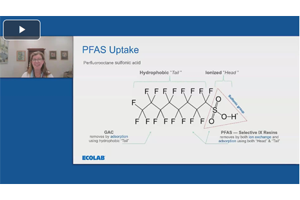
As PFAS contaminants continue to reshape water treatment priorities, utilities, engineers, and treatment professionals are being asked to make high-stakes technology decisions with rapidly evolving information. Ion exchange offers a proven, high-performance option—but knowing when, where, and how to apply it is essential to achieving reliable results.

In this on-demand webinar, Ecolab introduces the next-generation PRSM™ Softening Calculator, a powerful and free tool built to help water professionals evaluate system designs, optimize operating conditions, and clearly quantify total value delivered (TVD).