
V-BIO® Enhanced Polywrap
Polyethylene Encasement has been protecting ductile iron pipe since 1958, earning its reputation as the most economical and proven method of corrosion control in the industry.
By creating a low-oxygen environment around the pipe, standard polywrap naturally slows corrosion over time, reducing it to negligible levels. However, in uniquely severe environments where microbiologically influenced corrosion (MIC) may be present, enhanced protection is required. That’s where V-BIO® Enhanced Polywrap from U.S. Pipe sets a new standard.
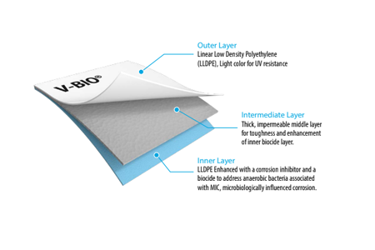
V-BIO builds on the proven success of traditional polyethylene encasement by eliminating the initial corrosion rate that can occur during early service life. It incorporates both a corrosion inhibitor and a powerful biocide to combat anaerobic bacteria that contribute to MIC. These protective elements are permanently infused into a three-layer, co-extruded linear low-density polyethylene (LLDPE) film, delivering multiple forms of corrosion defense in a single, integrated system.
The inner layer contains a proprietary blend of antimicrobial agents and a volatile corrosion inhibitor (VCI) to control both microbiological and galvanic corrosion at the pipe surface. A thick, impermeable intermediate layer enhances durability and reinforces the effectiveness of the inner protection. The light-colored outer layer provides additional toughness and UV resistance, ensuring long-term performance during storage, installation, and service.
With three distinct corrosion protection mechanisms fused into an 8-mil-thick film, V-BIO represents the next generation of polyethylene encasement technology. Proven in severe test environments, including the Everglades, V-BIO delivers lower corrosion rates from day one and sustained protection over time—helping extend pipe life and reduce maintenance costs. For utilities facing aggressive soil or water conditions, V-BIO Enhanced Polywrap offers confidence, durability, and long-term value.
Get unlimited access to:




Enter your credentials below to log in. Not yet a member of Water Online? Subscribe today.