
Purdue Student Engineers Conquer Blue-White® Assembly Challenge
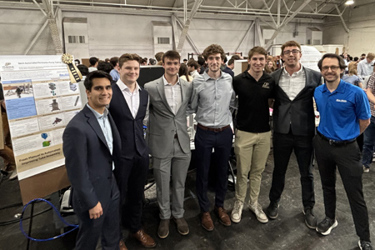
When Purdue University mechanical engineering students sought a senior design project that would provide real-world manufacturing experience, Blue-White delivered a challenge worthy of their ambition. Tasked with automating the assembly of peristaltic pump tubes for the company's FLEXFLO® One Series pumps, the team set out to replace a labor-intensive, manual process with a more efficient and consistent solution.
After touring Blue-White's manufacturing facility and collaborating closely with company engineers, the students gained a clear understanding of the production requirements, quality expectations, and technical specifications needed to modernize the assembly process. Their assignment focused on automating a series of repetitive tasks—including stretching, measuring, cutting, and attaching adapters—that previously relied on manual precision and significant operator effort.
The resulting fixture streamlined the workflow by eliminating repeated measuring, cutting, and crimping steps. Operators now simply feed the tubing into the fixture, secure the adapters, and unload the completed assembly, improving both manufacturing consistency and production efficiency.
Throughout the four-month project, the students worked closely with Blue-White engineers, providing regular design updates while refining their prototype through real-world manufacturing feedback. The collaboration culminated in an impressive final presentation, where the team's automated assembly system earned a third-place medal among more than 60 senior engineering projects.
This case study highlights the value of industry-academic partnerships, demonstrating how hands-on engineering challenges prepare future innovators while helping manufacturers improve production processes. It also showcases how automation can increase quality, reduce manual labor, and create more repeatable manufacturing outcomes for precision fluid handling equipment.
Get unlimited access to:




Enter your credentials below to log in. Not yet a member of Water Online? Subscribe today.