
Novel Mesh Bioreactor Promises Low-Cost, High-Efficiency Wastewater Treatment
Wastewater treatment facilities worldwide are facing surging wastewater volumes and increasingly expensive treatment solutions. As a result, technologies capable of processing more wastewater using fewer resources are in high demand. A research team from the Hong Kong University of Science and Technology (HKUST) believes it has devised such a solution by integrating “a mesh bioreactor (MeBR) with an ultrasound-induced transient cavitation cleaning mechanism,” the university announced in January.
The technology, designed to serve both industrial and municipal treatment systems, produces treated effluent that surpasses international and local discharge standards while reducing the cost-per-cubic-meter for treatment of wastewater by 50% compared to conventional membrane bioreactors (MBRs). The researchers say their solution combines scalability, sustainability, and affordability. Their findings were published in Nature Water in October 2025.1
“Whereas membrane-based separation methods employing micro- or ultra-filtration achieve high total suspended solids (TSS) removal, they are costly and energy-intensive because of membrane fouling, and gravity-based separation methods often cannot consistently meet TSS discharge standards,” states the researchers’ Nature Water abstract. They describe the solution as an “MeBR that combines a coarse-pore mesh with a piezoelectric fouling removal strategy for efficient sludge–liquid separation.”
This approach is intended to overcome issues associated with conventional MBRs, which use aerobic or anaerobic microorganisms to degrade organic matter in wastewater. These systems are prone to membrane fouling, requiring membranes to be regularly cleaned or replaced, which adds to a treatment facility’s overall operational costs. The researchers estimate the system can reduce wastewater treatment cost by about $0.05 per cubic meter.
“The MeBR uses mesh material with a pore size of 10 μm to 200 μm to separate water from solids. Unlike traditional MBRs that rely on pressure to push water through dense membranes, MeBRs form a self-generated biocake on the mesh surface from retained solids and microbial biomass. This biocake acts as a natural filtration layer, improving water separation while reducing clogging,” reports Uncover Reality.
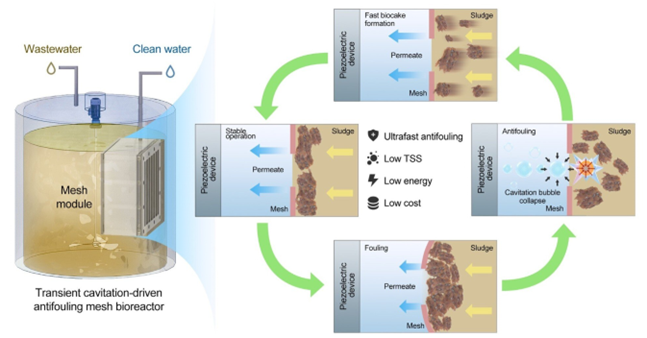
Fig. 1 — Schematic of transient cavitation-driven biofouling control using piezoelectric device. Image courtesy of HKUST
The researchers report that each square meter of mesh can process 148 to 307 liters per hour, while maintaining high durability; the mesh retained structural integrity across a 21-day municipal wastewater trial and 120 days of continuous filtration.
According to the researchers, the system can complete mesh cleaning within 3.8 seconds under anaerobic conditions and achieves 10 to 20 times higher flux than conventional MBRs. “Experiments revealed that irreversible mesh fouling was completely eliminated within 10 [seconds under aerobic conditions] when near-field transient cavitation, induced by piezoelectric ultrasound transducers, was the primary cleaning mechanism, rather than oscillation or reactive oxygen species generation,” states the abstract.
Contributing author Dr. Guo Hongxiao added the ultra-high fluxes “also reduce the biocake reformation period to under 10 minutes, overcoming a long-standing challenge and ensuring stable effluent quality during continuous operation."
Life Technology called the integration of a mesh bioreactor with ultrasound-induced transient cavitation cleaning “a major leap forward in wastewater treatment technology.” HKUST researchers also continue to explore other promising approaches, including self-forming dynamic membrane bioreactors (SFDMBRs), which offer high flux and low fouling, as a scalable, low-cost alternative to conventional MBRs.
- Luo, Y., Guo, H., Guan, D. et al. “Transient cavitation enables ultrafast fouling removal in mesh bioreactors for efficient sludge‒liquid separation during wastewater treatment.” Nat Water 3, 1436–1448 (2025). https://doi.org/10.1038/s44221-025-00531-7