
Advanced FRP Technology Restores Critical Waterfront Infrastructure At The Port Of New Orleans
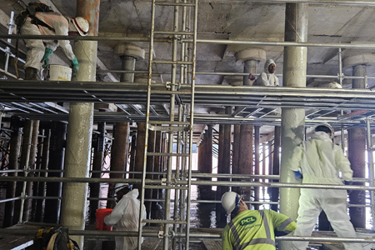
1,500 deteriorating wharf piles restored using Fyfe’s LOCTITE Tyfo FRP technology, extending service life for decades
Rocky Hill, CT – Fyfe has successfully completed one of the largest waterfront fiber-reinforced polymer (FRP) strengthening projects ever undertaken in North America, helping preserve critical infrastructure at the Port of New Orleans. More than 1,500 deteriorated piles supporting the historic Nashville Wharf have been repaired and strengthened using Fyfe's advanced LOCTITE Tyfo FRP structural strengthening system.
After decades of exposure to tidal fluctuations, moisture, and aggressive marine conditions, many of the wharf's steel piles, originally constructed in 1961 and 1962, had suffered extensive corrosion and pitting. In some areas, deterioration extended more than 13 feet vertically, with corrosion depths reaching up to one-quarter inch. Significant steel loss had exposed the concrete-filled cores of the piles, creating concerns about structural performance and long-term durability.
The complexity of the project was heightened by the location of much of the damage below the mudline and underwater. Construction crews worked in challenging tidal river conditions, managing fluctuating water levels, limited access through soft mud, elevated temperatures, and high humidity. Temporary work platforms, scaffolding systems, excavation activities, and specialized access methods were required to safely reach and repair affected areas.
To address these challenges, the project team, including PCL Construction, Royal Engineering, and Design Engineering Inc., the engineer of record, selected Fyfe's LOCTITE Tyfo FRP strengthening system, specifically engineered for demanding infrastructure applications. The solution creates a high-strength, corrosion-resistant structural jacket around each pile, restoring structural integrity and providing long-term protection against future deterioration.
Despite challenging site conditions, the project team continually improved installation efficiency throughout construction, enabling the rehabilitation to be completed ahead of schedule. The $13.5 million program addressed severe deterioration while allowing the port to remain fully operational throughout the construction process.
"Projects of this scale require solutions that can perform reliably in some of the most demanding marine environments," said Mark Brand, Head of Civil Composites at Henkel. "The Nashville Wharf rehabilitation demonstrates how FRP strengthening systems can restore structural capacity, protect against future deterioration, and significantly extend the service life of essential infrastructure, all while minimizing disruption to ongoing operations."
The completed project has preserved a strategically important asset for the Port of New Orleans while avoiding the substantial costs, operational impacts, and environmental disruption associated with large-scale pile replacement.
Christopher Smith, Construction Manager at Royal Engineering, said: "The use of LOCTITE Tyfo SCH-41 fabric in combination with the LOCTITE Tyfo SW-1S underwater epoxy system proved to be an outstanding solution for the Nashville A Substructure Repairs Project. Installation was efficient, material performance exceeded expectations, and the system integrated seamlessly into the project's requirements.
“The successful outcome improved schedule efficiency, reduced anticipated lifecycle costs, and delivered a high-quality result to the client. Based on our experience, we would confidently recommend this FRP system for similar rehabilitation projects."
About Water and Civil Infrastructure, Henkel
Henkel’s Water and Civil Infrastructure group was established to tackle the rapidly growing global challenge of aging infrastructure and to address some of the most complex issues facing the water industry today.
Henkel’s water industry solutions are provided by Advanced Valve Technologies (AVT), GeoTree, Fyfe, LifeLast, Stopaq, Polyken, Canusa, Covalence and Powercrete.
As water networks around the world continue to deteriorate, utilities and industrial operators are increasingly seeking reliable, long term solutions that minimise downtime, reduce risk, and extend the life of critical assets.
With decades of hands on experience and a deep understanding of water industry environments, the Henkel team delivers proven, high performance technologies designed to restore, strengthen, and protect essential infrastructure.
The group offers a comprehensive portfolio of solutions, including:
- Valve installation without shutting off flow
- Large diameter pipeline lining and structural reinforcement
- Manhole rehabilitation
- Steel water line and tank protection
- Advanced coating systems
- Machine applied tape coatings for large pipelines
- Heat shrink sleeve applications
- Liquid epoxy coatings that deliver durable pipeline protection.
Through these pioneering technologies—combined with exceptional engineering expertise—Henkel helps industries safely extend both the life and value of their infrastructure. By improving reliability, reducing operational disruptions, and enhancing long term sustainability, Henkel’s plays a vital role in ensuring that the world’s most critical water systems remain resilient for generations to come.
Source: Henkel