
Your Next NPDES Permit Won't Look Like Your Last One
By Martin Strøh
For most utilities, a National Pollutant Discharge Elimination System (NPDES) permit renewal comes around every five years, and it always seems to arrive sooner than expected. The next cycle is unusually concentrated. An analysis by Klarifi of EPA ICIS-NPDES data found that 5,570 of the 14,322 active individual NPDES permits at sewage treatment facilities expire between January 2026 and December 2028.1 That is 39% of that permit universe in three years.
The permits that come out of this wave are unlikely to match the ones going in. State water quality standards have moved, nutrient and ammonia limits keep tightening, and a 2025 Supreme Court decision pushes permit writers toward more specific requirements.2 For a utility, the renewal is where a decade of regulatory change lands at the plant gate.
The Renewal Wave In Numbers
The wave builds over three years: 1,360 sewage treatment permits expire in 2026, 2,141 in 2027 and 2,069 in 2028 (Figure 1). Together they cover 16,037 million gallons per day (MGD) of design capacity, 34% of the 47,235 MGD reported for all active sewage treatment permits. The cohort includes 1,212 major facilities.3
Small systems make up most of the count. Of the expiring permits, 3,056 are for plants under 1 MGD, 1,334 are for plants of 1–10 MGD, and 307 are for plants over 10 MGD; 873 report no usable design flow.4 Small plants have the least engineering staff and the least rate base to absorb a new limit, which makes early preparation more valuable, not less.
Geography matters too. Ten states hold 56% of the expiring permits, led by Texas (717), Ohio (469), and Pennsylvania (386) (Figure 2). And the clock has already run out for some: 1,026 of the permits in the 2026–2028 cohort had passed their expiration date as of November 9, 2026, and were either administratively continued (ADC) or listed as expired.5
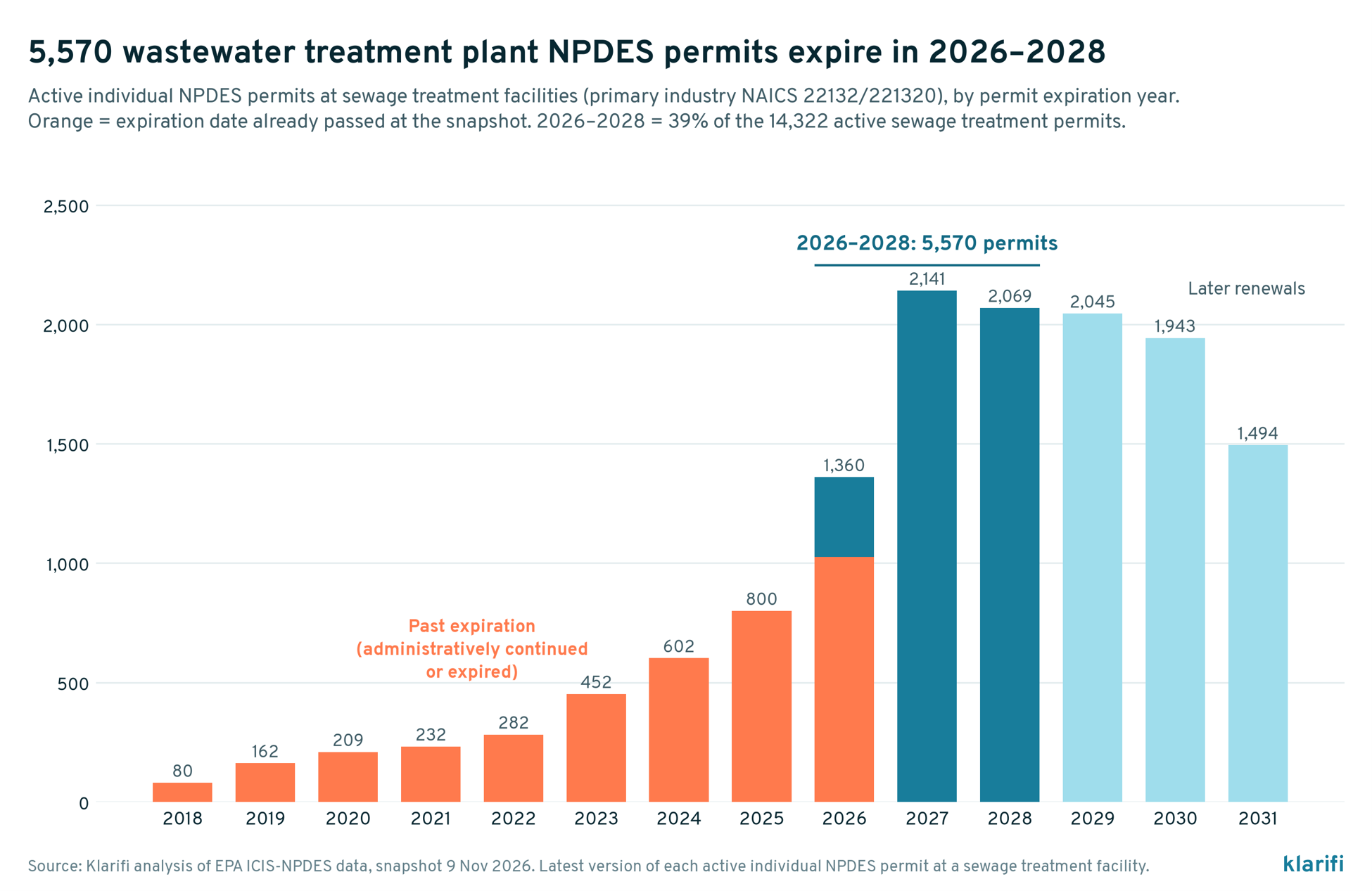
Figure 1. 5,570 active NPDES permits at sewage treatment facilities expire in 2026–2028, 39% of the 14,322 active individual sewage treatment permits. Source: Klarifi analysis of EPA ICIS-NPDES data, snapshot Nov. 9, 2026.
[Alt text: Column chart of active individual NPDES permits at sewage treatment facilities by expiration year, 2018 to 2031. Bars for 2026 (1,360), 2027 (2,141) and 2028 (2,069) are highlighted; earlier years are mostly permits already past their expiration date.]
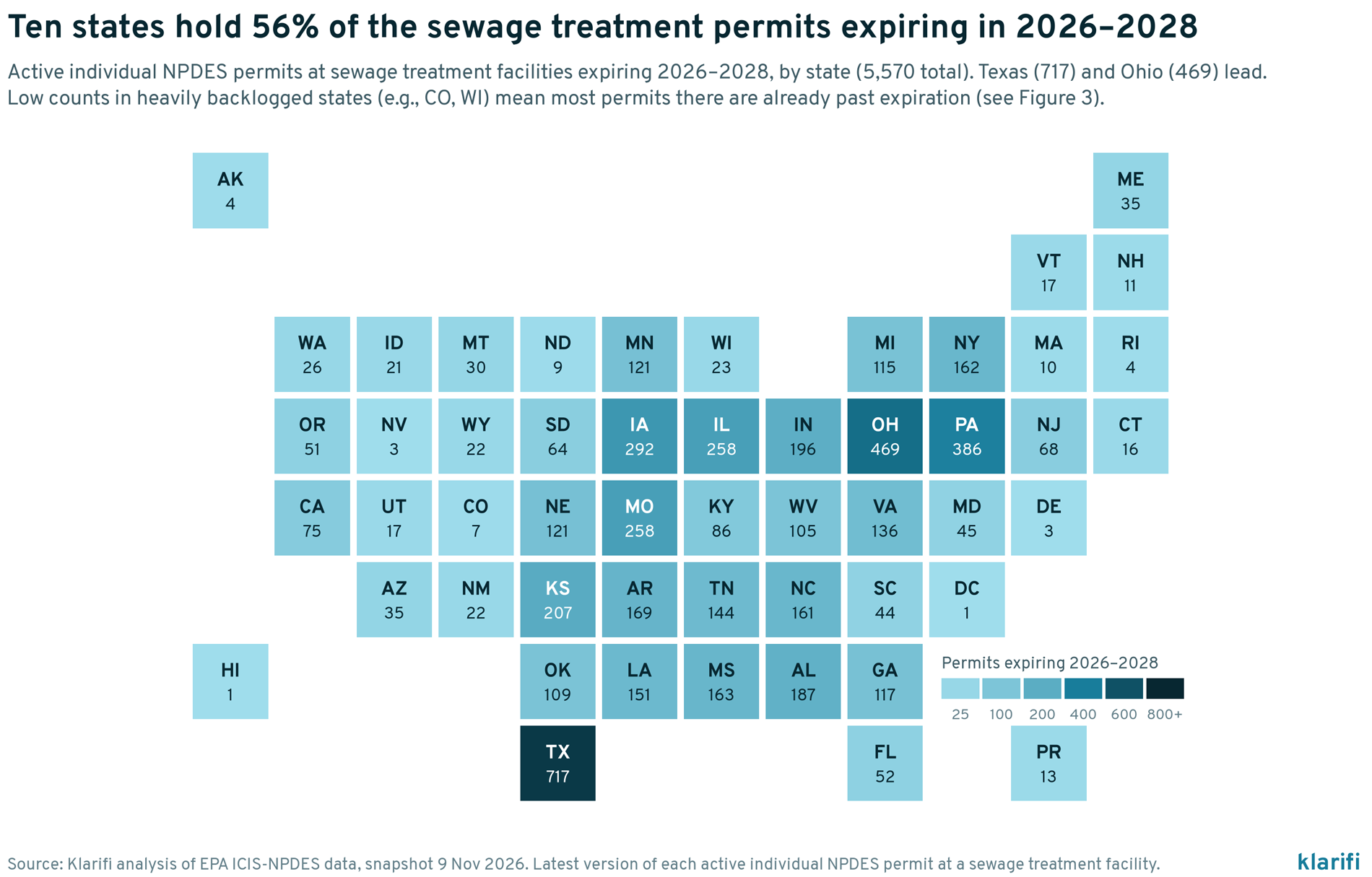
Figure 2. Ten states hold 56% of the sewage treatment permits expiring in 2026–2028, led by Texas, Ohio and Pennsylvania. Source: Klarifi analysis of EPA ICIS-NPDES data, snapshot Nov. 9, 2026.
Many Renewals Are Catch-Up Renewals
Expiration dates tell only part of the story. When a utility files a complete renewal application on time but the agency does not reissue the permit before it expires, the old permit is administratively continued and stays in force.6 As of October 1, 2025, EPA counted 8,724 of 41,330 state-issued existing individual NPDES permits (21.1%) as backlogged, meaning not reissued within 180 days after expiration.7 In 15 states with 100 or more permits, a third or more were backlogged (Figure 3).8
The picture at sewage treatment plants is similar. As of November 9, 2026, 4,296 active sewage treatment permits (30.0%) were past their expiration date and 3,609 (25.2%) were more than 180 days past it. Of those past due, 1,088 were five or more years past expiration and 331 were 10 or more years past. The past-due group includes 347 permits at plants over 10 MGD.9
A permit that has been continued for a decade still reflects the standards, total maximum daily loads (TMDLs), and data of the year it was written. When it is finally reissued, the change in requirements can arrive all at once rather than in steps.
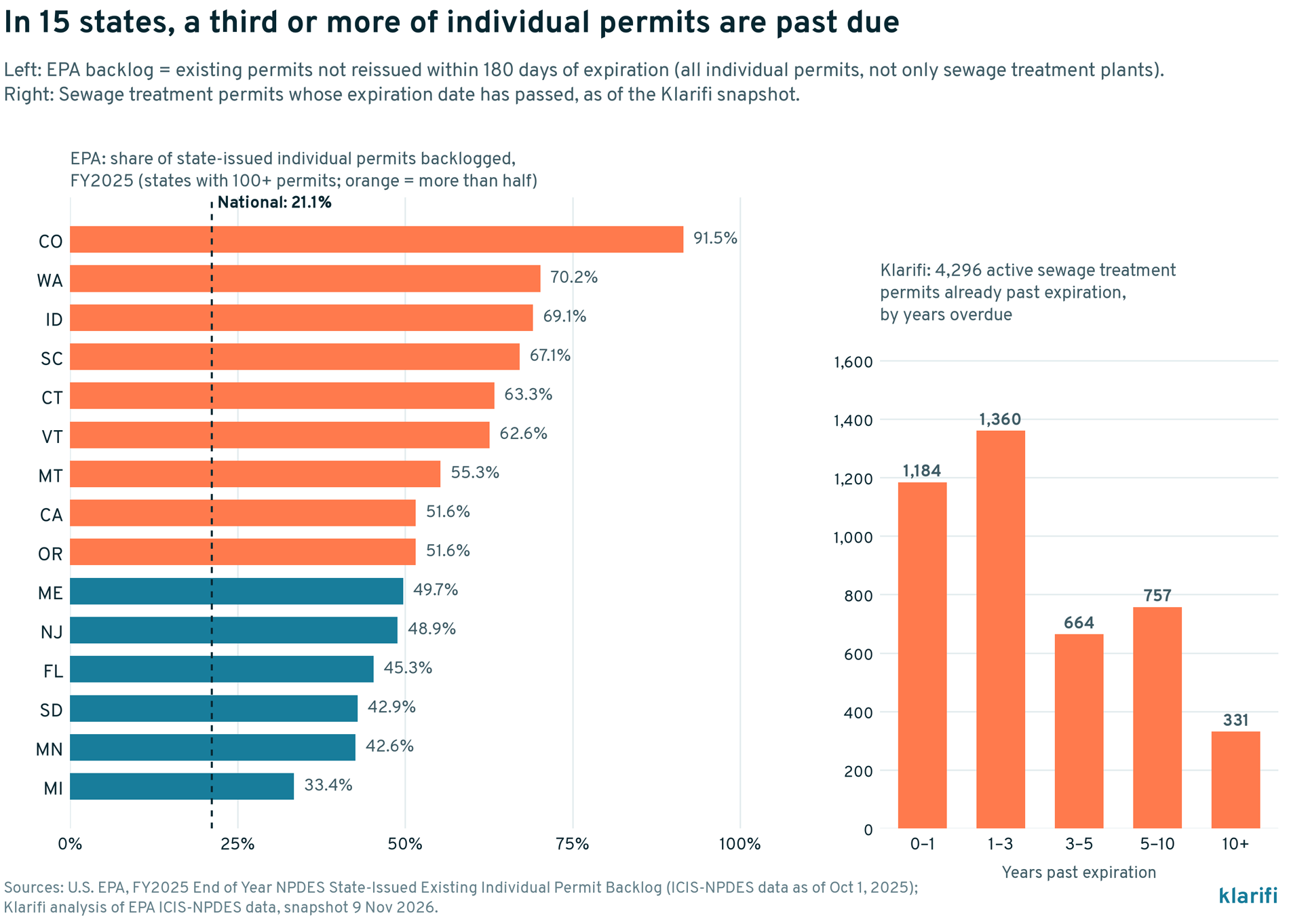
Figure 3. In 15 states, a third or more of state-issued individual permits were backlogged as of Oct. 1, 2025; 30% of active sewage treatment permits were past expiration as of Nov. 9, 2026. Sources: U.S. EPA, FY2025 End of Year NPDES State-Issued Existing Individual Permit Backlog; Klarifi analysis of EPA ICIS-NPDES data, snapshot Nov. 9, 2026.
What's New In Your Next Permit
What changes depends more than ever on your state. Figure 4 summarizes three of them — nutrients, PFAS monitoring, and PFAS source control — and how settled each one is as of October 2026.
Nutrients remain the largest cost driver. Nitrogen and phosphorus limits are set through state water quality standards, TMDLs, and water-quality-based effluent limits (WQBELs). Tighter limits, especially for phosphorus, are coming in many places; the Great Lakes region is a hotspot.10 In Medford, Oregon, stricter nitrogen and phosphorus limits in a 2021 Oregon Department of Environmental Quality permit are driving a $330 million overhaul of the regional water reclamation facility, supported by a $147 million Water Infrastructure Finance and Innovation Act (WIFIA) loan.11 In Siren, Wisconsin, the state formula at renewal points to a 0.04 mg/L phosphorus limit versus the village's current 1 mg/L variance, and a roughly $10 million upgrade estimate, as reported in September 2026.12
Federal policy on per- and polyfluoroalkyl substances (PFAS) is in flux. As of October 2026, EPA had rescinded its December 2022 memo on addressing PFAS in NPDES permits, in an Office of Water memo dated August 11, 2026.13 EPA still recommends Method 1633/1633A for PFAS monitoring, but the method is not nationally required for Clean Water Act compliance monitoring until it is added to 40 CFR Part 136; that rule is proposed, not final.14
Two federal actions are only plans as of October 2026. EPA's regulatory agenda lists a proposal adding PFAS to NPDES permit applications for January 2027 and proposed effluent limitations guidelines (ELGs) for PFAS from chromium electroplating for February 2027.15
States are not waiting. Michigan reports PFAS monitoring requirements at 176 municipal plants.16 New York finalized guidance in December 2025 that puts priority POTWs on quarterly PFAS sampling.17 In current ICIS-NPDES permit terms, Klarifi finds PFAS monitoring or limits at 271 sewage treatment facilities in 18 states. That figure is a lower bound: many state requirements are not coded as ICIS parameter rows. Michigan is the clearest gap — 176 plants in EGLE's count, 61 in ICIS (Figure 5).18
Some states, including Michigan, require utilities to measure and address PFAS through their industrial pretreatment programs; Michigan reports a 59% cut in PFOS discharged to surface waters at plants with those programs.19 Drinking-water maximum contaminant levels (MCLs) are not NPDES limits, and EPA's August 2026 memo cautions against putting them directly into permits.20
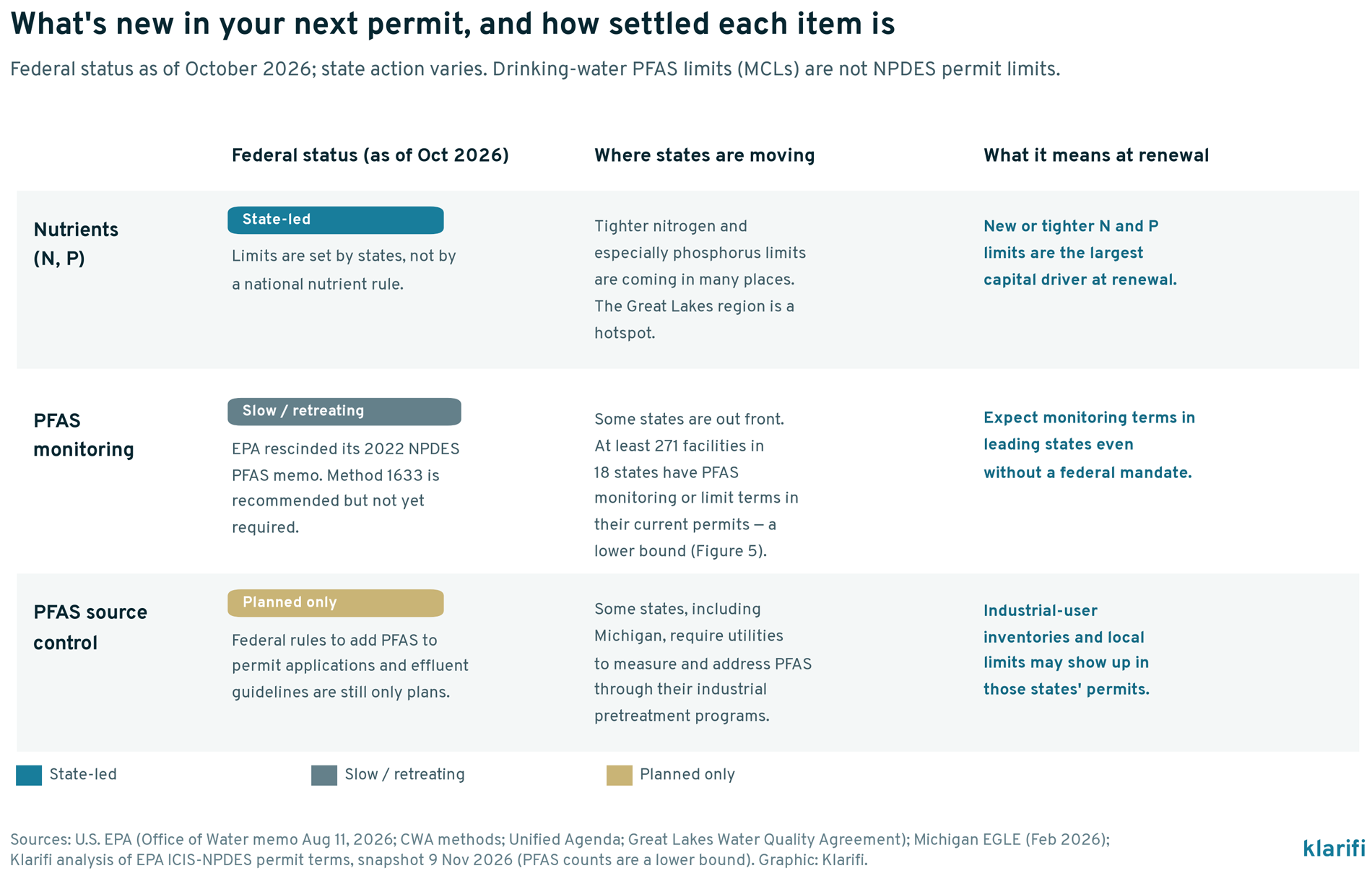
Figure 4. Nutrients, PFAS monitoring and PFAS source control: federal policy is slow or state-led, and states are setting the direction. Sources: U.S. EPA; Michigan EGLE; Klarifi analysis of EPA ICIS-NPDES permit terms, snapshot Nov. 9, 2026 (PFAS counts are a lower bound). Graphic: Klarifi.
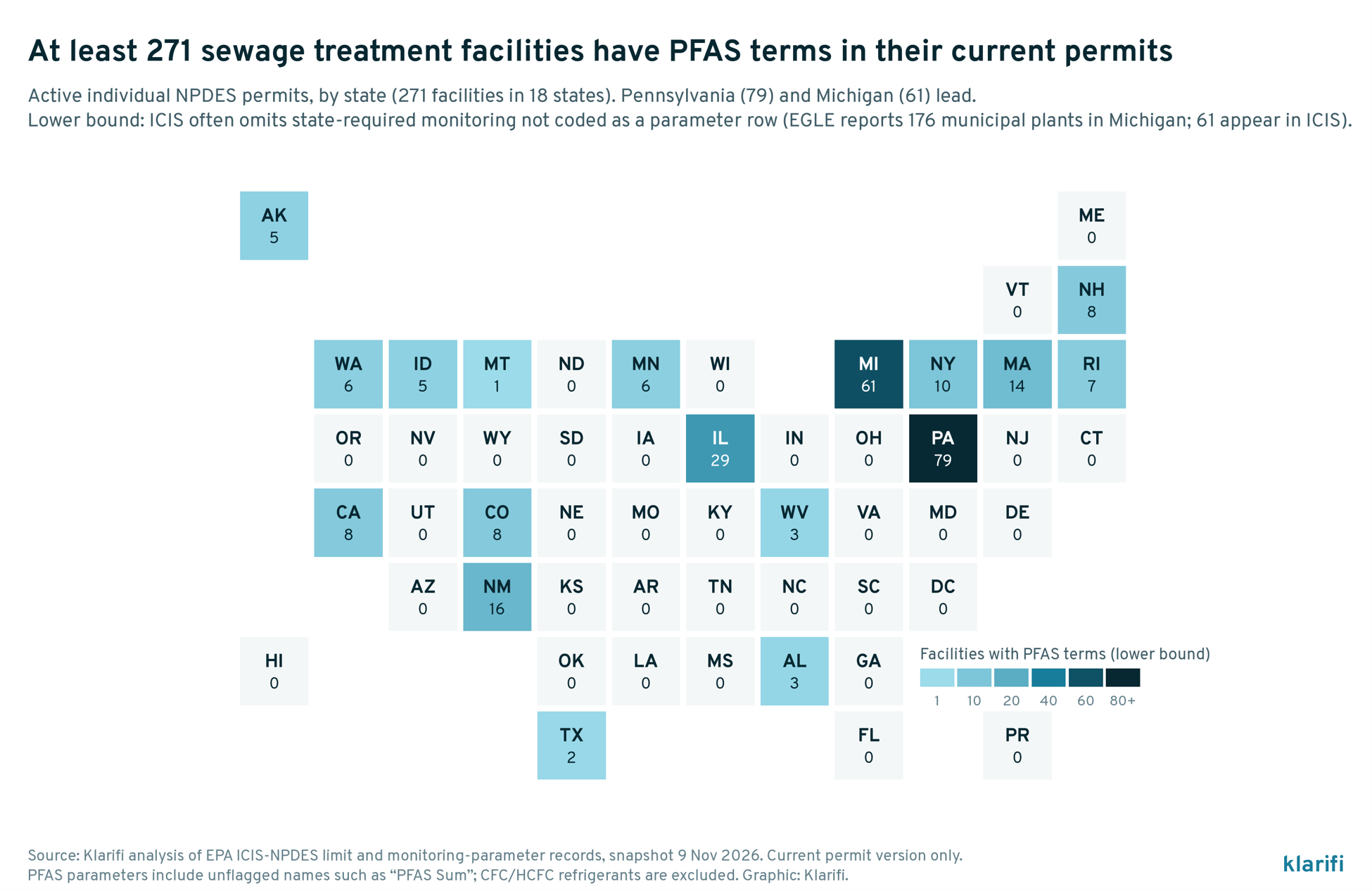
Figure 5. At least 271 sewage treatment facilities have PFAS monitoring or limit terms in their current ICIS-NPDES permits, led by Pennsylvania (79) and Michigan (61). Counts are a lower bound. Source: Klarifi analysis of EPA ICIS-NPDES limit and monitoring-parameter records, snapshot Nov. 9, 2026.
Your Compliance Record Is Your Starting Position
Permit writers start from your discharge monitoring reports (DMRs). Of the 5,520 expiring sewage treatment permits that filed DMRs in the 36 months to November 9, 2026, 77% reported at least one value above a permit limit, and 35% reported 10 or more (Figure 6). The rate was 79% at plants of 10 MGD or less and 74% at plants over 10 MGD. The most common exceedances were for biochemical oxygen demand (BOD) and total suspended solids (TSS) (50% of permits), bacteria (43%), and ammonia (33%).21
Formal enforcement is rarer. Only 231 of the 5,570 expiring permittees (4.1%) had an EPA-led Clean Water Act formal enforcement case in the last five years.22
Capacity is the other half of the record. Among 1,868 expiring permits with usable flow data, 314 (17%) reported average flow at or above 80% of design flow.23 Texas, for example, requires engineering and financial planning once flow reaches 75% of the permitted average for three consecutive months.24 The share was highest at plants under 1 MGD (19%).
None of this is a verdict. But a record with recurring ammonia exceedances or flows near capacity shapes compliance schedules, variances, and negotiating room, so it is better to know it before the permit writer does.
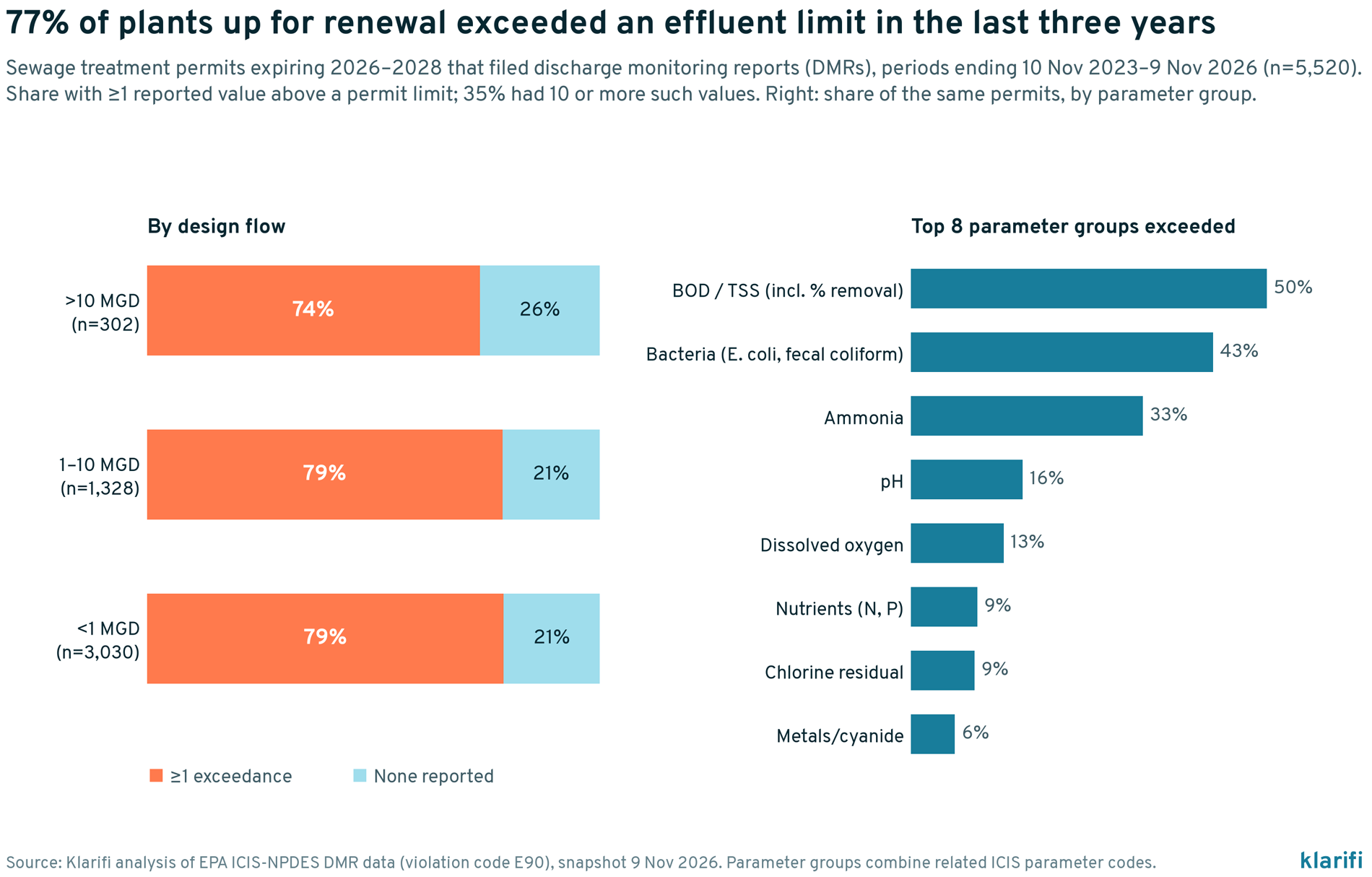
Figure 6. 77% of expiring sewage treatment permits that filed DMRs reported at least one effluent limit exceedance between Nov. 10, 2023 and Nov. 9, 2026. Source: Klarifi analysis of EPA ICIS-NPDES DMR data (violation code E90), snapshot Nov. 9, 2026.
The Permit You Help Write
Thousands of utilities will receive new permits over the next three years, many of them replacing documents written a decade or more ago. The requirements will be more specific and more state-driven than before. Utilities that arrive with their own data, cost scenarios and questions can help shape that permit instead of simply reacting to it.
About The Data
Figures come from EPA's Integrated Compliance Information System for NPDES (ICIS-NPDES), snapshot November 9, 2026.25 The universe is the latest version of each active individual NPDES permit (status effective, administratively continued or expired, not terminated) at facilities whose primary industry is sewage treatment (NAICS codes 22132 and 221320). That classification comes from the facility's primary industry code, not from EPA's publicly owned treatment works (POTW) facility-type flag. General-permit coverages are excluded. An exceedance is a DMR value flagged E90 (above a permit limit). PFAS monitoring counts are taken from parameter and limit rows on the current permit version and are a lower bound, because many state monitoring requirements are not coded that way in ICIS-NPDES. Enforcement counts cover EPA-led cases only. State data flows vary; Wisconsin's ICIS-NPDES expiration data appear inconsistent with EPA's backlog report. Readers can check any facility at echo.epa.gov.26
References
- Klarifi analysis of EPA ICIS-NPDES data, snapshot Nov. 9, 2026 (latest version of each active individual NPDES permit, permit identifier type 30, at facilities whose primary industry is sewage treatment — NAICS 22132 or 221320). Source data: U.S. EPA, ECHO, “ICIS-NPDES Download Summary,” accessed Oct. 29, 2026: https://echo.epa.gov/tools/data-downloads/icis-npdes-download-summary
- Supreme Court of the United States, City and County of San Francisco v. Environmental Protection Agency, No. 23-753, 604 U.S. ___ (decided Mar. 4, 2025): https://www.supremecourt.gov/opinions/24pdf/23-753_f2bh.pdf
- See note 1: Klarifi analysis of EPA ICIS-NPDES data, snapshot Nov. 9, 2026.
- See note 1: Klarifi analysis of EPA ICIS-NPDES data, snapshot Nov. 9, 2026.
- See note 1: Klarifi analysis of EPA ICIS-NPDES data, snapshot Nov. 9, 2026.
- U.S. EPA, “NPDES Program Management and Oversight” (administrative continuance of expired permits), accessed Oct. 29, 2026: https://www.epa.gov/npdes/npdes-program-management-and-oversight
- U.S. EPA, “NPDES State Individual Permit Backlog” (FY2025 report, ICIS-NPDES data as of Oct. 1, 2025): https://www.epa.gov/system/files/documents/2024-12/npdes-state-individual-permit-backlog_0.pdf; backlog definition from U.S. EPA, “NPDES Permit Status Reports,” accessed Oct. 29, 2026: https://www.epa.gov/npdes/npdes-permit-status-reports
- Klarifi count of states with a backlog of 33% or more in U.S. EPA, “NPDES State Individual Permit Backlog” (FY2025, data as of Oct. 1, 2025): https://www.epa.gov/system/files/documents/2024-12/npdes-state-individual-permit-backlog_0.pdf
- See note 1: Klarifi analysis of EPA ICIS-NPDES data, snapshot Nov. 9, 2026.
- U.S. EPA, “Status and Progress” under the Great Lakes Water Quality Agreement (tighter phosphorus effluent limits at major municipal wastewater facilities in the western Lake Erie basin), accessed Nov. 13, 2026: https://www.epa.gov/glwqa/status-and-progress. See also U.S. EPA, “U.S. Action Plan for Lake Erie: 2025 Milestone Report,” June 2026: https://www.epa.gov/system/files/documents/2026-06/lake_erie_dap_final-6-15-26.pdf
- U.S. EPA, “WIFIA Loan: City of Medford, Oregon” fact sheet (loan of $147 million closed Dec. 17, 2025; new ammonia, total nitrogen and total phosphorus limits), December 2025: https://www.epa.gov/system/files/documents/2025-12/factsheet-medford-oregon.pdf. Total program cost of about $330 million and 2021 Oregon DEQ permit: C. Novo, “Nitrogen and phosphorus limits drive $330 million wastewater overhaul in Medford, Oregon,” Smart Water Magazine, June 26, 2026: https://smartwatermagazine.com/news/smart-water-magazine/nitrogen-and-phosphorus-limits-drive-330-million-wastewater-overhaul
- B. Strabel, “Siren seeks phosphorus variance request ahead of DNR deadline,” Burnett County Sentinel, Sept. 18, 2026: https://www.burnettcountysentinel.com/news/siren-seeks-phosphorus-variance-request-ahead-of-dnr-deadline/article_745cee75-b3e3-44e0-bbcf-c553b65d1418.html
- J. L. Kramer, U.S. EPA Office of Water, “Initial Review of EPA Office of Water Guidance Documents” (memorandum, Aug. 11, 2026), rescinding the Dec. 5, 2022 memo “Addressing PFAS Discharges in NPDES Permits and Through the Pretreatment Program and Monitoring Programs”: https://www.epa.gov/system/files/documents/2026-09/initial-review-of-ow-guidance_memo_june-2026.pdf
- U.S. EPA, “Frequent Questions about PFAS Methods for NPDES Permits,” accessed Oct. 29, 2026: https://www.epa.gov/cwa-methods/frequent-questions-about-pfas-methods-npdes-permits; Federal Register, “Clean Water Act Methods Update Rule 22 for the Analysis of Contaminants in Effluent” (proposed rule), Jan. 21, 2025: https://www.federalregister.gov/documents/2025/01/21/2024-29239/clean-water-act-methods-update-rule-22-for-the-analysis-of-contaminants-in-effluent
- Office of Information and Regulatory Affairs, Unified Agenda (Fall 2025), RIN 2040-AG34 (PFAS in NPDES permit applications; NPRM 01/2027): https://www.reginfo.gov/public/do/eAgendaViewRule?RIN=2040-AG34&pubId=202510; RIN 2040-AG24 (PFAS effluent limitations guidelines for chromium electroplating; NPRM 02/2027): https://www.reginfo.gov/public/do/eAgendaViewRule?RIN=2040-AG24&pubId=202510
- Michigan Department of Environment, Great Lakes, and Energy (EGLE), “By the Numbers: Michigan PFAS Action Response Team continues to be a national leader in addressing PFAS,” Feb. 3, 2026: https://www.michigan.gov/egle/newsroom/mi-environment/2026/02/03/by-the-numbers-michigan-action-response-team-continues-to-be
- New York State Department of Environmental Conservation, TOGS 1.3.14, “Publicly Owned Treatment Works (POTWs) Permitting Strategy for Implementing Guidance Values for PFOA, PFOS, and 1,4-Dioxane,” December 2025: https://dec.ny.gov/sites/default/files/2025-12/togs1.3.14.pdf; NYSDEC press release, Dec. 11, 2025: https://dec.ny.gov/news/press-releases/2025/12/dec-issues-suite-of-pfas-response-actions-and-resources-to-protect-communities
- Klarifi analysis of EPA ICIS-NPDES data, snapshot Nov. 9, 2026 (latest version of each active individual NPDES permit, permit identifier type 30, at facilities whose primary industry is sewage treatment — NAICS 22132 or 221320); current-permit PFAS monitoring or limit terms, identified from ICIS-NPDES parameter rows (PFAS names and the official flag, excluding CFC/HCFC refrigerants). This is a lower bound: many state monitoring requirements are not coded as ICIS parameter rows. Source data: U.S. EPA, ECHO, “ICIS-NPDES Download Summary,” accessed Oct. 29, 2026: https://echo.epa.gov/tools/data-downloads/icis-npdes-download-summary
- See note 16: Michigan Department of Environment, Great Lakes, and Energy.
- U.S. EPA Office of Water memorandum, Aug. 11, 2026 (cautioning against “inappropriate direct incorporation of MCLs in issued CWA permits”): https://www.epa.gov/system/files/documents/2026-09/initial-review-of-ow-guidance_memo_june-2026.pdf
- Klarifi analysis of EPA ICIS-NPDES data, snapshot Nov. 9, 2026 (latest version of each active individual NPDES permit, permit identifier type 30, at facilities whose primary industry is sewage treatment — NAICS 22132 or 221320); effluent limit exceedances from discharge monitoring reports, Nov. 10, 2023 – Nov. 9, 2026. Source data: U.S. EPA, ECHO, “ICIS-NPDES DMR and Limit Data Set,” accessed Oct. 29, 2026: https://echo.epa.gov/tools/data-downloads/icis-npdes-dmr-and-limit-data-set
- Klarifi analysis of EPA ICIS-NPDES data, snapshot Nov. 9, 2026 (latest version of each active individual NPDES permit, permit identifier type 30, at facilities whose primary industry is sewage treatment — NAICS 22132 or 221320); EPA-led Clean Water Act formal enforcement cases, last five years. Source data: U.S. EPA, ECHO, “ICIS-FE&C Download Summary,” accessed Oct. 29, 2026: https://echo.epa.gov/tools/data-downloads/icis-fec-download-summary
- Klarifi analysis of EPA ICIS-NPDES data, snapshot Nov. 9, 2026 (latest version of each active individual NPDES permit, permit identifier type 30, at facilities whose primary industry is sewage treatment — NAICS 22132 or 221320); average reported flow (DMR) compared with permitted design flow. Source data: U.S. EPA, ECHO, “ICIS-NPDES DMR and Limit Data Set,” accessed Oct. 29, 2026: https://echo.epa.gov/tools/data-downloads/icis-npdes-dmr-and-limit-data-set
- 30 Tex. Admin. Code § 305.126(a) (expansion planning at 75% and construction at 90% of permitted flow), via Cornell Legal Information Institute: https://www.law.cornell.edu/regulations/texas/30-Tex-Admin-Code-SS-305-126
- U.S. EPA, ECHO, “ICIS-NPDES Download Summary,” accessed Oct. 29, 2026: https://echo.epa.gov/tools/data-downloads/icis-npdes-download-summary; “ICIS-NPDES DMR and Limit Data Set”: https://echo.epa.gov/tools/data-downloads/icis-npdes-dmr-and-limit-data-set; “ICIS-FE&C Download Summary”: https://echo.epa.gov/tools/data-downloads/icis-fec-download-summary
- U.S. EPA, Enforcement and Compliance History Online (ECHO), accessed Oct. 29, 2026: https://echo.epa.gov/
 Martin Strøh is co-founder and CTO of Klarifi, a market intelligence and lead generation platform for wastewater technology companies. Klarifi combines public budgets, EPA permit, compliance, and enforcement data on every NPDES-permitted treatment plant in the U.S. to show which utilities are facing new limits, renewals, or capacity pressure. Vendors can then see who needs their solution and when. Martin leads Klarifi's data and product work. Learn more at klarifi.io.