
What The Backfill Hides: Why Hold Points Are An Owner's Only Real Window Into A Buried Sewer
By Mirza Sabir Baig
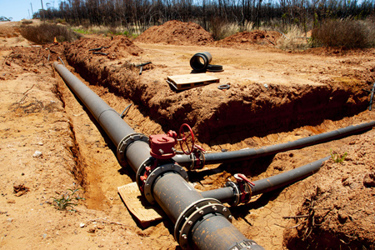
By Friday, nearly all of a gravity sewer can be hidden. A crew lays the pipe, the bottom of the trench disappears beneath bedding, the bedding sits under the pipe, and the pipe is covered by initial backfill. Soon the entire assembly is under compacted fill and fresh asphalt. Whatever was right or wrong with each layer becomes a matter of record rather than observation, if anyone recorded it at all.
That record matters more than ever. Cities and towns are replacing aging collection systems under the same streets while facing pressure to reopen traffic. That is why hold points belong at the heart of an inspection and test plan: work does not move beyond an agreed stage until the authorized person verifies and formally releases it.
Hold, Witness, Review: Getting The Categories Right
Inspection plans usually divide verification into three tiers. A review point checks a drawing, certificate, submittal or test report. At a witness point, the owner’s representative has the opportunity to observe a notified activity, subject to the agreed notice rules. A hold point is different: work stops until the named person checks the result and records the release. Too many holds create bottlenecks. Too few let critical layers disappear unexamined.
Why Buried Work Is Unforgiving
Sewer construction is unforgiving for two reasons. First, the price of a second look rises with every lift: re-excavating beneath a new road is expensive and disruptive. Second, defects may not appear at handover. Infiltration, settlement, poor grades, and displaced joints can become operating problems years later.
Table 1 sets out what each hold point (HP) protects, from foundation (HP1) to post-backfill acceptance (HP5), and the record it should leave behind.
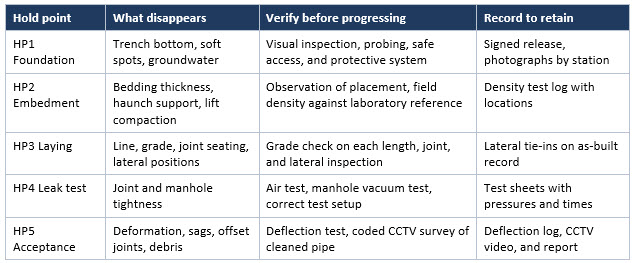
Table 1. Hold points, what each one protects, and the record it should leave.
Five Things That Disappear
HP1 Trench bottom and foundation
The inspector needs to observe the formation before bedding is placed. That means suitable ground or replacement foundation, no soft pockets, groundwater under control and unsuitable material removed to the required depth. Under U.S. Occupational Safety and Health Administration (OSHA) rules, excavation protection is generally required at depths of 5 ft (1.52 m) or more unless the excavation is entirely in stable rock. Shallower excavations also need protection if a competent person identifies a cave-in risk.1 An unsafe trench cannot be released for the next stage.
HP2 Bedding and haunching
In flexible pipe, the haunch zone between bedding and springline provides vital side support against deflection. Embedment material, lift thickness, and compaction must meet the project specification, and ASTM International standard D2321 gives installation guidance for thermoplastic gravity sewer pipe.2
HP3 Pipe laying, joints, and connections
Confirm line and grade independently instead of assuming them from the pipe laser, because a disturbed setup can pass an error along an entire reach. Gaskets must seat correctly, spigots must reach their specified insertion marks, and wyes, tees and lateral stubs must sit at their designed positions. Record each lateral’s distance from a known manhole, its depth and its direction before it disappears.
HP4 Leakage testing before final backfill
Low-pressure air or water testing gives an early indication of pipe and joint integrity. ASTM F1417 covers low-pressure air acceptance testing for plastic non-pressure sewers, and the European standard EN 1610 covers testing of drains and sewers.3,4 The test is valid only when the setup is correct: laterals isolated, plugs restrained, specified pressures, and test periods followed, and groundwater effects accounted for where required. Pressurized plugs are dangerous, so personnel must stay clear of the test hazard zone.
HP5 Post-backfill acceptance
Some requirements can only be verified after backfill. Depending on the governing specification, deflection testing may be required for flexible pipe after a stated waiting period and against a defined limit. Neither a 30-day interval nor a 5% criterion is universal. Closed-circuit television (CCTV) inspection of cleaned pipe, coded to an agreed defect standard such as the National Association of Sewer Service Companies (NASSCO) Pipeline Assessment Certification Program (PACP), can document sags, offset joints, debris, and lateral conditions.
Manholes: The Overlooked Hold Points
Manholes concentrate connection risks. Check the base foundation, the precast joints and the pipe penetrations, and test the structure where required. Inspect connections while they can still be repaired from outside.
From My Own Sites
FIELD NOTE 1 · NEW SEWER · WATER-TIGHTNESS TEST
The leak was not in the pipe
On one sewer project we ran a water-tightness test after installation and backfilling. Our installations normally passed without major problems, but this time the water level was dropping. We first checked the pipeline and its connections and found nothing. Further investigation showed that water was escaping through the bottom of one manhole. We reported the defective manhole to the supplier, and it was removed and replaced. For me, it was a reminder that even properly executed work can fail a leakage test because of a defective component. When a test fails, do not assume the pipeline is responsible. Find the actual cause before deciding what to repair or replace.
FIELD NOTE 2 · ACCESS ROAD · BEFORE PAVING
The manhole was too low
While we prepared an asphalt access road between two buildings, we checked a manhole that another contractor had already built as part of the sewer work. Its height did not match the planned finished road level. It had been left too low. We corrected the height with an additional adjustment ring before installing the cover and paving. The sewer contractor had finished its part, but that did not mean everything was ready for the next contractor. A small difference in level could have become a permanent problem in the finished road. Because we found it before paving, we could fix it while the work was still accessible
FIELD NOTE 3 · EXTERNAL WORKS · BEFORE THE CRUSHED-STONE BASE
The subgrade changed after the rain
On one project we were preparing the ground for external works around a building. Excavation had started when several days of heavy rain stopped the work. When we returned, the excavated ground was wet and soft and no longer suitable for the next construction layers. Instead of placing the crushed-stone base over the affected ground, we removed the unsuitable soil and replaced it with suitable material. Ground conditions can change during construction, even after excavation is complete. We cannot assume the subgrade is still suitable just because it was acceptable before the rain. Before covering it with the next layer, we need to check its actual condition and take corrective action where necessary.
Germany And The U.S.: Same Goals, Different Frameworks
In Germany, EN 1610 is the framework for installing, testing and accepting sewers. The DWA-A 139 worksheet supplements it where the contract specifies it, together with the project specifications.4,5 Tightness can be tested with air (Method L) or water (Method W). In my projects, a preliminary test before backfilling is followed by a final test after backfilling and removal of trench support.
In the U.S., the technical objectives are similar, but requirements depend more on the applicable ASTM standard, state regulations, municipal specifications, and pipe material. ASTM F1417 covers low-pressure air testing of plastic gravity sewers, and some owners also require CCTV inspection and mandrel testing for flexible pipe.3
Two Cases From The Public Record
PUBLIC RECORD 1 · ONTARIO, CANADA · 2005 TO 2017
Brand-new subdivisions, old-age leakage
In 2005, a downstream flow monitor caught significant baseflow from a new subdivision in St. Jacobs, Ontario. The township then monitored its other new subdivisions, and three more showed unacceptable inflow and infiltration. By June 2017, researchers had results from 31 subdivisions. Their survey of municipalities found that most were not performing tests required by Ontario Provincial Standard Specification (OPSS) 410, and the feeler-gauge check of gasketed joints was never observed. Mandrel testing was the most common, reported by 71% of those surveyed. The lesson is not more tests. It is proof that the specified tests were completed, and understood, before acceptance.6
PUBLIC RECORD 2 · DENTON, TEXAS, USA · 2019
When the record is blank
Denton’s August 2019 audit of utility street cuts reviewed a statistical sample of 279 inspection records for permits closed in 2018. More than 80% had no inspection result details. Auditors also saw early distress at 6 of 90 sampled street cuts and could not determine the cause by observation. Non-City utility permits received a pre-paving inspection of trench form and backfill compaction, but City utility permits did not. The audit covered street cuts in general, not only sewers, but the trench lesson is the same: an undocumented inspection cannot show a future owner what was checked before the road was closed. These are 2019 findings, not a description of Denton’s current practice.7
Where Hold Points Are Most Vulnerable
From my experience, hold points are most vulnerable when the contractor is trying to finish a section quickly, especially before backfilling or road reinstatement. On municipal projects there is always pressure from traffic, residents, deadlines, and the need to reopen roads. I understand these pressures because I have worked on both the contractor side and the client side. But I have learned that finishing quickly does not always mean finishing correctly. Earlier in my career, I was more focused on keeping construction moving and solving problems as they appeared. With more experience, I try to identify possible problems earlier, check critical details before the next activity starts, and make sure important decisions are documented. For me, this is the real purpose of a hold point.
Why I Choose The Inspection Before Backfilling
If I have to choose one hold point, I choose the inspection before the pipe is covered with backfill. While everything is still visible, we can check pipe alignment, invert levels, bedding, connections, and whether the work follows the drawings and specifications. Sometimes the actual conditions differ from what was planned, and we need to resolve the differences before continuing. Once the pipe is covered and the road is reinstated, checking or correcting the same problem becomes much more difficult and expensive. That is why I prefer to spend a little more time checking the work before the next construction stage proceeds.
Advice For A First-Time Inspector
The most important thing is to understand what is actually happening on site, not just what is written in the drawings. Before starting, check the drawings, pipe levels, existing utilities, soil conditions, and construction requirements. On site, look carefully at the work and do not hesitate to ask the contractor if something is unclear. Even small differences between the drawings and the actual conditions can create bigger problems later. Take photographs, record important measurements, and make sure critical work is checked before it is covered. And do not be afraid to raise a concern. It is much easier to solve a problem while the trench is still open than after the road is completed.
Conclusion
Backfill conceals the sewer and, without disciplined documentation, can also conceal how it was built. A small issue found while the trench is open may be simple to correct. The same issue found after road reinstatement can mean excavation, traffic restrictions, added cost, and disruption to the public. Specify the check, name the person who releases it, and keep the record. Everything else is inference.
References:
- Occupational Safety and Health Administration. “Requirements for Protective Systems.” 29 CFR 1926.652. U.S. Department of Labor.
- ASTM International. D2321-26, Standard Practice for Underground Installation of Thermoplastic Pipe for Sewers and Other Gravity-Flow Applications. West Conshohocken, PA: ASTM International.
- ASTM International. F1417-25, Standard Practice for Installation Acceptance of Plastic Non-Pressure Sewer Lines Using Low-Pressure Air. West Conshohocken, PA: ASTM International, 2025.
- European Committee for Standardization (CEN). EN 1610:2015, Construction and Testing of Drains and Sewers. Brussels: CEN, 2015.
- Deutsche Vereinigung für Wasserwirtschaft, Abwasser und Abfall (DWA). DWA-A 139, Einbau und Prüfung von Abwasserleitungen und -kanälen (Installation and Testing of Sewer Pipes and Channels). Hennef: DWA, March 2019.
- Robinson, Barbara, and Dan Sandink. “Study Shows Subdivisions Have ‘Unacceptably High’ Rates of Sewer Inflow and Infiltration.” Environmental Science & Engineering Magazine, September 12, 2017. https://esemag.com/wastewater/study-shows-subdivisions-unacceptably-high-rates-sewer-inflow-infiltration/
- City of Denton, Texas, City Auditor. Audit of Utility Street Cuts. August 2019. https://www.cityofdenton.com/DocumentCenter/View/2654/Audit-of-Utility-Street-Cuts-PDF
 Mirza Sabir Baig (mirxasabirbaig@gmail.com) is a construction manager working in municipal sewer, road, and underground-infrastructure construction in Germany. His earlier experience includes Qatar, Oman, and Pakistan, with an emphasis on construction coordination, groundwater control, and dewatering. He holds an MSc in Groundwater Management from TU Bergakademie Freiberg, Germ