
What It Actually Takes To Get PFAS Out Of Drinking Water
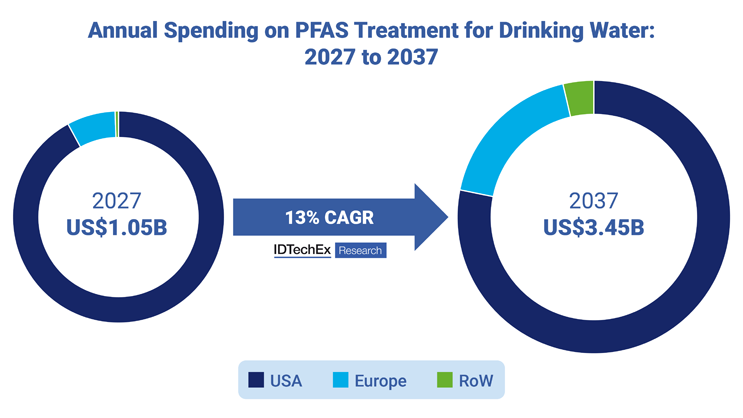
For our grandparents, it was lead. For our parents, asbestos. Today, PFAS dominates the environmental narrative, and with good reason. Through the latter half of the 20th century, per- and polyfluoroalkyl substances (PFAS) firmly integrated themselves into a wide range of industries. These molecules had unique and useful properties on account of their strong and highly polar carbon-fluorine bond. PFAS are highly stable, both chemically and physically, and repel both water and oil, making them valuable in applications from non-stick pans and waterproofing to critical industries like heat transfer fluids and semiconductor manufacture. However, due to their high stability, PFAS are highly persistent in the environment (and in our bodies). With some PFAS associated with a suite of health problems, including cancer and fertility issues, organizations around the world have taken action to limit the use of PFAS and to remove them from water systems. IDTechEx covers the whole PFAS landscape, from global regulations to PFAS-free alternatives in critical industries, to removal and destruction technologies, in "PFAS Regulations, Alternatives, Removal, and Destruction 2027-2037: Technologies, Players, Market Outlook", where IDTechEx forecasts annual spending on PFAS treatment for drinking water to reach US$3.45 billion by 2037.
Several drivers converge to accelerate PFAS treatment requirements
Multiple regions worldwide are now adopting limits on PFAS in drinking water. While the EU's main strategy to tackle PFAS is an overall restriction across every industry (see IDTechEx's report "PFAS Regulations, Alternatives, Removal, and Destruction 2027-2037: Technologies, Players, Market Outlook" for more details), the region has also introduced limits on PFAS under the EUDrinking Water Directive, which came into effect at the start of 2026. This limits total PFAS concentrations to 0.5ppb, with a limit of 0.1ppb for a sum of 20 common PFAS. In the USA, at a federal level, the EPA has set limits for PFOA and PFOS at 4.0ppt, with 10ppt limits for PFBS, PFHxS, PFNA, and GenX. Under the Trump administration, however, the EPA is attempting to remove the limits for these latter four chemicals, and to delay the enforcement deadline from 2029 to 2031. Across Asia-Pacific, monitoring guidelines are expected to gradually shift towards concrete limits, matching Western regulations.
Wherever PFAS is found to be above set limits, water companies will be required to provide water treatment capable of removing and destroying the PFAS. The situation is even more precarious for chemical companies manufacturing PFAS and for the companies making use of them. Several high-profile legal cases set precedent for companies leaking PFAS into the environment. In August 2026, the State of New Jersey successfully sued 3M and DuPont/Chemours/Corteva for a total of up to US$1.325 billion. For players using PFAS, this creates a strong initiative to monitor any wastewater and utilize the best available treatment technologies.
Carbon and ion-exchange dominate removal today, but emerging technologies promise distinct advantages
PFAS treatment can be broadly split into "removal" technologies, which take PFAS out of water sources, and "destruction" technologies, in which the PFAS molecules are chemically broken down, usually into mineralized fluoride.
Removal of pollutants from water sources is not a new problem; a wide range of metal ions, chlorides, organics etc. are routinely removed. The dominant technology for most pollutant removal is the use of granular activated carbon (GAC), which can be derived from fossil or renewable sources (e.g. from coconut). GAC has an exceptionally high surface area, typically 500-1000m2/g, on account of its highly porous structure, creating large areas for pollutant molecules to bind. Much of the GAC used for removal of other pollutants has simply been repurposed for PFAS removal, though there are some GAC sources tailored specifically for PFAS, such as Puragen's surface-modified activated carbon. While GAC is the most readily available and cheapest removal technology, and can be thermally reactivated for reuse, it struggles with poor adsorption of short-chain PFAS, which bind less effectively and can be displaced by long-chain PFAS. GAC is also negatively affected by co-contaminants, which affect how well it binds to PFAS. Ion-exchange resins, while more expensive than GAC on a unit-cost basis, can typically be tailored for improved affinity to PFAS including, to some extent, short-chain PFAS. They also typically have longer breakthrough times, though also struggle with co-contaminants.
Many emerging technologies are still based on adsorption. For example, Puraffinity's G400+ is a functionalized activated alumina which adsorbs PFAS much more quickly than GAC and IX, greatly reducing the volume of treatment containers. Essentially all adsorption methods, however, face challenges with heavily laden water (such as sewage) and with short-chain PFAS. One emerging technology based on an entirely different treatment method is foam fractionation. This involves pushing air bubbles through a PFAS-laden water source treated with surfactants. The PFAS binds to the air-water interface, allowing the PFAS to be reduced to a highly concentrated, low-volume stream. Without membranes or sorbent media, foam fractionation enables PFAS removal across a much wider range of water sources including, possibly, raw sewage.
IDTechEx does not expect that a single treatment source is going to outclass all others; depending on the amount and type of PFAS to be removed, and depending on the presence and identity of co-contaminants, different removal technologies will be required. What is missing, however, is a system highly tuned to short-chain and ultra-short chain PFAS, especially as trifluoroacetic acid continues to come under intense scrutiny. Assessment of a broader range of PFAS removal technologies can be found in PFAS Regulations, Alternatives, Removal, and Destruction 2027-2037: Technologies, Players, Market Outlook.
The USA is warming to incineration technology
PFAS removal concentrates the chemicals in one place and produces clean effluent water but does nothing to destroy the PFAS once they are collected. Given their extreme physical and chemical stability, destroying PFAS is not straightforward. Incineration remains one of the dominant technologies for permanently destroying PFAS; however, attitudes towards incineration have fluctuated over recent years. Concerns about the effectiveness of incineration and about possible fluorinated byproducts led the US to issue a moratorium on incineration of PFAS-laden firefighting foams in 2022. Evidence has since continued to build around incineration; a 2025 study by Clean Harbor demonstrated very low release (often below the detectable limit) of 49 semi-volatile targets, and 30 volatile fluorinated compounds which could be products of incomplete combustion. PFAS destruction levels varied from 99.95% to 99.9999%. The moratorium on incineration has since been lifted. Temperatures in excess of 1100°C are required, with incomplete combustion occurring below these temperatures.
Beyond incineration, supercritical water oxidation (SCWO) and hydrothermal alkaline treatment (HALT) are emerging as promising technologies for PFAS destruction. In SCWO, PFAS-laden water is pumped through a reactor which heats and pressurizes the system above the critical point of water, enabling an oxidation reaction to occur which breaks down PFAS. HALT is similar, but utilizes a catalyst like sodium hydroxide to allow the reaction to take place at lower temperatures. These two technologies have undergone a range of tests in the past couple of years, demonstrating effective PFAS destruction of firefighting foams, and even demonstrating the ability to reactivate spent GAC and IX resins. SCWO and HALT installations have been selected for several firefighting foam take-back and "collect-and-destroy" schemes in the USA, further establishing them as leading emerging technologies in PFAS destruction. "PFAS Regulations, Alternatives, Removal, and Destruction 2027-2037: Technologies, Players, Market Outlook" further benchmarks these technologies as well as a range of other emerging destruction methods.
There is a clear route from PFAS identification to PFAS removal, to PFAS destruction. Many removal players now offer destruction services, such as through GAC reactivation. Challenges still remain in treating sources heavily laden with co-contaminants, or with PFAS molecules more challenging to remove, and those involved in water treatment must remain flexible in terms of the removal and destruction technologies employed. However, whether through legal requirements or the pervading threat of litigation, the incentive to be proactive in PFAS treatment is strong.
For more information on "PFAS Regulations, Alternatives, Removal, and Destruction 2027-2037: Technologies, Players, Market Outlook", including downloadable sample pages, please visit www.IDTechEx.com/PFAS, or for the full portfolio of sustainability-related research available from IDTechEx, see www.IDTechEx.com/Research/Sustainability.
About IDTechEx
IDTechEx provides trusted independent research on emerging technologies and their markets. Since 1999, we have been helping our clients to understand new technologies, their supply chains, market requirements, opportunities and forecasts. For more information, contact research@IDTechEx.com or visit www.IDTechEx.com.
Source: IDTechEx