
What Is Asset Management?

Editor's Note: This article is a condensed version of a presentation entitled Why Industry Needs Asset Management Tools given by the author during the recent American Public Works Association's International Public Works Congress and Exhibition in Denver, Colorado. The paper was one of five offered at the APWA conference as the seminar series Innovations in Urban Infrastructure 1999 sponsored by the National Research Council Canada.
Asset management is a business function receiving an increasing amount of attention by private and public sector owners of "built assets." The author provides here an overview, to some extent from the Canadian perspective, of the status of asset management today. Innovative, decision-support tools are available for assisting owners of substantial assets when they must make choices between long-term alternatives related to the maintenance, repair and capital renewal of those built assets. Substantial background information was uncovered in the first phase of an investigation into asset management. This information helped identify the need for decision-support tools for municipal infrastructure planning, and also define six basic questions that should be asked in planning an asset management course of action.
The investigation actually found a limited number of applications for decision-support in the domain of asset management, and did not find any comprehensive solution that addresses the current and future needs for strategic planning. However, integration with corporate legacy systems, for instance computerized maintenance management systems and geographic information systems, appears to offer challenging opportunities for infrastructure asset managers to implement decision-support tools.
Built Environment Support Costs Are Major
Owners of built asset portfolios such as federal departments, regional governments, municipalities, universities, or the armed forces have responsibility for a diversified set of constructed facilities. This asset infrastructure, however, cannot be completely protected from deterioration due to such factors as usage, climatic effects or geological conditions. Furthermore, because of inadequate funding or inappropriate support technologies, certain components of this infrastructure have been neglected and all too often have received only remedial treatments.
Canada's stock of residences, buildings and engineering works has an estimated value of $3 trillion. Its growth since 1960 is shown in the figure below. These numbers are at once significant, frightening and difficult to confirm. However, the operation, maintenance, repair, and eventual renewal of this "built environment" together represent a major and rapidly growing cost to Canada. Similar problems exist in the USA, Australia and other developed countries.
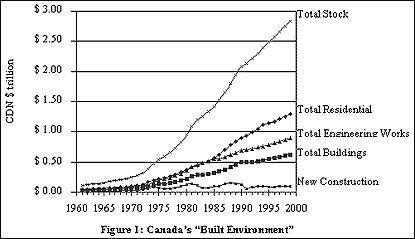
In the area of maintenance and repair, the Federal Facilities Council of the United States recommends expenditures of 2 to 4% of the "Capital Replacement Value" of constructed facilities per year. Using the conservative 2% figure, this is equivalent to approximately $66 billion of maintenance and repair activity per year in Canada.
Regarding capital renewal, most building components or systems have relatively short service lives ranging from five to 35 years, whereas engineering facilities have accepted values for service life that range from 10 to 100 years. On average, the necessary renewal expenditures on the approximately $3 trillion of built assets in Canada could equal $46 billion each year, using conservative averages.
The average service lives for existing building construction and engineering construction are 37 and 30 years respectively, according to a recent Statistic Canada report. A conservative average of 35 years is assumed, and it is conservatively assumed, with a normal distribution, that the entire asset base is replaced every 2 x 35 or 70 years.
Referring to the estimated costs quoted above, the maintenance and repair expenditures added to the capital renewal in Canada therefore could be upwards of $112 billion. Note that this number does not include new construction. The figure represents a large amount of work for the construction industry, as well as significant expenditures that will have to be made by owners and operators of buildings and other facilities. In fact, many organizations and municipalities may have more facilities than they can afford to maintain, and in many instances they may be unaware of the situation and the serious predicament facing them. Because we are not spending enough on maintenance, repair or renewal, we are accumulating an ever-increasing maintenance deficit, which can lead to premature failures.
What Do You Do First?
The problems of the asset manager are indeed complex, but they are not intractable. In the author's view, the key to success in cost-efficient asset management is the reduction of the problem to its smallest component. Here are six "Whats" of asset management, in order of priority:
- What do you own?
- What is it worth?
- What is its condition?
- What is the remaining service life?
- What is the maintenance backlog?
- What will you fix first?
Typically, most organizations fare well when they address the first two questions, then may fail miserably on the remaining four questions. Or, there might be a scattering of responses depending on the discipline domain (e.g., roadways, bridges, buildings, parks and buried facilities). Certain tools can be employed to answer these six questions. The author described these in some detail in his APWA presentation, which also included a summary of the current state of asset management in Canada.
What's the Current Status?
The investigation into asset management to date revealed a limited number of applications for decision-support systems, and did not find any comprehensive solution that addresses strategic planning. Integration with corporate legacy systems such as computerized maintenance management systems and geographic information systems is seen as the most challenging opportunity for using decision-support tools in the area of asset management.
About the Author: Dr. D.J. "Dana" Vanier is a senior research officer at the National Research Council Canada. He is currently investigating the use of Information Technologies in the field of service life asset management. For more information please contact him at: Tel. 613-993-9699, or via e-mail at dana.vanier@nrc.ca. The Institute for Research in Construction, National Research Council Canada, is located at 1500 Montreal Road, Ottawa, Canada K1A 0R6.