
SWAN Corner: What Does Resilience Really Look Like In A Water Utility?
By Dr. Amir Cahn, SWAN CEO and Shirley Ben-Dak, SWAN Senior Advisor
Ask a water utility what keeps them up at night and you'll usually hear two kinds of answers. There's the slow build, often ongoing challenges such as deteriorating infrastructure, underinvestment, and knowledge loss resulting from a retiring workforce. Then there are sudden impacts such as a flash flood, main break, grid failure, or cyberattack. At the same time, utilities must balance competing needs amongst residents, agriculture, industry, mining, and the environment — this is further highlighted by the public outcry over polluted rivers, PFAS in drinking water, and increased demand from data centres.
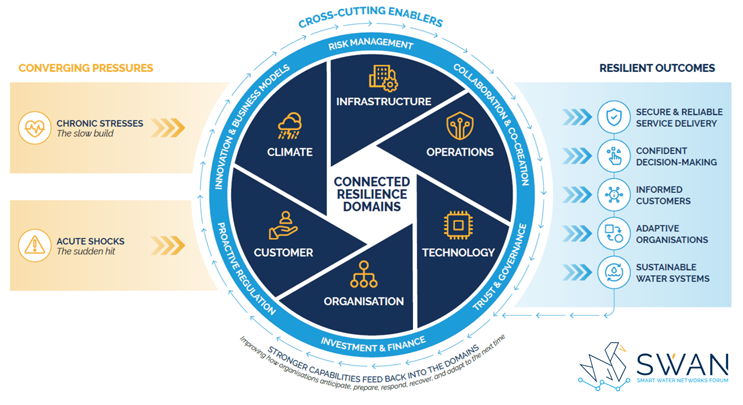
These pressures often do not operate in isolation. They converge across several “resilience domains” including climate, infrastructure, operations, technology, organisation, and customer. Progress in one domain can create a problem or an opportunity in another.
Take technology, for example. It can enable resilience, but it must first be trusted and work with the people and processes around it. A changing climate can also change how a utility deploys technology. When the Australian town of Rochester flooded in 2022, 11 of 13 sewer pump stations were inundated. The area utility, Coliban Water, has since built a prototype electrical cabinet that rises automatically, and secured funding to retrofit 10 of the town's pump stations so their electrical systems can be raised above floodwaters.1
The same applies to infrastructure. Predictive asset maintenance can help a utility get ahead of deteriorating assets, but only if its staff have the right skills and data management capabilities to act on the diagnostics. In another example within the realm of water scarcity, during Cape Town’s 2015-2018 drought, the City could not build its way out of “Day Zero”. It openly shared dam levels and water availability with ratepayers as restrictions tightened, and average daily demand fell by more than half. Communication was only part of that result, but it helped customers understand what was being asked of them and why.2
Given the variability and complexities at stake, addressing resilience along these domains requires cross-cutting enablers like risk management, collaboration, trust and governance, investment and finance, proactive regulation, and innovative business models. In a related publication, Arup developed The City Water Resilience Approach (CRWA) to map out urban resilience roadmaps to best address dynamic water-related shocks and stresses through a combination of mitigation and integrated system performance improvements.3
The term “resilience” is often associated with sustainability and efficiency, but the label is not always supported by concrete evidence of improved performance. Moving beyond buzzwords requires utilities and their partners to adopt adaptive strategies that address interconnected and converging pressures. A whole-system approach replaces isolated, short-term fixes with integrated, cross-departmental solutions informed by data and a shared understanding of risk.
The industry needs more real accounts of connected resilience, including what worked, what didn’t, and what the rest of the sector can learn from them. We cannot keep relying on historical patterns to prepare for a future that looks nothing like the past. We must strengthen our organisations in each resilience domain and improve how we connect the dots between them.
Interested in sharing your experience?
We invite you to attend and submit a speaker abstract for the SWAN 17th Annual Conference, taking place May 18-20, 2027, in Porto, Portugal. Powered by the theme “Connected Resilience: Transforming Complexity into Capability”, this year’s event introduces two additions: an Industrial & Data Centre Track and “Fail Fest”, a candid look at what didn’t work as expected and the resilience gaps it revealed.
Submit an abstract by December 4, 2026: https://swan-forum.com/swan-2027-call-for-abstracts/
Learn more about the Conference: https://swan-forum.com/swan-2027/
Let’s transform water, together.
- Coliban Water, “Rochester Recovery,” Connect Coliban, accessed November 4, 2026, https://connect.coliban.com.au/recovery-and-rebuild/rochester-recovery.
- Leon Schreiber, “Keeping the Taps Running: How Cape Town Averted ‘Day Zero,’ 2017–2018,” Innovations for Successful Societies, Princeton University, February 2019, https://successfulsocieties.princeton.edu/publications/keeping-taps-running-how-cape-town-averted-day-zero-2017-2018.
- Arup, “The City Water Resilience Approach,” October 2022, https://www.arup.com/insights/the-city-water-resilience-approach/.