
WEFTEC 2026: A Good Time To Be Curious

By Kevin Westerling,
@KevinOnWater
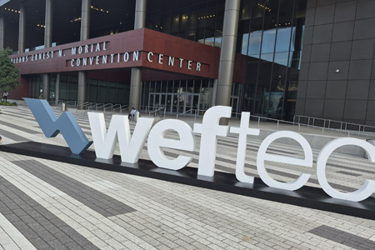
For an industry built on technical expertise, being asked to question what we know might seem like an unusual way to open its largest annual conference. But it was a fitting start to WEFTEC 2026.
In New Orleans, opening keynote speaker Diana Kander, an innovation strategist, entrepreneur, and bestselling author, challenged water professionals to remain curious, question assumptions, and keep learning. Expertise remains essential, of course. The risk is becoming so comfortable with familiar answers that we stop asking useful questions.
Considering how much is changing around water utilities — and how much they are being asked to accomplish — there was plenty of opportunity to put that advice to work.
Artificial intelligence was an obvious place to start. But some of the most useful conversations focused on the people expected to use it.
Getting Comfortable With AI
During the Water-AI Nexus panel “How 18 Utility Leaders Are Using AI,” Charlotte Water Director Angela Charles described concerns that will sound familiar to many managers. Employees were worried about losing their jobs, while the utility also needed a common understanding of what AI actually means within the organization.
Charlotte Water’s response included chartering a team to develop an AI framework. That gives employees a role in shaping how the technology enters their workplace, while helping the utility establish a shared direction.
Fellow panelist Matt Kennelly, executive director of LOTT Clean Water Alliance, described differing levels of enthusiasm even among senior leaders. His utility’s approach was to learn together before undertaking AI initiatives as an organization.
I appreciate the practicality of those accounts. Utilities need room to ask questions, express reservations, and establish where a tool can help. An operator’s skepticism may reveal something important about how a proposed application will perform under actual plant conditions.
The promise of AI is certainly substantial, but realizing that promise depends on getting employees comfortable enough to explore it — while preserving their judgment and experience.
Water’s Role In The AI Economy
During the Water-AI Nexus session “State of the Industry: Water and AI,” WEF Executive Director Ralph Exton described the broader issue in two parts — using AI to improve water operations, and addressing the water demands of the infrastructure supporting AI.
The second part came up repeatedly in interviews for The Water Online Show, conducted by Angela Godwin at our booth.
In their WEFTEC wrap-up conversation, Angela and Water Online’s Chief Industry Officer Travis Kennedy identified data centers as a recurring topic among guests. Garney’s Matt McKinnon discussed water reuse, including its potential to help meet cooling demand and reduce pressure on community water supplies.
That’s an important opportunity for the water industry, but the details matter. Available supply, treatment requirements, infrastructure, and local conditions will determine what is feasible at a particular site.
The conversations also offered a useful reminder that new applications still depend on familiar equipment. Mueller’s Philip Morgan discussed the importance of selecting valves suited to the water quality and operating conditions they will encounter. A treatment strategy can look promising on paper and still run into trouble if the components supporting it are overlooked.
WEF’s emphasis on the circular water economy provided a broader context for these discussions. Reuse, nutrient recovery, and energy generation all ask us to reconsider what can be gained from streams traditionally managed as waste.
Keeping The Systems Secure
As utilities consider more connected equipment and digital tools, cybersecurity must be part of the conversation.
But as our interviews highlighted, utilities are trying to meet that need with limited staff and budgets, while their operators already carry considerable responsibility. Asking those operators to take on cybersecurity as well is a difficult proposition.
One encouraging takeaway was the availability of assistance, including free resources utilities can use to assess their practices and identify improvements.
The challenge is making time for that work and incorporating it into operational decisions. Cybersecurity deserves attention when equipment and systems are being selected, connected, and maintained. Waiting until a problem occurs leaves utilities with fewer options.
Investing In The People Behind The Process
Workforce development received visible attention at WEFTEC, including a new Workforce Hub devoted to career pathways, professional growth, and operator excellence.
Retirements make those investments urgent, but hiring replacements is only part of the task. Utilities also need to transfer knowledge, prepare employees for greater responsibility, and give people reasons to build a career in water.
Preparing employees for leadership also means recognizing that even strong technical skills don’t necessarily prepare someone for a supervisory role. An excellent operator should have support when moving into a role that involves supervising employees, communicating priorities, and managing competing demands.
The Operations Challenge offers another view of workforce development — and a particularly enjoyable one.
This year’s 39th competition drew a record 59 teams, testing skills in process control, laboratory work, safety, collection systems, and maintenance. Elevated Ops, representing the Rocky Mountain Water Environment Association, earned first place in Division I.
The competition gives everyday operational skills an audience and some well-deserved recognition. It also demonstrates how much preparation, coordination, and judgment the work requires. With so much attention devoted to the workforce we need, it's good to celebrate the professionals doing that work today.
Taking It Home
There is plenty for utilities to think about after New Orleans. The value of WEFTEC is having access to people who are working through similar questions, along with technologies and approaches worth investigating further.
Kander’s opening message was a useful starting point. Back at the utility, curiosity becomes more specific. It might mean asking a colleague how they solved a problem, revisiting an assumption in a project plan, or giving an employee time to investigate a better approach.
Those are manageable steps. And they are how the ideas discussed at WEFTEC begin to improve the work.