
Webinar: Watershed Modeling For Extreme Weather Inflow Ground And Stormwater
Tuesday, April 6
Session One: Case Studies 10AM PT, 1PM EST
Session Two: Interactive Training: 11.30 AM PT, 2.30PM EST
(There is no charge for this event.)
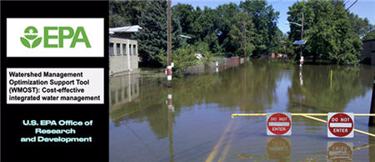
The Watershed Management Optimization Support Tool (WMOST) is a decision support tool that facilitates integrated water management at the local or small watershed scale.
Integrated water management involves coordination across multiple programs for land, water, and related resources (stormwater, wastewater, drinking water, land conservation) to find sustainable and cost-effective solutions.
WMOSTv3 has an associated theoretical documentation report as well as a detailed user guide. While version 2 only included management options related to water quantity, version 3 of WMOST also includes water quality management.
Users can identify least-cost solutions to meet water quality criteria for lakes or streams/rivers, pollutant loading targets, and/or minimization of combined sewer overflows. Version 3 also includes riparian buffer zone restoration or conservation, a few agricultural BMPs, and additional stormwater best management practices, both structural, such as rain gardens and nonstructural, such as street sweeping.
The Hydroprocessor, a program which formats output from watershed models such as SWAT and HSPF for input to WMOST, is also included. ScenCompare allows comparisons across different WMOST runs set up under different climate scenarios.
Dr. Naomi Detenbeck
Naomi Detenbeck earned a Master’s and Ph.D. in ecology from the University of Minnesota-Minneapolis.
Dr. Detenbeckcurrently works in EPA’s Office of Research and Development, Atlantic Coastal and Environmental Sciences Division, overseeing projects to evaluate the most cost-effective management approaches to meet water quantity and quality goals at the scale of small watersheds and regional basins under changing climate and land-use conditions. She is project lead for e-Estuary and oversees the development of WMOST and the regional optimization support tool.
The Watershed Management Optimization Support Tool (WMOST) allows water-resource managers and planners to screen a wide range of practices for cost-effectiveness in achieving watershed or water utilities management goals, such as meeting projected water demand and minimum and maximum in-stream ecological flow targets.
See https://www.epa.gov/ceam/managing-watersheds-wmost for an overview and https://www.epa.gov/ceam/wmost for download of tools, user guides, and theoretical documentation.
WMOST allows evaluation of over twenty potential management practices and goals related to water supply (demand management practices, surface and groundwater pumping, surface water storage, water treatment plant, potable distribution system leak repair), wastewater (septic systems, wastewater treatment plant, infiltration repair in wastewater collection system), nonpotable water reuse (wastewater reuse facility, nonpotable distribution system), aquifer storage and recharge, interbasin transfer of water and wastewater, land conservation and up to fifteen stormwater management practices including traditional, green infrastructure and LID practices, minimum human demand, and minimum and maximum in-stream flow targets.
Source: WasteWater Education 501c3