
Web Cams: The next best thing to being there
Remote cameras hooked to the Internet are allowing anyone with a computer and a modem to monitor remote sites, equipment, weather and other items. The U.S. Army's CRREL is already using the new technology to save time and dollars.
By Marie Darling, Public Affairs, U.S. Army Engineer Research and Development Center's Cold Regions Research and Engineering Laboratory
At an Army Corps laboratory in Hanover, NH, a technical staff member has taken an Internet idea and made monitoring of remote worksites a reality.
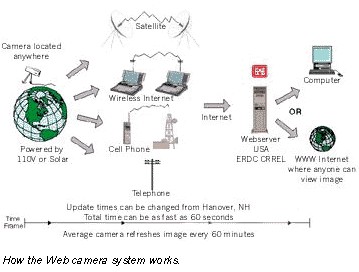
All it takes to "see" your work site hundreds of miles away is a camera and phone modem connected to the Internet. According to John Gagnon, a technical staff member with the U.S. Army Engineer Research and Development Center's Cold Regions Research and Engineering Laboratory (CRREL). And he should know. Over the past few years Gagnon has successfully linked many Web cams to the Internet all over the country in an effort to bring the work site closer in order to allow a researcher to observe from a desktop computer what is happening at that specific site.
Ice navigation monitored from afar
"All it takes is a written proposal and a package that consists of a camera, phone modem and, for a nominal fee, you're up and running on the Internet," he explains. Initially, Gagnon's idea was to connect the winter-time activities of the Soo Locks located in the Upper Penninsula of Michigan (the series of locks which connects Lake Superior with the lower lakes) to the Internet so that ice navigation activities could be observed from the Hanover facilities.
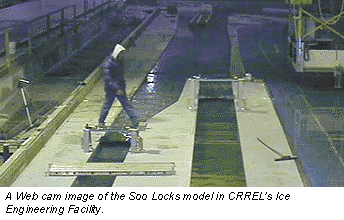
Access to distant sites like the Soo Locks enables research civil engineers like CRREL employee Andrew Tuthill to monitor the severity of the ice conditions at the locks without the cost and downtime of travel from Hanover. Tuthill used this information to calibrate and verify a physical model of the Soo Locks. The purpose of the model study was to develop solutions to ice problems at the locks. The Web cams enabled Tuthill to monitor the ice situation at the Soo Locks during the early spring, better yet, he was able to save images and make animations of the vessels moving into the ice-filled locks. The Web cam images helped Tuthill to understand the interaction between the ice, the vessels, and the structure and then to design a model testing schedule to address the problem in the Hanover lab.
Remote teaching also possible
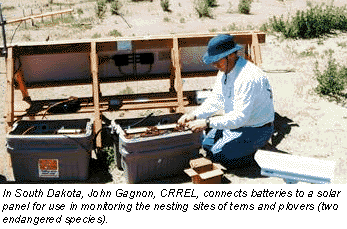
There are many applications for this type of technology. Academia can use Web camera images to teach students about the mechanics of ice and related problems. From the classroom, students can access many sites, such as locks and dams in Illinois and Michigan and even observe experiments and physical model studies conducted at CRREL. Barge operators and lock masters have also used the Web images to keep up-to-date on the ice conditions at particular sites of concern. The technology has also been used to observe endangered species with minimal disruption of their habitat.
We invite you to browse our "cammed" sites at www.crrel.usace.army.mil/ierd/webcams/ (the sites of interest are under the key words "web camera"). The most popular site is the Soo Locks in Sault Ste. Marie, MI. This site has received up to 30,000 hits per day.
With all the existing and potential uses of Web cams, the possibilities are endless. Web cams for engineers at the Cold Regions Laboratory have surely shown that they are the next best thing to being there.
Edited by Tracy Fabre
Managing Editor, Water Online