
UToledo Researchers Develop 'Set It And Forget It' Buoy System To Combat Algal Blooms
By Shawn Salamone
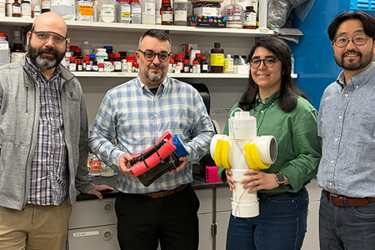
More than a decade after a toxic algae bloom left 400,000 Toledo-area residents without safe drinking water, University of Toledo researchers have developed a novel buoy system designed to fight back before blooms ever fully form.
The team, led by Dr. Youngwoo Seo, a professor in UToledo’s Department of Civil and Environmental Engineering, and Dr. Yakov Lapitsky, professor and chair of the Department of Chemical Engineering, designed buoys that slowly release algaecide into water over weeks or months.
The research, which also included chemical engineering doctoral student Umberto A. Kober and civil and environmental engineering doctoral student Haniehsadat Barikbin, is newly published in the journal ACS ES&T Water.
The Problem
Harmful algal blooms form when excess nutrients from fertilizer runoff cause cyanobacteria to rapidly multiply. While the shimmering green hues can look striking, cyanobacteria can release toxins dangerous to humans, pets and wildlife.
A 2014 Lake Erie bloom that triggered Toledo’s do-not-drink order helped spark the Seo-Lapitsky collaboration.
Current treatments are reactive and labor-intensive.
“When operators try to control a bloom, they need the manpower to prepare the algaecide chemical and to apply those chemicals continuously,” Seo said.
Without sustained concentrations, cyanobacteria can rebound in as little as a day.
The Solution
The plastic buoys use hydrogel disks — developed in Lapitsky’s soft materials lab — to precisely control how a hydrogen peroxide-based algaecide diffuses into surrounding water.
The release rate is adjustable depending on conditions, and when the algaecide runs out, the buoy tips onto its side as a visual refill indicator.
“Our approach is more related to early intervention,” Seo said. “When we have a big bloom, it’s more difficult to control. What Dr. Lapitsky and I tried to develop is a buoy that releases algaecide so we can control the algae in an early stage with minimum manpower.”
Promising Results
An early prototype buoy designed to slowly release algaecide into water over weeks or months and, as part of a larger buoy system, fight back before harmful algae blooms ever fully form.
In lab tests using Lake Erie water, the buoys eliminated nearly all cyanobacteria within a week while leaving other microbes largely unaffected. Buoys also proved reliably reusable across four refill cycles.
“If successfully scaled up, this concept could enable early mitigation of harmful algal blooms without the need for labor-intensive repeated algaecide applications,” said Lapitsky, who is already thinking ahead to future modifications.
“It might be better, especially if we’re going to be deploying this in larger bodies of water, to make a larger buoy so that you don’t have to deploy hundreds of them but can use a dozen or so buoys to provide a relevant release rate.”
Next Steps
The published study represents the first in what the researchers describe as a series of papers on this ongoing work.
Since completing lab tests on contaminated water collected from Lake Erie, the team has conducted a larger pond-scale experiment under real weather conditions and is working with northwest Ohio water treatment operators toward full seasonal deployment. The vision is for those operators to simply deploy buoys at the start of the season and let them work continuously throughout, dramatically reducing labor demands.
“This research exemplifies what UToledo does best: tackling real problems that affect our neighbors,” said Dr. Grace Bochenek, UToledo’s vice president for research. “The 2014 water crisis touched everyone in this region, and seeing our faculty developing a practical, scalable solution is a powerful reminder of why university research matters — not just here in northwest Ohio, but for communities facing the same challenges around the world.”
The researchers also see potential for the underlying technology to extend well beyond algaecide. The same controlled-release platform could be adapted for pesticides in rice paddies or other aqueous environments where repeated chemical applications are currently required.
A U.S. patent application has been filed and licensing discussions are underway. Funding for the research was provided by the U.S. Army Corps of Engineers, and additional papers from this ongoing research program are expected to be submitted for publication in the coming months.
Source: The University of Toledo