
Understanding Biofilm Through Oxidative Chemistry
By Emma Flanagan
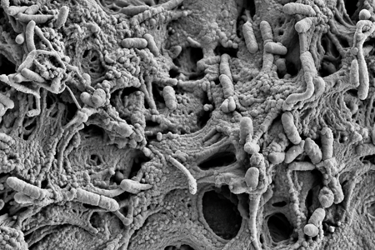
Biofilm is one of those water treatment problems that can look deceptively simple.
Microorganisms attach to a surface, multiply, and begin building a community. The natural response is to disinfect, apply enough oxidant to kill the organisms and maintain a residual strong enough to keep them under control, however in practice, it is rarely that straightforward.
A system can maintain what appears to be an adequate disinfectant residual and still develop persistent biofilm. Increasing the oxidant dose may improve control for a while, but the problem often returns. Even when many of the microorganisms are successfully inactivated, the material surrounding them can remain attached to the surface and continue to support regrowth.
The reason becomes easier to understand once we stop thinking of biofilm as simply microorganisms growing on a surface.
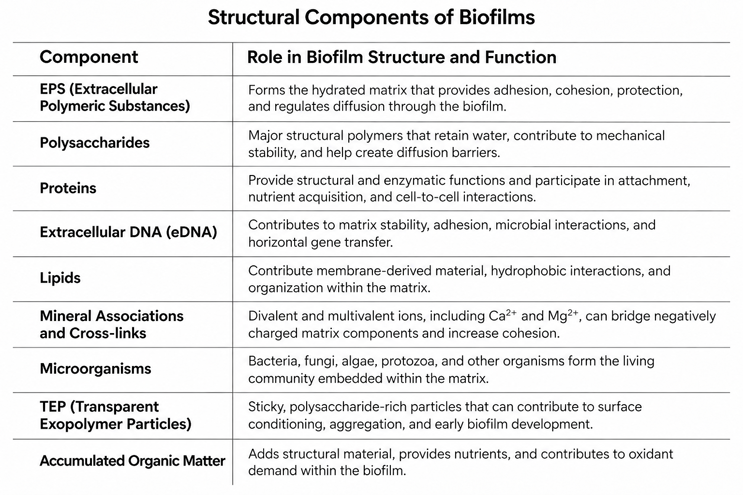
A mature biofilm is a complex three-dimensional structure. The microorganisms are embedded within an extracellular polymeric matrix which is an active part of the biofilm made up largely of polysaccharides, proteins, extracellular DNA, lipids, minerals, and organic material collected from the surrounding water.
This matrix helps the community attach to surfaces, retain nutrients and water, and remain stable under changing conditions. It also creates both a physical and chemical barrier between the microorganisms and whatever treatment is being applied.
This is where biofilm control begins to differ from conventional disinfection.
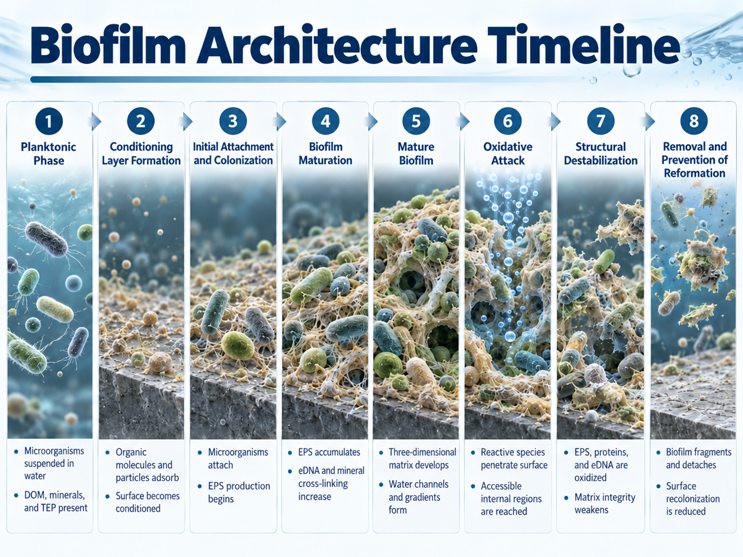
An oxidant moving through bulk water may encounter a freely suspended microorganism directly. Inside a biofilm, that same oxidant first has to work its way through a reactive organic matrix, where part of its oxidative capacity may be consumed, redirected, or lost before it ever reaches the organisms deeper inside.
At that point, the biofilm itself becomes part of the chemical demand and oxidative chemistry starts to matter with biofilm in the forefront in a much more intentional way.
From Oxidant To Reactive Chemistry
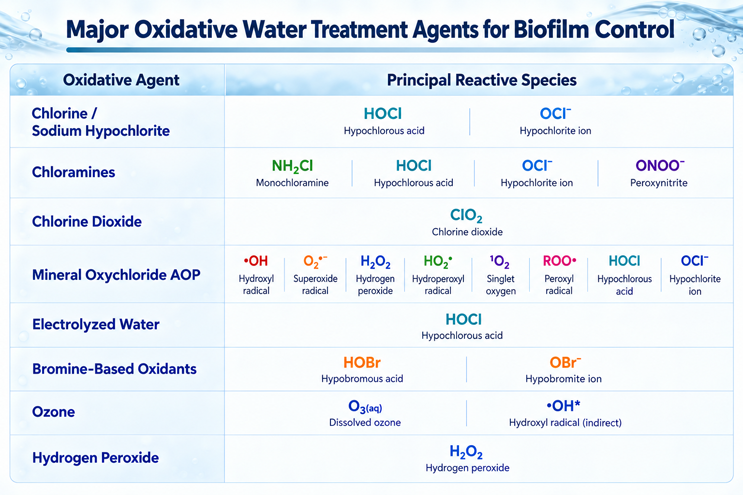
In water treatment, we normally identify a treatment by the chemical or technology being applied. Chlorine, chlorine dioxide, ozone, hydrogen peroxide, permanganate, mineral oxychlorides, UV-based advanced oxidation, and other oxidative processes are all familiar examples.
That description is only useful if it tells us what is introduced into the water. Once the treatment begins interacting with the water itself, the chemistry can become more complex than the name of the original oxidant suggests.
Depending on the oxidant and the surrounding water chemistry, additional reactive species can form through dissociation, decomposition, catalytic reactions, photochemical reactions, or electron-transfer processes. As a result, the species actually performing the oxidative work may be considerably more diverse than the chemical that was initially added. These reactive species do not all behave in the same way. Some are extremely powerful but exist for only a fraction of a second, while others are less reactive yet remain available longer. Some react with almost anything they encounter, while others are much more selective. Some contribute mainly through direct oxidation, while others participate in secondary reactions that generate additional reactive species and extend the chemistry further.
The oxidative treatment that ultimately develops in the water can therefore be quite different from what the name of the original oxidant alone might suggest.
So, once an oxidant enters water, the important question is no longer only what was added, but what reactive chemistry does it create?
This understanding is especially important with biofilm, where the treatment is not facing a single microbial target but a chemically complex environment capable of consuming, redirecting, and responding differently to each reactive species it encounters.
Different Oxidants Create Different Oxidative Environments
The principal oxidative agents used in water treatment do not all produce the same chemistry once they enter the water.
With chlorine, chemistry is dominated by hypochlorous acid and hypochlorite, and the balance between the two shifts strongly with pH. Ozone behaves differently. It can react directly with contaminants, but as it decomposes it can also generate hydroxyl radicals and other reactive oxygen intermediates. Hydrogen peroxide is itself an oxidant, yet it can also become a precursor in advanced oxidation processes designed to generate more reactive species. UV-based systems add another dimension by using energy to initiate reactions that would not otherwise occur as readily.
Mineral oxychloride chemistry also extends beyond conventional hypochlorite behavior, combining reactive chlorine chemistry with pathways involving reactive oxygen species and catalytic redox interactions.
The point is not that one of these approaches is universally better than another. It is that each can create a different oxidative environment, and those differences become particularly important when the treatment target is biofilm.
A biofilm presents many chemical and biological targets at the same time. Microbial membranes and proteins are part of the structure. The surrounding matrix also contains polysaccharides, extracellular DNA, accumulated organic matter, minerals, and other materials, each presenting its own chemical demand.
An oxidant that is highly effective at damaging a microbial cell may not be equally effective at breaking down the matrix surrounding it. In the same way, a highly reactive species may deliver intense oxidation near the outer surface of a biofilm but be consumed before it can reach deeper layers. Another species may react more slowly, yet remain available long enough to travel farther into the structure.
When we look at biofilm this way, we should not simply wonder whether an oxidant is strong enough and if the dose is sufficient. We should also question what actions that oxidant, and the reactive chemistry it creates, can actually accomplish within such a complex structure.
There Is More To Oxidative Performance Than Strength
Oxidants are often compared by their oxidation potential, and for good reason. Oxidation potential describes the thermodynamic tendency of a species to accept electrons and gives us valuable information about its oxidative strength. But strength alone does not tell us how an oxidant will perform once it enters a complex water environment.
It does not tell us how rapidly a reactive species will react, how selective that reaction will be, how long the species will remain available, or how far it may travel into a biofilm before being consumed. In practice, these characteristics can be just as important as oxidation potential itself.
The hydroxyl radical is a good example. It is one of the strongest oxidizing species relevant to water treatment and reacts extraordinarily fast with a broad range of organic compounds, which is precisely what makes it so valuable in advanced oxidation. But that same extraordinary reactivity also makes it exceptionally short-lived. It reacts almost as soon as it is formed, so its strength and its lifetime are inseparable parts of its behavior.
Other oxidative species make different tradeoffs. Some may be less powerful but remain available longer. Others may react more selectively, or persist long enough to travel farther before they are consumed. These differences can determine where oxidation occurs and what it is able to accomplish.
Once we consider these characteristics together, ranking oxidants simply from strongest to weakest begins to look incomplete. Biofilm is not one target, and oxidation is not one reaction.
The effectiveness of an oxidative treatment depends not only on how strongly it can oxidize, but also on which reactive species are present, what they react with, how rapidly they react, how long they remain active, and where those reactions can occur.
That gives us a much broader way to think about oxidative performance, particularly when the target is something as structurally and chemically diverse as biofilm.
And it brings us to the question:
If the strongest oxidant is not always the most effective one, what combination of chemical properties determines how well an oxidative species performs against biofilm?
Coming next in this series: Reactivity, selectivity, persistence, and penetration, and why each tells us something different about oxidative performance.
 Emma Flanagan is the CEO and CTO of Envirocleen, LLC, an Illinois-based water treatment consulting, manufacturing, and distribution company specializing in mineral oxychloride advanced oxidation technologies. Her work focuses on the homogeneous catalytic generation of reactive oxygen species using transition minerals, drawing on principles related to modified Fenton and Haber-Weiss chemistry. She oversees the implementation of Bio-hydrox®, a ready-to-use mineral oxychloride solution formulated for advanced water treatment and disinfection applications. Emma holds an M.S. degree in Sanitary Engineering from the IHE Delft Institute for Water Education in the Netherlands. Her professional activities include research, education, and consulting across a broad range of industrial, municipal, healthcare, agricultural, and aquaculture water treatment challenges. She can be reached at info@envirocleen.com.