
Ultrafiltration Specialist inge Watertechnologies AG Presents New Generation Of Products
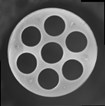
The core component of the new "dizzer" product line is the new generation of the patented Multibore membrane developed by inge watertechnologies AG. This optimized design increases permeability by almost one-third while maintaining the same high levels of virus and bacteria retention. It also features superb enhancements to the honeycomb structure of the membrane's geometry. The cross-section of a Multibore membrane reveals seven perfectly round capillaries (see photo). The company has succeeded in independently controlling two key factors in the production process, namely the thickness of the outer layer and the space between the capillaries. This means it is now possible to reduce the outer diameter from 4.3 mm to 4.0 mm while maintaining the same thickness for the outer layer and the same capillary diameter (0.9 mm). This makes it possible to increase the membrane surface area from 50 m² to 60 m², which marks a 20 percent improvement over the previous dizzer 5000 model. At the same time, there is virtually no contact between the membranes in the modules, which is an important factor in maintaining the correct operating pressure: the fewer the points of contact between the membranes, the lower the pressure loss.
Peter Berg, Chief Technology Officer of inge watertechnologies AG, explains further: "These additional improvements to our membrane have once again given us a huge competitive advantage thanks to our ability to fully exploit the advantages of our Multibore technology. It is not possible to increase the density of conventional single-bore membranes to this extent without causing stability problems or hydrodynamic losses. "
Eight years of operations without a single fiber breakage
For operators of water treatment plants, the advantages of the new Multibore membrane combined with the new dizzer generation represent yet another good reason to deploy ultrafiltration technology. There are enormous cost benefits to be achieved, in particular due to the footprint being so much smaller than conventional systems. The fully plumbed T-Rack – which inge can equip with up to 80 dizzer modules depending on the treatment capacity required – already takes up around 50 percent less space than a conventional rack, and the increased density in the new dizzer module has now reduced its footprint by a further 20 percent. This compact and efficient design not only cuts capital costs, but also provides long-term reductions in operating costs. Peter Berg continues: "These economic benefits combined with the peace of mind of knowing that there is no risk of fiber breakage are powerful arguments in favor of using our technology. We provide a standard warranty stating that NO fiber breakage will occur for a period of five years. Our systems have already been successfully implemented in more than 500 facilities worldwide and we have not witnessed a single case of fiber breakage – even after eight years of operations.
New dizzer XL 0.9 MB 60 also suitable for sea water desalination
In addition to its use in the treatment of drinking water, process water and wastewater, the modified properties of the new Multibore membrane also make it an even more attractive option for sea water desalination plants. One problem often faced by conventional membranes is fouling with organic substances, something that is fortunately not an issue with inge's new Multibore membrane thanks to the further optimization of its adhesive and anti-fouling properties. One thing that has not been changed is its capacity to retain virtually all particles and viruses. Superb retention performance, antifouling features and high permeability are the criteria required for sea water desalination. And it is precisely these factors – combined with a reduced footprint and the corresponding reduction in capital and operating costs – that make deployment of the new dizzer modules such an attractive option, especially for large sea water desalination plants.
inge watertechnologies AG is represented at WEFTEC at joint booth 2451 "Research in Germany - Lands of Ideas".
About inge watertechnologies AG
The company inge watertechnologies AG – based in the town of Greifenberg on the Ammersee lake in Bavaria, Germany – employs more than 80 staff and is the world's leading provider of ultrafiltration technology, a membrane process used to treat drinking water, process water, wastewater and sea water. For more information visit www.inge.ag.
With a global reach enhanced by its network of partners, the company has completed numerous reference products around the globe featuring its cutting-edge technology. Its range of products include highly-efficient ultrafiltration modules and cost-effective, space-saving rack designs as the core components of water treatment plants, rounded off by the superb technical support it provides to its customers.
All the company's products are based on the in-house development of its patented Multibore membrane technology, providing the top-quality standards for which German-made goods are famous. The extremely small-pore filters of the Multibore membrane reliably intercept not only particles, but also microorganisms such as bacteria and viruses, thereby providing a dependable source of clean water. Deployment of the inge technology also offers significant advantages over conventional water treatment methods, such as rapid and easy module installation and stable, highly resilient membranes. This makes planning a water treatment facility much simpler, enabling customers to achieve low-cost installation and operation. And all this comes with a guarantee of long-lasting reliability.
SOURCE: inge watertechnologies AG