
The Importance Of Pretreatment In Protecting Wastewater Treatment Facilities
By Olivia Tahti, Kristel Baumgardner-Kranz, PE, Mary Kate Forkan, and Sydney Pazera
From the smallest towns to the largest cities, wastewater treatment plants are an essential element of effective water management — purifying wastewater before it's returned to the environment, preventing the spread of waterborne pathogens, and safeguarding aquatic ecosystems. Communities rely on these facilities to help protect their quality of life. But what protects your treatment plant?
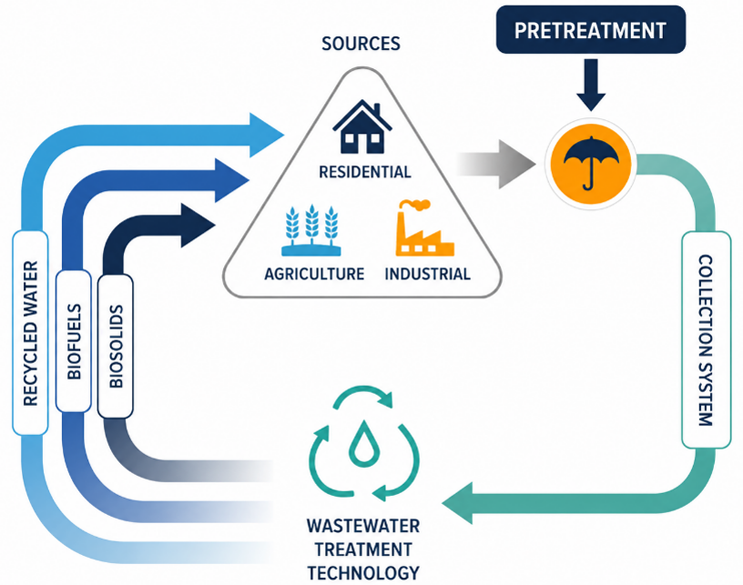
Pretreatment in the wastewater cycle helps safeguard facilities, receiving ecosystems, and residential, agricultural, and industrial recycled water users.
The Preventative Mitigation Toolbox
Industrial pretreatment programs (IPPs) are the first barrier for publicly-owned treatment works (POTWs) to safeguard their facilities and the receiving ecosystems from excessive or harmful pollutants. Developing regulations and requirements for industrial users can protect utilities from toxic or high-strength discharges that the POTW was not specifically designed to treat — such as heavy metals, toxic chemicals, or corrosive acids. These harsh pollutants can corrode pipes or destroy fragile biological processes, and eventually reach a receiving lake or river.
Because many pollutants adhere to solids during the wastewater treatment process, high-influent loading can cause excessive pollutant concentrations in the biosolids as well, making the disposal of municipal sludge increasingly difficult or even impossible.
Alleviating these issues is especially important for water reuse or recycling programs.
- Local limit maintenance. One of the most common tools in a utility’s pretreatment toolbox is maintaining local limits that reflect the current service area and its limitations. Local limits regulate industrial discharges to protect treatment plant infrastructure, improve worker safety, and secure environmental compliance. They should be evaluated every National Pollutant Discharge Elimination System (NPDES) permit cycle or when significant modifications or end uses change at the POTW.
- Industrial protocols. Industrial dischargers have a primary impact on pretreatment programs. Protocols are a requirement of a federally-approved IPP and include frequent inspections, updated permits, and recurring industrial waste surveys.
- Awareness. Organized pretreatment programs must remain current to respond to ongoing regulations and local ordinances, such as sewer use ordinances, enforcement response plans, and inter-jurisdictional agreements.
- Adaptability. Change is constant. This is evidenced by
the recent surge in large-scale industrial facilities such as data centers and semiconductor facilities — as well as the adoption of direct potable reuse in many communities. Utilities must remain nimble to develop, evaluate, or update pretreatment programs that reflect the current service area, treatment train, and compliance priorities. Adaptability is essential in responding to unexpected changes, such as
abrupt pollutant discharges, unexpected industrial development, or upcoming water reuse needs.
It's important to recognize that wastewater treatment plants frequently discharge to bodies of water that may ultimately become sources of drinking water. Protecting them is a shared responsibility — affecting utilities, dischargers, and rate payers alike.
PRETREATMENT IN ACTION - How OCUD Applied These Principles To Protect Its Facilities
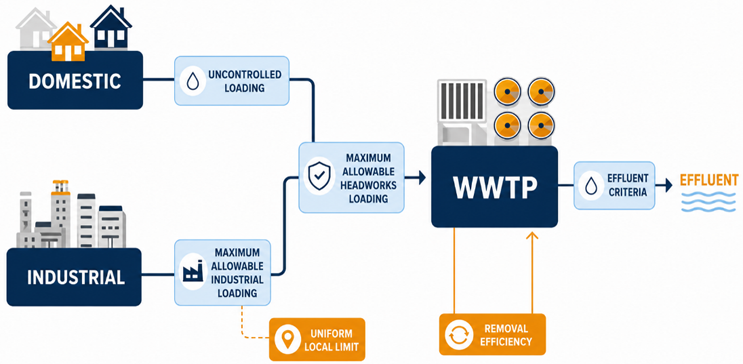
For OCUD, the maximum allowable headworks loading analysis helped determine that existing local limits were adequate for all three plants.
Challenging Project Meets A Tight Schedule In The Sunshine State
The Orange County Utilities Department (OCUD) in central Florida reached out to Carollo Engineers to re-evaluate its industrial local limits as part of its NPDES permit renewal. Typically, local limits re-evaluations are scoped for around six months for a single treatment plant. However, for this project OCUD required a meticulous evaluation of a large water quality dataset from three water reclamation facilities (WRFs) and a key report delivered to a state agency in just two months.
The work addressed four major components:
- Compliance history.
- A headworks loading comparison of existing local limits and pollutants of concern.
- Identification of new pollutants of concern.
- Potential WRF design or operational modifications.
The team also evaluated historical water quality data, NPDES permit requirements and modifications, disposal practices, flow data, and design-based loading capacities at each WRF.
To be effective, a local limits evaluation typically includes a headworks loading analysis. If the pollutant load at the headworks is greater than the treatment process can remove, a more stringent local limit may be required.
Historical water quality and flow data provided a basis to calculate average annual pollutant loadings (AAPLs) for each local limit pollutant entering each WRF every year for a four-year period. This enabled comparing the maximum allowable headworks loadings (MAHLs) — back-calculated from OCUD’s existing local limits to the AAPLs — to determine if the existing local limits were enough to protect each plant.
KEY FINDINGS
- All existing local limits protected each WRF.
- Two pollutants of concern showed MAHL exceedances:
- Total Kjeldahl Nitrogen (as N).
- Total dissolved solids (TDS).
While neither pollutant had existing local limits, the evaluation recommended they be considered during OCUD’s next local limits evaluation.
Carollo's review of OCUD's priority pollutant scans at each WRF identified a total of 11 new potential pollutants of concern. Based on Florida Department of Environmental Protection (FDEP)’s feedback, plans of study for oil and grease at two WRFs and for all pollutants of concern at one WRF are in development.
No two local limits evaluations are alike. Each pretreatment program has different industrial users, relevant end uses, and opportunities for improvement. Tailoring solutions for each utility requires diligence, foresight, and expertise — all of which are specialties of Carollo's pretreatment team.
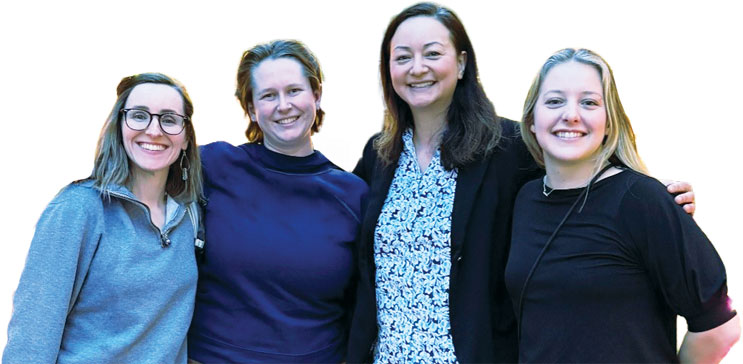
The Carollo pretreatment team has refined all the tools necessary to close the loop between scientific analysis, wastewater treatment facility planning and design, and potable reuse implementation to protect POTWs, their receiving waters, and the communities they serve.
 Olivia Tahti is a pretreatment-focused staff professional at Carollo Engineers. She specializes in ESRI mapping programs including ArcGIS and ArcMap. She assists with a variety of projects, including evaluation of industrial pretreatment programs, local limit developments, and enhanced source control projects
 Kristel Baumgardner-Kranz has more than 10 years of experience working on industrial pretreatment programs, wastewater treatment, water treatment, and water recycling projects including indirect potable reuse. As a lead engineer at Carollo Engineers, her experience includes development and implementation of pretreatment program elements including industrial waste survey, sewer use ordinance updates, uniform and site-specific local limits for industry dischargers, industry permits, sampling plans, public and industry outreach programs, and funding and resources.
 Mary Kate Forkan is the source control lead at Carollo Engineers. She assists utilities in a variety of projects including building tools, evaluating pretreatment programs, helping develop source control programs for potable reuse, and developing local limits. She recently was part of a Water Research Australia grant that developed an enhanced source control framework for the country of Australia for use in developing potable reuse programs. She is also a representative for pretreatment as part of NACWA.
 Sydney Pazera is a staff professional at Carollo Engineers, focused on pretreatment and wastewater treatment design. She assists with pretreatment projects including evaluating pretreatment programs, local limits development, sewer use ordinance updates, uniform and site-specific local limits for industry dischargers, industry permits, and sampling plans.