
Sustainable Wastewater Solutions For Today's Challenges
By Catherine Kirkland
Municipal wastewater infrastructure plays a critical role in protecting public health and environmental quality, yet it is often invisible until it fails. Today’s wastewater systems must balance growing service demands, tightening regulatory expectations — especially around nutrient limits — and evolving community priorities, all while operating within constrained budgets and staffing levels.
“Sustainable” means capable of being sustained, prolonged, or continued. In the wastewater world, that equates to long-lasting, effective collection and treatment systems that can keep up with demand while producing effluent clean enough to safely release back into the environment. The New Climate Economy Report applied this concept directly to municipal infrastructure, emphasizing that sustainable infrastructure is essential for building resilient communities and protecting ecosystems over the long term. (New Climate Economy 2016)
The report defines sustainable infrastructure through three branches: social, economic, and environmental. (New Climate Economy 2016) In wastewater, this means systems that protect receiving waters (environmental), remain affordable over their lifecycle (economic), and are practical for communities to operate and maintain (social). These goals have become more urgent as regulators in many regions increasingly incorporate nutrient controls (nitrogen and phosphorus) into wastewater discharge permits to address eutrophication, harmful algal blooms, and water quality impairment. (EPA 2024)
Municipal Wastewater Challenges In Context
Across the country, municipalities grapple with infrastructure that was often designed for lower flows, lighter regulatory expectations, and smaller service areas. Many wastewater collection networks and treatment plants are now operating near or beyond capacity. Aging gravity sewers and manholes can contribute to inflow and infiltration (I&I), increasing wet-weather loading and placing additional strain on treatment facilities.
Financial constraints are a major barrier to sustainability. Many utilities do not have adequate reserves to fund renewal, replacement, or expansion. Raising rates can be politically difficult, especially in smaller or rural communities. As a result, maintenance is frequently deferred until failures occur, leading to emergency repairs and increased long-term costs.
Operational capacity is another growing concern. Centralized biological treatment systems can require trained operators and consistent oversight. Smaller municipalities may struggle to recruit or retain staff with the technical expertise needed to manage complex systems, and outsourcing specialized services can strain already-limited budgets.
These pressures are compounded by evolving regulatory expectations. Across many states, nutrient criteria and tighter effluent limits have emerged in permits to address eutrophication and water quality impacts. (EPA 2024) These evolving limits require systems that can achieve higher levels of nutrient and pathogen reduction than many older treatment technologies were designed for.
Proven Alternatives Supporting Sustainability Goals
Decentralized Collection Systems: A Strategic Shift
Traditional gravity sewers rely on large-diameter mains, deep trenches, and often multiple lift stations — elements that carry significant capital and restoration costs, particularly in rural or rugged terrain. To improve cost efficiency and sustainability, many municipalities are adopting decentralized collection systems such as Septic Tank Effluent Pump (STEP) systems, Septic Tank Effluent Gravity (STEG) systems, and liquid-only sewers.
These systems allow solids to remain and digest in an interceptor tank at each property, reducing the solids load in the collection network. The result is smaller pipe diameters, shallower installation, fewer manholes and deep excavations, reduced I&I vulnerability, and more predictable performance over time. (Orenco 2015)
Decentralized collection systems also offer practical resilience. Onsite tanks provide emergency storage capacity that can be valuable during power outages or peak flow events. (Orenco 2015)
In addition, decentralized collection can phase with growth, allowing communities to avoid the large upfront cost of extending full gravity sewer and centralized infrastructure that may sit underutilized for years. For many municipalities, decentralized collection becomes the difference between “no feasible sewer solution” and a practical, fundable project.
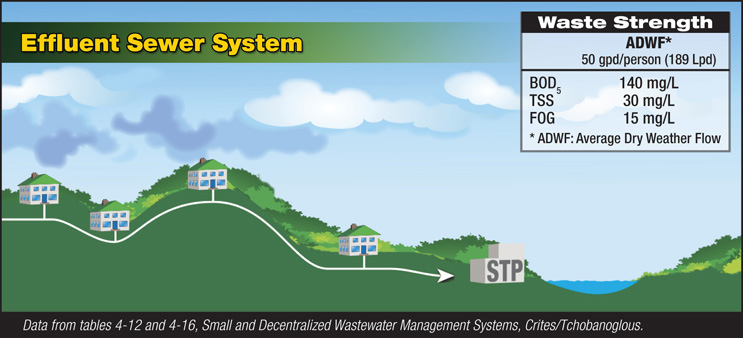

Decentralized collection systems such as STEP and liquid-only sewers retain solids onsite and convey screened effluent, enabling smaller-diameter mains, shallower installation, and reduced vulnerability to inflow and infiltration (I&I).
Secondary and Advanced Treatment Options
Once collected, wastewater must be treated effectively and reliably. Traditional lagoon systems, sand filters, and natural treatment processes have a long track record, but when tighter nutrient controls and smaller land footprints are required, modern packaged systems often provide the best outcomes.
Packed bed filters — engineered media systems that support attached-growth biological treatment — offer a compact footprint, consistent effluent quality, and reduced operational complexity compared to conventional activated sludge systems. In Orenco’s AdvanTex technology, for example, the textile media is engineered specifically for wastewater treatment and does not decompose, supporting long-term stability and predictable performance.
Packaged treatment structures also integrate recirculation tanks, dosing logic, and simplified piping in a pre-plumbed solution that can reduce contractor error and installation risks.
Management and Institutional Capacity
Technology alone does not guarantee sustainability. Long-term success is strongly influenced by how systems are managed — including planned inspections, preventive maintenance, operator training, and funding for long-term repairs. In municipal settings, communities often see the most consistent performance when these responsibilities are clearly assigned and supported, whether through a utility, a service provider, or an informed homeowner program. This aligns with sustainable infrastructure principles that emphasize lifecycle planning, resilience, and long-term performance over short-term cost savings. (New Climate Economy 2016)
Case Studies: Practical Municipal Implementation
Elkton, Oregon — Effluent Sewer + Recirculating Sand Filter
In Elkton, Oregon, failing septic systems along the Umpqua River posed water quality risks and limited business expansion. In 1989, the community installed a watertight effluent sewer conveying flow from about 100 onsite systems to a recirculating sand filter designed for 30,000 gpd, followed by sequentially dosed drainfield dispersal.
Serving 147 equivalent dwelling units (EDUs), the system achieved effluent averaging less than 10 mg/L for both biological oxygen demand (BOD5) and total suspended solids (TSS), even with higher-strength users such as wineries.
Economically, the project’s total cost was $897,800 (engineering, construction, inspection), funded through a combination of grants and loans, with monthly fees of $33.75 for residents.
Elkton’s approach shows how decentralized collection and simple, proven treatment can deliver sustainable results in a rural municipal context.
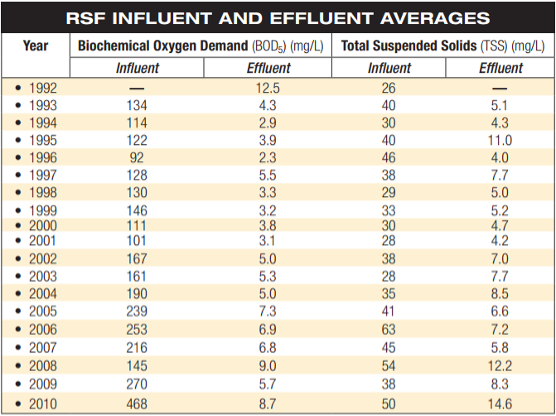
Elkton, OR used a watertight effluent sewer to convey primary-treated effluent to a recirculating sand filter and drainfield dispersal system, achieving strong effluent quality with long-term affordability.
Pinebrook, New York — Packed Bed Filtration Replacement
Pinebrook, a community in Hyde Park, New York, faced a failing rotating biological contactor (RBC) wastewater plant in 2014. The system was underperforming, sewer backups were occurring, and discharge contaminated the Maritje Kill (a tributary of the Hudson River).
A Preliminary Engineering Report evaluated three replacement options — new RBC, membrane bioreactor (MBR), and packed bed filtration — with packed bed filtration selected for its low lifecycle cost, high effluent quality, minimal operational requirements, and compact footprint.
The new system utilized AdvanTex AX-Max units with UV disinfection and met strict NPDES limits for cBOD5, TSS, and ammonia. Achieved effluent outperformed permit requirements, exemplifying how advanced packaged systems can address both regulatory and operational challenges.
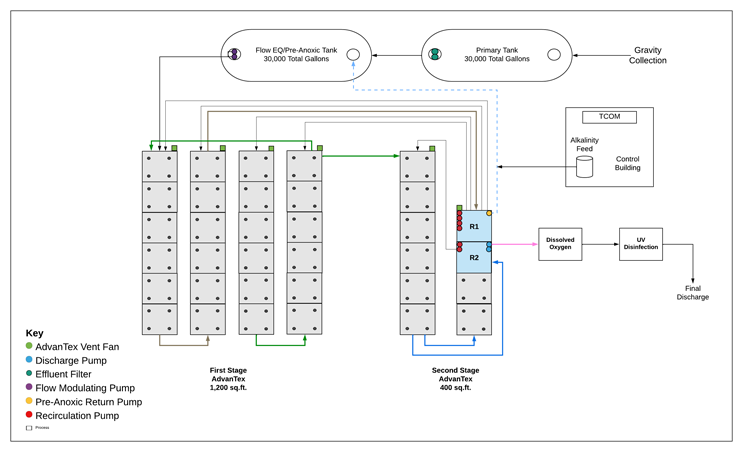
Pinebrook’s replacement system uses a compact, modular treatment train with packed-bed filtration and UV disinfection to meet strict discharge requirements while minimizing footprint and operational complexity.


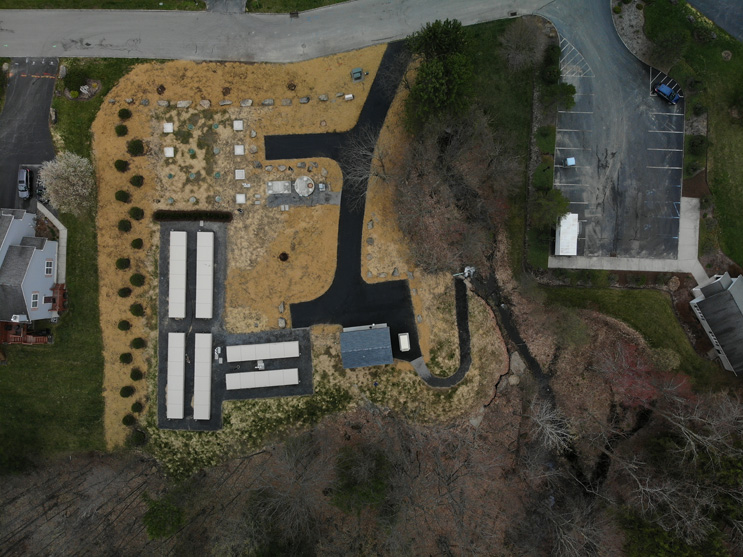
The modular nature of packed bed filtration allowed the new system to be installed while the existing RBC remained operational, enabling a smooth transition and fast-tracked construction.
Section, Alabama — ECOPOD Advanced Treatment for a Small Town
The Town of Section, located in the northeast corner of Alabama (population ~770), needed a 30,000 gallon-per-day wastewater treatment system after local septic systems no longer met current requirements. Project designers selected an ECOPOD® Advanced Wastewater Treatment System to treat domestic wastewater from both residential and commercial sources, emphasizing quiet operation, odor-free performance, and simplified maintenance due to the system’s design, which does not include internal filters, screens, or diffusers requiring routine service.
The system was designed for influent strengths of 300 mg/L for both BOD and TSS and to handle daily flow fluctuations from 50–100%. The process includes a 19,190-gallon primary tank followed by a 14,200-gallon flow equalization tank with duplex pumps to stabilize dosing, ECOPOD treatment reactors installed in poured-in-place concrete tanks, and UV disinfection to reduce fecal coliform below permit limits prior to dispersal through a drip disposal system. The Section project demonstrates how advanced decentralized treatment can provide consistent performance while minimizing operational complexity — a key sustainability advantage for rural utilities with limited staffing capacity.
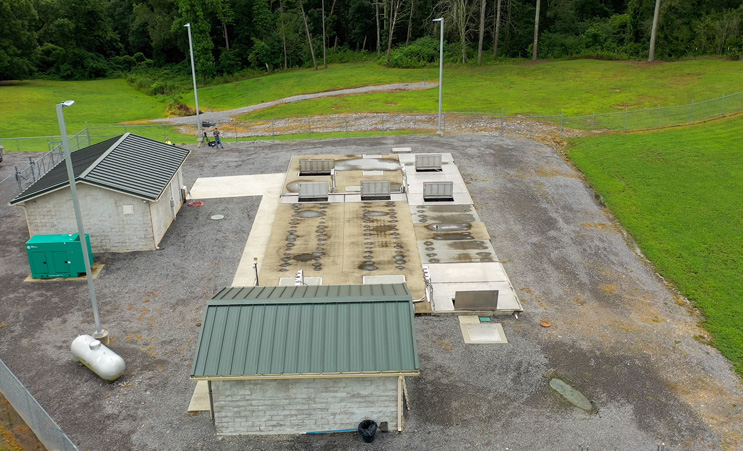
The Town of Section, AL installed a 30,000 gpd ECOPOD Advanced Wastewater Treatment System with primary treatment, flow equalization, and UV disinfection to provide a low-odor, low-maintenance wastewater solution for a rural community.
Conclusion — Sustainable Infrastructure = Sustainable Impact
Sustainable municipal wastewater infrastructure is not defined by a single technology but by a strategy that balances environmental protection, economic viability, and social practicality.
Developing systems and products that support sustainable infrastructure — particularly those that protect the world’s water — will help ensure a healthy future, financial well-being, and environmental protection for our communities for years to come. (New Climate Economy 2016)
SOURCES
New Climate Economy. 2016. “The Sustainable Infrastructure Imperative.” Accessed February 12, 2026, https://newclimateeconomy.report/2016/the-sustainable-infrastructure-opportunity.
U.S. Environmental Protection Agency. 2024. “NPDES Permit Limits: Nutrient Permitting.” Accessed February 12, 2026, https://www.epa.gov/npdes/permit-limits-nutrient-permitting.
Orenco Systems. 2015. “Effluent Sewer Design Manual,” NDA-EFS-1, Rev. 2.0. https://odl.orenco.com/documents/NDA-EFS-1.pdf.
Orenco Systems. 2021. “Case Study: Pinebrook, Hyde Park, New York,” NCS-53, Rev. 3. Accessed February 12, 2026, https://www.orenco.com/case-studies/pinebrook-hyde-park-new-york.
Orenco Systems. 2025. “Case Study: Elkton, Oregon.” https://www.orenco.com/case-studies/elkton-oregon.
Infiltrator Water Technologies. 2021. “Case Study: Section, Alabama,” IWTCS-ECOPOD-882021_SectionAL_Rebranded. Accessed February 12, 2026, https://www.infiltratorwater.com/Customer-Content/www/CMS/files/case-studies/IWTCS-ECOPOD-882021_SectionAL_Rebranded.pdf.
 Catherine Kirkland is an Engineered Systems Consultant for Infiltrator Water Technologies and Orenco Systems who supports commercial and municipal wastewater projects across the western United States. She holds a degree in Environmental Engineering from Michigan State University and works with engineers, regulators, and community stakeholders to evaluate sustainable infrastructure solutions that balance environmental performance, long-term affordability, and operational practicality.