
Superoxide: Continuous Reactive Oxygen Species (ROS) Supply And Dissolved-Oxygen Gains For Lagoons And Ponds
By Keith Boulais, with technical input from Cameron Speirs
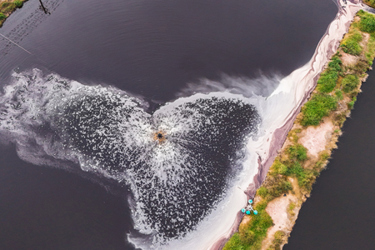
Superoxide is a selective member of the reactive oxygen family. Used as a supporting step with continuous oxygen delivery and mixing, it can strengthen the aerobic processes lagoon and pond operators already rely on.
Why Superoxide Belongs In Today’s Oxidation Conversation
Advanced oxidation has moved from specialist niche toward mainstream utility planning as micropollutants, reuse, and receiving-water stress climb the agenda. Most of that conversation still centers on ozone, hydrogen peroxide, ultraviolet light, and hydroxyl radical (•OH) — the familiar workhorses of advanced oxidation processes (AOPs).1
Superoxide (O₂•⁻) belongs to the same reactive-oxygen family. It is a one-electron reduction product of molecular oxygen: a selective radical anion that can act as a mild reductant or, through secondary chemistry, open pathways to other reactive oxygen species (ROS).2,3 For lagoons, ponds, and similar open systems, the practical opportunity is not a stand-alone “oxidant residual.” It is a generation package that continuously supplies transient ROS together with dissolved oxygen (DO) and mixing — the same levers EPA lagoon guidance already treats as first-line tools when aerobic treatment and odor risk are on the line.4,5
Superoxide generation technology works best as a supporting and pretreatment step: it creates better oxygen and redox conditions so the biological and physical processes already in place work more reliably.
What Superoxide Is — And Why Continuous Generation Matters
In aqueous solution, superoxide sits in acid–base equilibrium with its conjugate acid, the hydroperoxyl radical (HO₂•). The pKa of HO₂• is about 4.8, so near neutral pH the anion form dominates.2 Classic kinetic compilations show that HO₂•/O₂•⁻ disappears largely by second-order disproportionation to hydrogen peroxide and oxygen, with rates that depend strongly on pH.2 At circumneutral pH and micromolar concentrations, that chemistry is fast on the order of seconds — and metals and dissolved organic matter can shorten it further. Copper complexes and chromophoric dissolved organic matter are documented superoxide sinks in natural waters that can outcompete simple bimolecular disproportionation.6,7
That transient character is exactly why continuous generation is the operational story. Generation systems create value by steadily supplying O₂•⁻ and oxygen-rich microbubbles so a steady-state of transient ROS and elevated DO is maintained while the unit runs — and by the aerobic biology and mixing that follow.2,6,7,8
In the water-treatment literature, superoxide is therefore useful as a working intermediate that:
- participates in reductive and oxidative pathways toward specific contaminants in controlled systems;3,8
- disproportionates to O₂ and H₂O₂, linking one-electron oxygen chemistry to peroxide and, under catalytic conditions, to Fenton-type •OH pathways;1,2,8
- appears in nature as well: bacterially generated superoxide can oxidize manganese(II) to manganese oxides — proof that environmental ROS chemistry is real, not laboratory folklore, though not a substitute for site data on metals or solids at any particular installation.9
Reviews of superoxide generation emphasize electrochemical and chemical routes to O₂•⁻ and note that aqueous reactivity is medium and scavenger-dependent.3 The distinction matters: superoxide is selective; hydroxyl radical is more indiscriminate; molecular oxygen is the sustained oxidant that keeps aerobic biology online. Continuous generation keeps the useful part of that cascade available where the process needs it.
What Independent Reactor Tests Show: DO, Mixing, And Selective Redox
Independent U.S. Army Engineer Research and Development Center (ERDC) reactor tests of a superoxide-charging ionizing water system give the clearest published measurements for this technology class:
- Dissolved-oxygen supersaturation. The tests documented supersaturated DO — approximately 300% of saturation — alongside recirculation and microbubble discharge that enrich the water with oxygen while superoxide is charged.8 Semi-quantitative superoxide dismutase (SOD) assays confirmed elevated superoxide activity during charging.8
- Lagoon- and pond-relevant applications flagged by the authors. ERDC identified mixing and oxygenation of small lakes, ponds, and wetlands — and simple wastewater lagoons under septic, odorous conditions — as natural fits for the oxygenating reactor, with the potential to promote biological activity through effective oxygen delivery.8
- Selective contaminant results in controlled water. Aqueous diesel showed 58% removal after 72 hours in the superoxide reactor versus no removal in the matched control.8
These are laboratory reactor findings. They support a strong, testable hypothesis for field use — elevated DO, active mixing, and selective redox chemistry — but site pilots with true controls remain the proof for any lagoon or pond.8 As operators already know from lagoon practice, DO collapse drives odor and sludge stress; EPA tip-sheet and troubleshooting guidance remain the baseline for diagnosing those failures and for scoring any aeration or mixing upgrade.4,5
Environmental ROS Chemistry Reinforces The Story
Beyond engineered reactors, environmental manganese redox chemistry shows why engineers take superoxide seriously. Bacterially generated superoxide can drive Mn(II) to Mn oxides in natural waters — direct evidence that O₂•⁻ participates in real aquatic redox cycles.9
Taken together, the sourced benefits stack cleanly:
- Continuous supply of transient ROS while the unit runs, paired with oxygen-rich microbubbles.2,8
- Documented DO supersaturation (~300% of saturation) in independent reactor tests, with SOD-confirmed charging activity.8
- Selective redox pathways with literature support — including 58% aqueous diesel removal versus a no-removal control in ERDC work, and environmental Mn oxidation as proof-of-concept chemistry.3,8,9
Deploy It As A Supporting Step
The most credible placement in a multi-cell lagoon or pond system is upstream or polishing support — not a rip-and-replace of the plant:
- Pretreat early cells where organic load and low DO suppress aerobic activity, so downstream cells inherit better oxygen and redox conditions.
- Polish late cells where stratification or overnight DO sag still threaten effluent quality — as aeration and mixing reinforcement.
Because superoxide works through continuous generation, its benefits show up in the parameters lagoon and pond operators already track. Dissolved oxygen and ORP profiles capture the oxygen and redox gains directly, while BOD/COD, sulfide, and a site’s permit analytes show how the downstream biology responds.4,5,8 A pilot run alongside an untreated control cell, with metered power, gives a utility site-specific numbers to plan around.
Bottom Line
Superoxide is a selective member of the reactive oxygen family whose value in the field arrives with continuous oxygen transfer and mixing — documented DO supersaturation in independent reactor tests, SOD-confirmed charging activity, selective redox pathways with published controls, and real environmental chemistry that explains why engineers keep paying attention.2,8,9 Used as a supporting step, superoxide generation technology can strengthen the aerobic processes lagoons and ponds already depend on. For small systems that need dependable oxygen and mixing, that is a practical, well-grounded role.
References
- Wang, J., and S. Wang. “Reactive Species in Advanced Oxidation Processes: Formation, Identification and Reaction Mechanism.” Chemical Engineering Journal 401 (2020): 126158. https://doi.org/10.1016/j.cej.2020.126158
- Bielski, B. H. J., D. E. Cabelli, R. L. Arudi, and A. B. Ross. “Reactivity of HO₂/O₂⁻ Radicals in Aqueous Solution.” Journal of Physical and Chemical Reference Data 14 (1985): 1041–1100. NIST PDF: https://srd.nist.gov/JPCRD/jpcrd285.pdf ; reprint: https://srd.nist.gov/jpcrdreprint/1.555739.pdf
- Hayyan, M., M. A. Hashim, and I. M. AlNashef. “Superoxide Ion: Generation and Chemical Implications.” Chemical Reviews 116, no. 5 (2016): 3029–3085. https://pubmed.ncbi.nlm.nih.gov/26875845/
- U.S. Environmental Protection Agency. Treatment Lagoons Wastewater Tip Sheet. November 2024. https://www.epa.gov/system/files/documents/2024-11/ww-lagoon-tipsheet.pdf
- U.S. Environmental Protection Agency. Troubleshooting Manual for Small, Facultative, Partial-Mix Aerated, and Complete-Mix Aerated Wastewater Lagoons. February 2024. https://www.epa.gov/system/files/documents/2024-02/lagoon-troubleshooting-manual.pdf
- Zafiriou, O. C., B. M. Voelker, and D. L. Sedlak. “Chemistry of the Superoxide Radical (O₂⁻) in Seawater: Reactions with Inorganic Copper Complexes.” Journal of Physical Chemistry A 102 (1998): 5693–5700. https://www.semanticscholar.org/paper/ab9fdb6b6b02f1ca7a0be2348ed171d906a5cd52
- Goldstone, J. V., and B. M. Voelker. “Chemistry of Superoxide Radical in Seawater: CDOM Associated Sink of Superoxide in Coastal Waters.” Environmental Science & Technology 34, no. 6 (2000): 1043–1048. https://www.semanticscholar.org/paper/704b986d0ade6495c119ef3397aa011391815b90
- Medina, V. F., A. Morrow, C. C. Thomas, and R. Wade. Testing of the KRIA Ionizing Water Treatment System for Waters Contaminated with Diesel, PCBs, and Nutrients (Nitrogen Forms). ERDC/EL TR-16-3. U.S. Army Engineer Research and Development Center, February 2016. https://www.epa.gov/sites/default/files/2016-02/documents/testing-kria-ionizing-report.pdf
- Learman, D. R., B. M. Voelker, A. I. Vazquez-Rodriguez, and C. M. Hansel. “Formation of Manganese Oxides by Bacterially Generated Superoxide.” Nature Geoscience 4 (2011): 95–98. https://doi.org/10.1038/ngeo1055
Keith Boulais (keith@premiermaterials.com) is CEO of Premier Materials in St. Paul, Minnesota, a company he has led for more than three decades. He leads development of the EcoSOAR superoxide generation system and works with small municipal wastewater facilities across Minnesota on lagoon and pond treatment projects, and he has presented the technology at operator training events in the state.
Cameron Speirs is the founder of Columbia Terrametrics, a Penticton, BC consultancy that designs pilots and validates process and environmental technologies. Before founding the firm in 2025, he studied chemical engineering at McGill University and environmental health management at University of British Columbia followed by six years in industry on process and controls projects, landfill leachate and gas collection, and wastewater treatment technology.