
Successful Pilot Program Uses Plants To Remove Arsenic From Drinking Water
Phytofiltration Using edenfern™ Easily Reduces Arsenic Levels Below New EPA Limit
The City of Albuquerque, New Mexico and Edenspace Systems Corporation today announced the successful completion of a four-month pilot program to remove arsenic from drinking water using a new arsenic-extracting plant, the edenfern™. A hydroponic treatment assembly of 80 plants reliably reduced drinking water arsenic levels from greater than 10 parts per billion to less than the detection limit of 2 parts per billion. More than 15,000 gallons (57,000 liters) of water were treated in the demonstration. In many regions of the world, including large parts of the United States, arsenic occurs naturally in groundwater that supplies drinking or irrigation needs. Individual homes and small communities, particularly in rural areas, may be unable or unwilling to install chemical treatment facilities. For many of these homes and communities, the pilot project demonstrates that phytofiltration may provide a low-cost treatment alternative.
Arsenic contamination of drinking water and soil causes cancer, mutations and birth defects, is detrimental to the immune system, and has been associated with the development of diabetes. Because of its toxicity to humans, pets and farm animals, the stability of its compounds in water and soil, and its widespread occurrence, arsenic constitutes a significant environmental health hazard.
Recognizing this, the United States Environmental Protection Agency (EPA) recently reduced the allowable level of drinking water arsenic from 50 parts per billion (ppb) to 10 ppb, effective in January 2006. Almost 4,000 community water systems are affected by the stricter standard, indicating an urgent need for new low-cost water purification techniques. Because arsenicís health risks are believed to be proportional to total levels ingested, several communities have expressed interest in attaining even stricter drinking water standards of 5 ppb or lower.
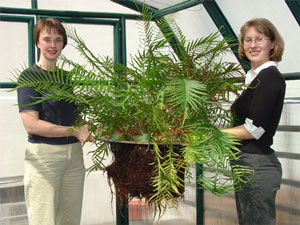
Phytofiltration of drinking water arsenic is based on the remarkable ability of a class of ferns to remove arsenic from water and soil. In recent studies, the edenfern™ has demonstrated bioconcentration coefficients (ratios of arsenic in the plants to arsenic in the water or soil) greater than 100, promising much lower costs for removing and disposing of arsenic than with current technologies. In addition to drinking water, the ferns have effectively removed arsenic from a variety of other sources, including chromated copper arsenate (CCA) used in pressure-treated lumber; arsenical pesticides used in apple orchards, citrus groves and grasshopper bait; and arsenical herbicides used in golf courses and cotton fields. The arsenic-extracting capabilities of this class of ferns were discovered and patented by the University of Florida, which has granted Edenspace an exclusive, worldwide license to enable cost-effective commercial cleanup of arsenic from soil and water using the technique.
The pilot demonstration began in early December 2003, when Edenspace shipped the treatment assembly and edenfern™ plants from Virginia to a greenhouse in Albuquerque operated by the Cityís Parks and Recreation Department. A treatment tray holding eight ferns was suspended in a cell containing 12 gallons (45 liters) of water. Ten such cells were plumbed together. Water was pumped continuously through the assembly at rates up to 450 gallons per day (GPD), or 1,700 liters per day (LPD). Water samples were collected daily and sent to a City laboratory for analysis. Following the initial installation, the treatment assembly was managed by Ms. Alisa C. Lopez, a graduate student at New Mexico University, under supervision of City Horticulturalist Mr. Mike P. Doyle and Department Director Dr. Dale A. Sokkary. Edenspace personnel included Research Associate Ms. Cari A Willms, Plant Scientist Dr. Charissa Y. Poynton, and Principal Investigator Dr. Mark P. Elless.
More than three months of continuous test data was obtained in the pilot project. The initial flow rate of 66 GPD (250 LPD) was increased to a maximum of almost 450 GPD (1,700 LPD) during the course of the demonstration. An average level of just over 10 ppb arsenic in City drinking water was consistently reduced to less than the detection level of 2 ppb even at the highest flow rate. Preliminary analysis suggests that the system might reliably have treated up to 1,000 GPD (3,800 LPD) below the 2 ppb detection limit, and up to 4,000 GPD (15,000 LPD) below the new EPA standard of 10 ppb. Other parameters of the treated water, such as pH and the presence of organic matter, salts, and bacteria, indicated that the process maintained excellent drinking water quality. At the end of the project, water was pumped through the assembly after the plants had been removed. As expected, in the absence of the plants there was no observed decrease in water arsenic levels.
Commenting on the pilot demonstration, Dr. Sokkary noted, "As a former plant scientist myself, I was impressed at the efficiency with which these ferns remove arsenic from water. I think itís also important that the process is easy to use, requiring just a few gardening skills."
The pilot demonstration culminated more than two years of Edenspace research sponsored by the National Institute of Environmental Health Sciences at the U.S. National Institutes of Health (NIH). Excellent results have been achieved at different water pH levels and at different levels of chlorination and fluoridation, and in the presence of sulfur, sodium and calcium compounds. Preliminary results have been published in Environmental Science & Technology, with additional results to be published later this year.
Mr. Bruce W. Ferguson, President and Chief Executive Officer of Edenspace, stated, "We greatly appreciate the cooperation of the City of Albuquerque in this important demonstration, which lays the foundation for simple, low-cost drinking water treatment in the U.S. and other countries."
Headquartered in Dulles, Virginia, Edenspace Systems Corporation is a commercial leader in the use of live plants to improve human health and clean the environment. Its techniques employ plants to detect, concentrate and remove lead, arsenic, radionuclides, chlorides (salts), hydrocarbons, and other minerals from water and soil. With expertise in plant science, soil science, genetics and agronomy, Edenspace is developing new markets for the restoration and enrichment of our surroundings.
Source: Edenspace Systems Corporation