
Reverse Osmosis Gets Smarter: New Technologies Target Energy Use And Membrane Fouling
By Ashish Kolte
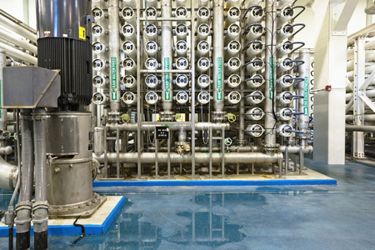
Reverse osmosis (RO) now supplies more than 300 million people with desalinated water worldwide and is increasingly used for industrial reuse, ultrapure water, and municipal wastewater recycling. Yet nearly 45–60% of an RO plant's operating cost is still linked to energy consumption, while membrane fouling can reduce productivity by 15–40% and increase cleaning costs by thousands of dollars annually. The newest generation of RO systems is therefore focused on reducing energy demand, extending membrane life, and using intelligent monitoring to predict fouling before performance declines.
Research by Market Intelo highlights that the global reverse osmosis market, valued at $18.6 billion in 2025, is projected to expand to $34.8 billion by 2034, advancing at a compound annual growth rate of 8.2% throughout the forecast period. This expansion reflects increasing investment in desalination, industrial water reuse, advanced membrane systems, and energy-efficient treatment technologies.
Why Conventional RO Still Consumes Significant Energy
Pressure is the largest energy expense in reverse osmosis. Seawater RO typically operates between 50 and 70 bar, while brackish-water systems generally require only 5–15 bar because of lower salinity. Producing 1 cubic meter of freshwater from seawater usually consumes 2.5–4.0 kWh of electricity, even in modern plants equipped with energy recovery devices.
As fouling develops, differential pressure across membrane vessels can increase by 10–25%, forcing high-pressure pumps to work harder. A pressure increase of only 5 bar can raise annual electricity costs by 6–10% in large desalination facilities operating continuously.
Membrane Design Is Changing The Energy Equation
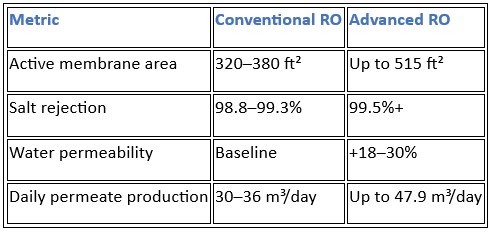
Modern RO membranes are being engineered for both productivity and durability. New spiral-wound elements now provide up to 515 ft² (47.8 m²) of active membrane area within a standard 8” pressure vessel — about 35–40% more surface area than many earlier commercial elements.
Higher permeability also reduces operating pressure. Laboratory evaluations show advanced membranes can increase water permeability by 18–30% while maintaining salt rejection above 99.5% for sodium chloride solutions. Lower hydraulic resistance translates into lower pump energy without sacrificing water quality.
Performance Gains From Advanced Membranes
3D-Printed Spacers Target Fouling At The Source
Although feed spacers represent less than 2% of an RO element's material cost, they have a major influence on hydraulic performance. Conventional mesh spacers create stagnant zones where particles and biofilms accumulate. New 3D-printed spacer geometries optimize turbulence and improve mass transfer.
Experimental results are promising:
- 19.8% higher membrane flux
- Only 8.9% additional pressure drop
- 46% → 41% reduction in permeability loss during silica fouling
- 33% → 22% reduction in biofouling-related permeability decline
These improvements can extend membrane cleaning intervals from every 3–4 months to 6–12 months, depending on feedwater quality.
Batch Reverse Osmosis Reduces Pressure Losses
Traditional RO applies continuous pressure throughout the treatment cycle. Batch RO instead adjusts pressure dynamically as salinity changes, reducing unnecessary energy input.
Pilot-scale studies suggest batch RO can deliver:
- 15–30% lower specific energy consumption
- 10–20% higher water recovery
- 20–35% lower membrane fouling rates
- 25% less concentrate volume requiring disposal
For facilities producing 50,000 m³/day, a 20% energy reduction could save approximately 8–10 GWh of electricity annually.
Sensors Turn Fouling Into A Predictable Problem
Modern RO plants collect thousands of operational data points every hour. Instead of relying on scheduled cleanings, operators now monitor normalized performance indicators that reveal membrane deterioration early.
Key predictive thresholds include:
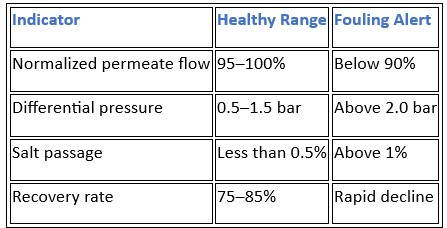
Detecting fouling just 7–10 days earlier can reduce chemical cleaning frequency by 30–50% and prevent irreversible membrane damage.
One industrial installation processing 3.5 million gallons/day reduced membrane cleanings by 83% after upgrading spacer technology. Another university facility increased production from 54 to 72 gallons/minute — a 33% improvement — while operating for 12 months without membrane cleaning.
Advanced Pretreatment Protects RO Membranes
Approximately 70% of severe RO fouling originates from inadequate pretreatment rather than membrane failure itself. Modern pretreatment combines multiple barriers to remove particles, microorganisms, colloids, and scaling ions before they reach the RO system.
Typical contaminant removal efficiencies include:
- Microfiltration: 90–99% suspended solids removal
- Ultrafiltration: 99.99% bacteria removal
- Activated carbon: 60–95% organic reduction
- Antiscalant dosing: Up to 80% reduction in scale formation risk
Reducing feedwater turbidity from 3 NTU to below 0.1 NTU can increase membrane lifespan by 25–40%.
Chlorine-Stable Membranes Could Expand Operating Flexibility
Conventional polyamide membranes begin degrading after relatively low cumulative chlorine exposure, limiting biological control strategies. Emerging chlorine-resistant polymers dramatically improve chemical durability.
Reported laboratory performance includes:
- More than 1,000× higher chlorine tolerance
- Stable salt rejection after repeated disinfection cycles
- Potential 20–30% reduction in pretreatment chemical demand
- Membrane replacement intervals extending from 5 years toward 7–10 years under favorable operating conditions
Greater chlorine stability could also reduce biofilm formation, one of the most expensive causes of productivity loss in municipal RO plants.
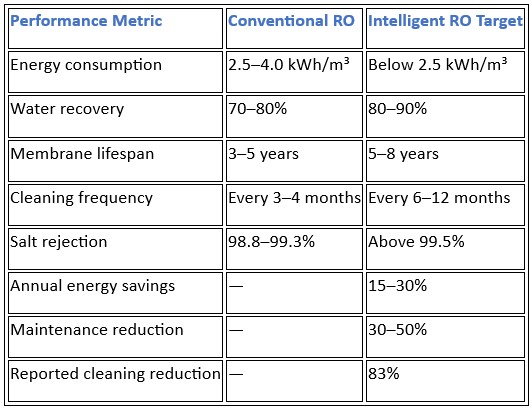
The Numbers That Matter In Smarter RO Systems
Rather than evaluating RO by water production alone, engineers increasingly track system-wide efficiency.
From Fixed-Pressure RO To Adaptive Water Treatment
The future of reverse osmosis is no longer defined by membrane chemistry alone. Intelligent RO combines AI-driven monitoring, predictive maintenance, optimized hydraulics, advanced pretreatment, and high-performance membranes into a unified treatment platform. Even a 10% reduction in energy use at a 100,000 m³/day desalination plant can save over 12 million kWh of electricity annually — equivalent to avoiding roughly 8,000 metric tons of CO₂ emissions in many power grids. As global demand for water reuse continues to rise, the smartest RO systems will be those that maximize every unit of pressure, every membrane square meter, and every kilowatt-hour consumed.
Reference: https://marketintelo.com/report/reverse-osmosis-market
Ashish Kolte is a marketing manager at Market Intelo with expertise in marketing, market intelligence, and business strategy. He combines marketing insights with industry research to analyze market trends, identify growth opportunities, and provide data-driven perspectives on emerging industries and global business developments.