
Report: Food & Beverage Manufacturers Investing In Advanced Industrial Water Treatment To Meet Rising Sustainability Standards
Water has become one of the most critical operational resources for food and beverage manufacturing today. As a central component of nearly every process — including the washing of raw ingredients, processing of ingredients, pasteurization, cooling, steam generation, and clean-in-place (CIP) operations and filling of finished products — a consistent and high-quality water supply is fundamental. This, however, coincides with increased scrutiny in wastewater discharge, increasing water scarcity, ever rising utilities expenses, and urgent ESG goals.
This latest phase of investment by no means is an isolated incident but is a major milestone to continued beverage manufacturing modernize efforts that our beverage industry has begun over the past several decades. Research by Market Intelo highlights that the global beverage processing equipment market is expected to increase from $22.4 in 2025 to $37.8 in 2034 and that is growing at a compound annual growth rate (CAGR) of 6.2% from 2025 to 2034. Even as beverage manufacturers invest in improving these production systems, there is significant and continued capital invested within every aspect from our filling and packaging lines up to our advanced water treatment facilities. Our latest modern beverage facilities today house the highest level of water treatment plants, standard with the best mixing and blending equipment, efficient heat exchangers, membrane technology, CIP systems and the latest in intelligent water management systems and processes designed to optimize and meet ever expanding sustainability initiatives.
Water Consumption Is Driving Technology Adoption
The Food processing sector is one of the most water using manufacturing sectors. The use of water in the food processing sector includes use in formulation of the product, cleaning of equipment, refrigeration, boilers, conveyor systems and treating effluents.
Typical water consumption includes:
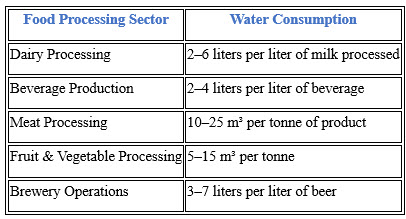
With freshwater costs increasing worldwide, reducing water intensity has become a measurable business objective rather than simply an environmental initiative.
Why Conventional Treatment Systems Are No Longer Enough
Until now most wastewater treatment facilities only existed for one purpose: to meet discharge standards. But not today’s plants. They must do a great deal more-water recycling, conservation of energy, constant performance monitoring and predictive maintenance.
Food industry wastewater typically contains:
- Chemical Oxygen Demand (COD): 2,000–10,000 mg/L
- Biological Oxygen Demand (BOD): 1,000–6,000 mg/L
- Total Suspended Solids (TSS): 500–3,000 mg/L
- Oils, fats, proteins, sugars, and cleaning chemicals
These contaminants are only usually effective at treatment within the conventional activated sludge process if specific (costly) chemicals are added.
AI Is Transforming Industrial Water Treatment
AI technology revolutionizes industrial water treatment plants from a manually controlled system to one with AI constantly analyzing thousands of operational data points that feed from units such as sensors, treatment, pumps, valves, and membrane technology.
Modern AI platforms can:
- Predict membrane fouling before it occurs
- Optimize chemical dosing
- Detect leaks automatically
- Forecast equipment failures
- Reduce unnecessary pumping energy
- Improve treatment efficiency in real time
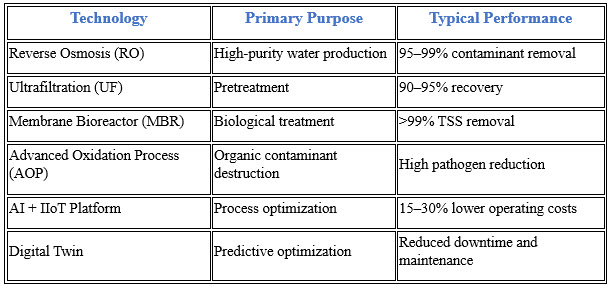
An optimisation based on A.I could decrease running costs by 15–30% and energy consumption by 10–20% with intelligent processing control.
Industrial IoT Enables Real-Time Water Intelligence
The Industrial Internet of Things (IIoT) has been the backbone for smart water treatment plant systems.
The average food production facility may make use of thousands of smart connected devices that monitors:
- pH
- Conductivity
- Turbidity
- Dissolved oxygen
- Flow rate
- Pressure
- Temperature
- Chlorine concentration
- Membrane pressure differential
These sensors relay the operational data in real-time to SCADA or cloud-based analytics, so that any abnormal conditions can be identified within seconds, compared to hours.
Advanced Membrane Technologies Deliver Higher Recovery
In the high standard applications concerning industrial water treatment, membrane filtration technologies are becoming widely acknowledged.
Reverse Osmosis (RO)
RO removes:
- Dissolved salts
- Heavy metals
- Organic contaminants
- Microorganisms
Today’s systems deliver water from which RO removes between 95-99% of all contaminants for use in boiler feedwater and process applications.
Ultrafiltration (UF)
UF effectively removes:
- Suspended solids
- Bacteria
- Viruses
- Colloidal particles
Recovery rates typically range from 90–95%, making UF an ideal pretreatment technology.
Membrane Bioreactors (MBR)
MBRs combine biological treatment with membrane filtration.
Typical performance includes:
- COD removal: 95–98%
- BOD removal: 98–99%
- TSS removal: >99%
A MBR system saves a lot of land and provide cleaner treated wastewater comparing with the conventional biological treatment method.
Advanced Oxidation Processes Improve Water Quality
Food manufacturers increasingly integrate Advanced Oxidation Processes (AOPs) after biological treatment.
Common AOP technologies include:
- Ozone
- UV radiation
- Hydrogen peroxide
- Hydroxyl radical oxidation
The systems work by eliminating permanent organic pollutants, reducing odor, inactivating microorganisms and increasing the overall quality of the water for reuse. Numerous systems couple both RO and AOP techniques to generate reclaimed water of high quality for non-product contact industrial applications.
Zero Liquid Discharge (ZLD) Is Becoming More Common
Large food processing facilities are investing in Zero Liquid Discharge systems to eliminate wastewater disposal entirely.
A typical ZLD system includes:
- Ultrafiltration
- Reverse Osmosis
- Brine concentrator
- Evaporator
- Crystallizer
These integrated systems recover 90-98% of wastewater, reducing the need for fresh water without generating environmental pollution.
While ZLD has high capital costs, increasing waste water disposal costs have improved project economics.
Digital Twins Improve Decision-Making
Digital twin technology is one of the most advanced breakthrough in the field of industrial water treatment. A digital twin is an exact replica (within limits) of the treatment plant which is generated using live data from the operational plant.
Engineers can simulate:
- Equipment failures
- Seasonal demand changes
- Membrane replacement schedules
- Chemical consumption
- Energy optimization strategies
Instead of reacting to operational problems, manufacturers can optimize plant performance before issues affect production.
Water Reuse Delivers Measurable Financial Benefits
Recycling treated wastewater is becoming standard practice across food manufacturing.
Recovered water can be reused for:
- Cooling towers
- Boiler feed
- Equipment washing
- Floor cleaning
- Utility operations
- Landscape irrigation
Worldwide plants today are able to reuse over 50-80% of the wastewater treatment works final effluent thereby saving millions of litres of clean, potable water a year. For instance, in one case a single beverage plant treating 20 million litres / year are able to save in excess of 100 million litres / year of clean water per year simply by increasing the amount of water recovered from the treatment works’ works final effluent from 40% to 70%.
Technology Comparison
Sustainability Is Becoming a Competitive Advantage
Water has become performance measure food manufacturers are required to track. Investors and regulators; retailers and consumers… they’re all looking for proof of better water use efficiencies and environmentally responsible practices.
Many global food companies now publicly report:
- Water intensity
- Wastewater recycling rates
- Carbon emissions
- Energy efficiency
- Freshwater withdrawal
- ESG performance metrics
Advanced industrial water treatment technologies help organizations achieve these targets while improving operational resilience.
Sustainable Water Management
Your industrial water no longer needs to be a disposal nightmare Water is no longer just a part of your food and drink manufacturing process and disappear after consumption — it now has value as a renewable asset in our modern industrial food & beverage plants, and a new production resource that smart players like the major brands are now integrating through the smart use of IIoT, AI analytics, advanced oxidation process, membrane filtration technology, digital twins, and ZLD. As a result, the food & beverage industry is going to be seeing better process yields from new technologies that reduce costs, drive compliance, and make our operations more reliable and our brand image far more sustainable.
This will likely result in sustained funding and development of water treatment technology as water access dwindles and environmental compliance issues worsen over the near term.
Reference: https://marketintelo.com/report/beverage-processing-equipment-market
Source: MarketIntelo