
Repairing Sewers Without Excavation

When repairing sewers, the UK-based company OnSite's no-dig solutions can often use manholes rather than digging up roads.
Until about 30 years ago, once a sewer was built, there was no way of inspecting the inside. But with the emergence of closed-circuit television, the poor condition of many sewers was revealed. Pipes were often cracked and groundwater infiltration was increasing the volume of sewage at the pumping stations. This led to an overload of the system, with sewage overflowing into watercourses. Treatment plants were working unnecessarily to process the additional volume and sometimes sewage seeped directly into the environment through the cracks.
However, in the UK at least, little was done until the privatization of the water industry in 1989, says Bryan Lord, Business Development Manager of the UK-based company OnSite. "Sewer maintenance was always a low priority, but with privatization, water companies were obliged to maintain their assets." In the past, this meant digging up roads, which was expensive and caused inconvenience.OnSite's sewer rehabilitation division specializes in no-dig repairs by using resin-impregnated fabrics. Most importantly, all the work can be completed from manholes.
OnSite's main product is its Premier Pipe, which, under certain circumstances, can rehabilitate or repair lengths of more than 500 meters in one installation. One method — supplied by Trelleborg Pipe Seals within Trelleborg Engineered Systems, which has cooperated with OnSite on the development of a no-dig solution — is to impregnate a fabric tube with a special resin. The tube is then rolled into a drum and gradually blown inside-out into the sewer, with the pressure forcing the fabric against the existing pipe. Steam or hot water is then used to cure the resin, making the lining a structural "pipe within a pipe."
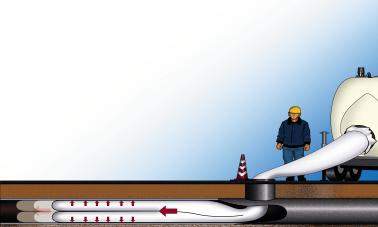
A resin impregnated fabric tube is rolled into a drum and gradually blown inside-out into the sewer. Pressure forces the fabric against the existing pipe. Illustration: Frank Brundin/ Trelleborg
"However, in cases involving a risk of water tracking between the new pipe and the host, we can use Premier Pipe Plus, a version involving the adhesion of the resin to the host pipe," says Lord. For this, OnSite uses an epoxy resin from Trelleborg Pipe Seals. Relatively small areas may be patched using this system, rather like a stent in an artery. The impregnated fabric is loaded onto a packer, which once in position, is expanded under pressure to cover the damaged area. When the resin has cured, the packer is contracted and removed.
A third solution was jointly developed by Trelleborg and Onsite. "In the past," says Lord, "when builders wanted to join a property with the main sewer, they would hammer a hole into the sewer and insert a connection pipe." This may be adequate as long as the outside water table or the sewage inside do not rise above the level of the hole. The two companies have developed a system that inverts a lining, the profile of which can be compared to the shape of a top hat, into the branch and seals it on to the main sewer.
Lord says the development was carried out on the basis that the UK government would transfer responsibility for lateral connections from property owners to water companies. "Property owners are not interested in maintaining their sewers," he says. "Parliament should have brought the law in three years ago, but a change of ministers led to a change in priorities, and the law is not likely to be amended until at least 2011." Nevertheless, OnSite has carried out a few such projects using Trelleborg's lateral lining system. One of these, in East Garston near Oxford, involved 128 hat profiles and 3.2 kilometers of pipe lining.
Pipeline systems experts
Trelleborg's trenchless sewer pipe repairs is part of the Pipe Seals product area within Trelleborg Engineered Systems. It develops, manufactures and markets polymer-based sealing solutions for water, drainage and sewerage pipeline systems.
Trelleborg has been the pioneer of many new pipe sealing systems, such as metal pipes and integrated seals for concrete and plastic pipes, involving the integration of the seal into the pipe socket during manufacture. The seals are developed in close association with pipe manufacturers and specifiers.
SOURCE: Trelleborg Engineered Systems