
Predicting Pump Ragging Before The Overflow: What Lift-Station Sensing Gets Right
By Faisal Mahmood
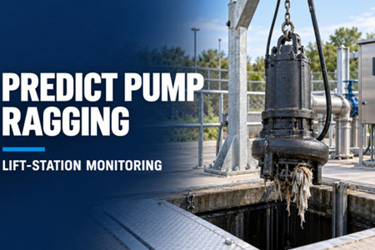
Rags and wipes don’t seize a pump overnight they load it gradually, and the sensors already in the station can see it coming days ahead. The stations that avoid overflows aren’t the ones with the most instruments; they’re the ones that read the right signals together.
The call always comes at the worst hour. Wet well rising, pump running, almost nothing moving. The crew pulls the pump and there it is the impeller wrapped solid in wipes, rags, and grease. Ragging. And here’s what stings: the station saw it coming. Not in some vague sense. The data was sitting right there in instruments that were already installed, days before the overflow. I’ve watched this pattern enough times to say it plainly the stations that don’t flood aren’t better equipped. They just pay attention to what their sensors are already saying.
Start with motor current, because it’s the earliest warning ragging gives you. Picture a clean impeller: predictable current curve every pump-down. Now rags start accumulating. Hydraulic efficiency drops, and the motor has to work harder to move the same volume so current creeps up, run after run, a little higher each time. Put a current sensor on each pump and actually trend the readings (not just wire them to an alarm), and that creep becomes a visible slope on a graph. Here’s the trick most people miss: alert on the rate of change, not some absolute threshold. Do that and you’ll spot a ragging event while the pump is still keeping up usually two to four days before the well starts climbing. The current transformers are probably already in the panel. Almost nobody trends them.
Then there’s pump-down time, which costs exactly nothing to measure. Time how long the lead pump takes to pull the well from start level to stop level under similar inflow. As debris loads the impeller, that time stretches. Log the run-time per cycle and flag anything running 15–20% longer than that pump’s own baseline. No flow meter needed just the level sensor and a clock. One caveat: compare each pump against its own history, not against its twin. Two identical pumps in the same well rag at different rates because inflow turbulence feeds each intake differently.
Which brings us to level sensing itself. Float switches still run most lift stations, and honestly they’re fine for start/stop control. But they’re blind to trends a float only knows “wet” or “dry.” Swap in a continuous level sensor — such as an ultrasonic or radar unit, or a submersible pressure transducer — and suddenly you can see the actual pump-down curve, the inflow rate between cycles, and the classic signature of a ragging pump: the well refilling faster than the pump can empty it, over and over. When the level trend, the current trend, and the run-time trend all degrade together? That’s not a sensor fault. That’s a pump you pull on the next scheduled visit instead of at midnight on a Saturday.
Vibration is your confirming sensor. A ragged impeller is an imbalanced impeller; full stop and imbalance shows up as a rising 1x running-speed component well before the rag mass is even visible. For critical stations, or pumps with a history of seal failures, a basic velocity or acceleration sensor on the motor bearing housing adds the mechanical dimension. Current tells you the pump is working harder. Vibration tells you it’s shaking itself apart. Together they tell the crew whether they’re scheduling a cleaning or a rebuild. That’s a very different work order.
Now here’s what the best-run stations actually get right, and it’s not any single instrument it’s the combination. Current rising, run-time stretching, level losing ground, vibration climbing. Any one of those alone could be a false alarm. All four moving together is a diagnosis. The stations that avoid overflows treat this as a weekly habit: ten minutes, four trend plots per station. Not a project. A habit. Way cheaper than the alternative.
Last piece: the controller has to do something with the diagnosis. Good lift-station controllers can run anti-ragging cycles on their own a brief reverse at the start of each cycle to shed debris, or a high-speed flush when the current trend crosses your threshold. Alternating lead/lag duty spreads the rag load instead of sacrificing one pump to do all the dying. This won’t save a pump that’s already mummified nothing but a crew with a hook knife does that but it stretches cleaning intervals from weeks to months. And it turns the 2 a.m. emergency into a line on the preventive maintenance schedule, which is where it belonged all along.
The honest truth? None of this needs a station rebuild. A current sensor per pump, one continuous level instrument, and a controller that logs data instead of just alarming on it that’s the whole upgrade for most sites. The rags aren’t going away; wipes keep getting more “flushable” every year. But the overflow doesn’t have to happen. The station already knows. Someone just has to look.
Faisal Mahmood (faisal.mahmood106@gmail.com) is a technical writer, content strategist, and CEO of Ourex.pro. He specializes in research-driven technical content covering engineering, industrial automation, robotics, AI, sensors, manufacturing technologies, and emerging technologies. His work focuses on translating complex technical concepts, systems, and engineering applications into clear, accurate, and accessible content for technical and professional audiences. With experience in technical research, content strategy, and digital marketing, Faisal works with technology and engineering companies to develop technically sound articles, technical guides, industry insights, and thought-leadership content.