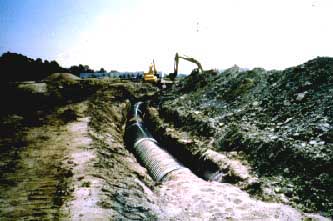
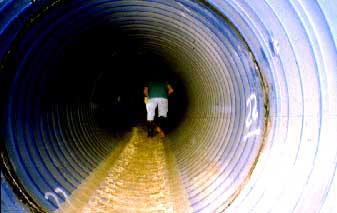
Polyethylene-Lined Pipe Design Saves Both Time and Installation Costs

With the potential to save thousands of dollars a day in interest costs alone, construction materials that allow developers to speed up project completion are not only important, but also in great demand.
New Pipe Designed for Savings
In the construction of Lakeside Community, Irvine, CA-based Catellus Residential Group decreased installation time and saved thousands of dollars when they installed TriShield pipe—a composite-designed, spiral-ribbed steel pipe from Pacific Corrugated Pipe Company, Newport Beach, CA. The utilities system for Lakeside—a 70-acre, 346-unit residential community in Buena Park, CA—was engineered by David Graves, project engineer, and installed by Clearwater Pipeline, Inc., Perris, CA.
The original construction plan for the storm drain system called for reinforced concrete pipe (RCP). However, Graves and Catellus selected TriShield pipe based on the potential for greater time and cost savings presented by the light-weight and long lay-lengths of the new pipe.
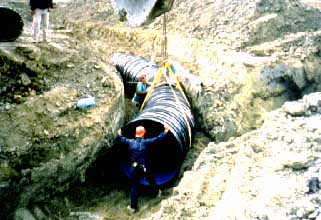
The multi-layer composite construction of the pipe includes a structurally sound, spiral-ribbed galvanized steel core pipe. The outer surface of the pipe is covered with Trenchcoat Heavy Gauge (HG) Protective Film, a corrosion resistant polyethylene film supplied by The Dow Chemical Company. The interior of the pipe is lined with a thick corrosion and abrasion resistant engineered polyethylene coating, also supplied by Dow. It is said that the design of TriShield pipe provides greater durability, improved hydraulic characteristics and increased structural strength than traditional RCP. (Click here for more details on the manufacturing process of this product.)
In addition to abrasion and corrosion resistance, the interior polyethylene lining offers a high degree of flex modulus and an extensibility that exceeds the limits of the steel pipe core. The composite integrity and structural flexibility make the product suitable in areas like California, where seismic activity can be a concern.
Due to the performance features of the composite-design pipe, Pacific expects the TriShield pipe used in Lakeside Community's storm drain system to exceed the project's design service life.
Lighter Weight = Lower Costs
TriShield pipe is typically 20 to 30 times lighter than RCP. As shown in Table 1, 30-ft sections of the pipe used in the Lakeside project weigh thousands of pounds less than 8-ft sections of RCP with the same diameters.
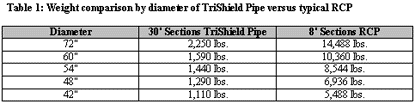
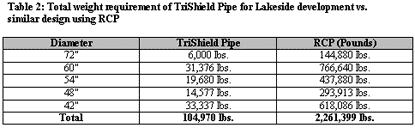
The total weight of TriShield pipe used at Lakeside was over 2,100,000 pounds less than it would have been with RCP (Table 2), contributing to a less time consuming, less costly installation. The lighter-weight pipe requires fewer trucks for transport, and expensive, heavy-duty lifting equipment is not necessary. The thinner pipe thickness also requires less excavation.
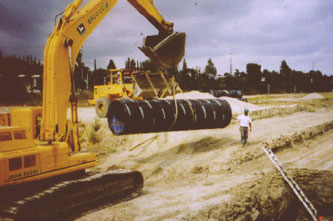
"For diameters 72 inches and greater, a crane is usually required to install RCP," says Gene Norris, owner of Clearwater Pipeline. "However, with TriShield pipe, a simple backhoe or small lifting device is sufficient."
Another time- and cost-saving feature of this new product is that it can be fabricated in 20-ft to 40-ft sections, compared to RCP, which is produced in lengths up to eight feet. As a result, construction crews can install at least twice as much TriShield pipe in one day versus RCP. Longer pipe sections also reduce the number of pipe joints in the system, which can help reduce maintenance costs over the life of a project.
Time = Money
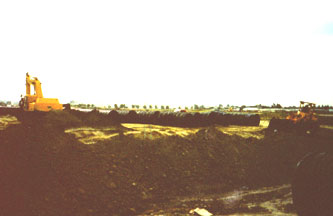
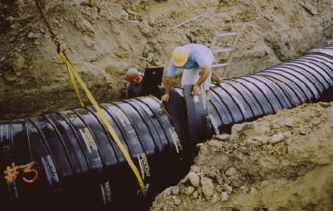
On the first day of the installation, Clearwater Pipeline installed the entire line (592 feet) of 60-inch pipe and 105 feet of 54-inch pipe in eight hours. The entire lineup of pipe was installed in only three days. (Click here to see a pictorial review of the installation process.)
The piping system was laid in a snake-like alignment. Both deflected straight pipe and elbows were used to negotiate curves. Because the pipe is lightweight, installers easily "pulled" the joints and laid the elbows.
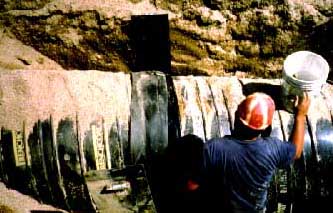
Laterals—smaller pipe connecting to the main line storm drain—were installed after the pipe was in place. Once the holes were cut and the laterals were connected to the mainline, a concrete collar was poured into the adjoining portion of each lateral to ensure a good connection.
"Typically, breaking a hole into RCP to tie in laterals is very laborious," says Gene Norris, Clearwater Pipeline. "However, only a simple Saws-All was required to cut holes in the TriShield pipe. I was amazed at how easy it was to install the pipe and was further amazed to learn of the cost savings we can pass on to our clients."
For more information about TriShield Pipe ,call Pacific Corrugated Pipe at 877-874-7443 (877-TRI-SHIELD).
For more information about Trenchcoat Protective Film or polyethylene from Dow Plastics, contact Dow's Customer Information Group at 1-800-441-4369 and reference Element #1487.
Edited by Tracy Fabre
The Manufacturing Process
TriShield pipe is constructed of six distinct layers, beginning with a spiral-ribbed steel core coated on both sides with two ounces per square foot of galvanized zinc (layers two and three). The galvanized core is then laminated on the soil-side with a corrosion resistant 10-mil thick layer of Trenchcoat Heavy Gauge (HG) Protective Film, supplied by The Dow Chemical Company, Midland, MI.
The fifth layer, a uniquely engineered adhesive, is laminated to the interior surface of the steel substrate. Through unique polymer chemistry, this polyethylene layer is bonded to the galvanized steel substrate, resulting in a tie layer, which assures the bond between the steel core and the final layer.
When the polymer-coated steel coils are fabricated into pipe, the final layer—a tough 65-mil thick corrosion and abrasion resistant sheet of polyethylene produced using Dow's Insite technology—is extruded into the ribs and onto the interior wall. During this process, the extruded sheet chemically bonds to the adhesive film substrate, forming a 75-mil thick polymer interior liner. For additional adhesion, the polymer-filled ribs (spaced every 7.5 inches from center) are slightly deltoid-shaped to create a mechanical interlock with the pipe wall.
Capitalizing on all aspects of TriShield Pipe's composite structure and design results in the ability to produce pipe in one-inch incremental diameters up to 108 inches and in sections from 20 feet to 40 feet in length, depending on project demands.