
Ohio State Research Shows Promise For New Harmful Algal Bloom Treatment
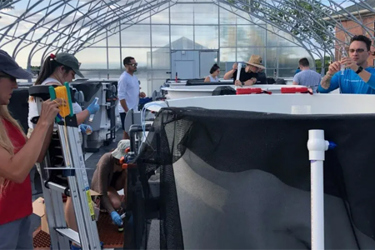
CFAES researchers report strong early results for a treatment designed to reduce harmful algae and toxins while protecting aquatic ecosystems.
Columbus, OH — Research led by The Ohio State University College of Food, Agricultural, and Environmental Sciences (CFAES) is showing promising results for a new way to fight harmful algal blooms — a problem that can threaten drinking water, close beaches, harm fisheries, and damage local economies in Ohio and beyond.
Using a specialized research facility at The Ohio State University Stone Laboratory on Lake Erie, scientists tested nanobubble ozone technology, or “NBOT,” to determine whether it could reduce toxin-producing cyanobacteria while protecting the health of the surrounding lake environment.
The results were significant.
Using Ohio State’s mesocosm facility, which allows researchers to test lake conditions in a controlled, real-word setting, the scientists found that NBOT reduced cyanobacteria by up to 99% and cyanotoxins by 92% in repeated trials.
The treatment also appeared to be less disruptive to other aquatic life than EPA-approved algaecides made with copper or hydrogen peroxide. Researchers saw increases in beneficial algae after treatment, an encouraging sign that the approach may help support a healthier aquatic ecosystem.
“Our main objective was to evaluate the efficacy of nanobubble ozone technology for eradicating cyanobacterial harmful algal blooms and cyanotoxins,” said Heather Raymond, director of CFAES’ Water Quality Initiative. “We also investigated the impact of the technology on nontarget organisms and its potential to transform nutrients.”
Toxin-producing harmful algal blooms are driven by excess nutrients in the water. While prevention remains critical, reducing those nutrients enough to make a measurable difference can take decades.
The project examined whether treatment technologies could provide another tool for water managers looking for faster relief from the impacts of toxins that affect water quality. NBOT works by generating ozone, a powerful oxidant, and delivering it into water through microscopic nanobubbles.
“Unlike common macrobubbles, nanobubbles do not quickly coalesce and rise to the water surface and ‘pop,’” she said.
Because nanobubbles are so small, they can move quickly through the water and help ozone work more efficiently to break down harmful algae and toxins.
“Overall, nanobubble ozone technology is proving to be an environmentally friendly and effective alternative harmful algal bloom treatment technology,” Raymond said.
The research also showed that water conditions can affect how well the treatment works. One key factor is the amount of dissolved organic carbon in the water, which can help researchers estimate how much ozone is needed for effective treatment. This finding could help guide future use of the technology.
At the same time, Raymond said important questions remain.
Although the technology demonstrated effectiveness in laboratory and mesocosm settings, researchers continue studying how changing water quality conditions and larger treatment areas influence performance.
“We still have questions on how to effectively scale up the technology,” Raymond said.
As part of the next phase of the work, Ohio State researchers are partnering with the Ohio Department of Natural Resources to test the technology next summer in multiple 1.3 million-gallon fish hatchery ponds.
Researchers also hope to collaborate with public water systems in future trials to better understand how the treatment performs at even larger operational scales.
“Harmful algal blooms impact recreation, drinking water, aquaculture and local economies,” Raymond said. “Our applied research on harmful algal bloom treatment technologies will help water managers find effective options for improving water quality and protecting public health.”
Source: Ohio State University