
New product tested to be superior to natural hay bales
GeoHay is a synthetic "hay bale" that its makers say offer numerous advantages over the real thing. As proof, they are offering a report from an independent research firm which looked at both the hydraulic performance and solids retention capability of each.
Contents
Hydraulic performance and solids retention capability compared
Labs tested for total suspended solids and turbidity
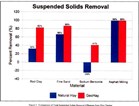
GeoHay provided higher TSS removal for fine particles
GeoHay found durable during rainstorms
Natural hay bales are commonly used during construction to control erosion and reduce the transport of solids from disturbed earthen areas into receiving surface waters. A new substitute for the natural hay bales was featured in the trade show at the recent International Erosion Control Association 32nd Annual Meeting. The product is called "GeoHay" and is being manufactured by Mary Ann Industries.
Its makers say its advantages far outweigh the use of natural hay bales. GeoHay is:
- weed-free
- durable and will last the duration of most construction projects
- consistent in size and weight
- designed with pre-made stake holes for easy installation
- Ireusable and recyclable
- able to be stored in the open
Hydraulic performance and solids retention capability compared
To back up the promises, the manufacturers were offering copies of a study performed by Environmental Research & Design, Inc. According to ERD, the "purpose of this study is to evaluate and compare the hydraulic performance and solids retention capability of natural hay bales and GeoHay, a new synthetic hay bale material."
The experiments were performed in Florida using natural hay bale material and GeoHay with four separate soils/solids, including Orangeburg Series sandy clay loam (red clay), fine sand, sodium bentonite (gray clay), and asphalt milling fines.
According to the ERD report:
"An 8-ft long x 3-ft wide wooden flume was constructed to perform the pilot testing. For each individual test, a natural hay bale or GeoHay was inserted into a slot in the experimental flume. Each solid material was mixed with 200 gallons of water in a large HDPE container. The soil/water mixture was maintained in suspension using an internal agitator. The tank valve was opened, and the water/solid slurry then flowed through the experimental flume into the natural hay bale or GeoHay.

"Flow rates were measured at the inflow point and the outflow point multiple times during each experiment. At the time of flow measurement, samples were collected from the inflow and outflow points and analyzed for total suspended solids (TSS) and turbidity. (Back to top)
Labs tested for total suspended solids and turbidity
"Laboratory results were used to determine removal efficiencies for total suspended solids and turbidity for natural hay bales and GeoHay with each of the tested soil/solid materials. The hydraulic flow capacity of GeoHay was estimated based on the inflow and outflow rates measured during the experiments. The following sections provide a detailed description of the experimental design, pilot testing results, and conclusions."
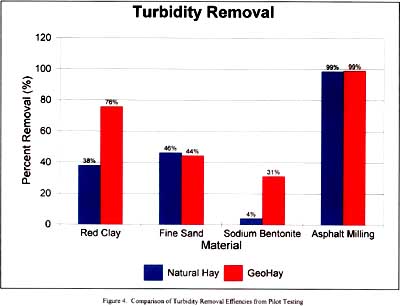
The report went on to say that, "Based on the experimental results, natural hay and GeoHay provide equal turbidity removal efficiencies for larger solid particles such as fine sand and asphalt milling fines. However, for fine-grained materials, such as red clay and bentonite, GeoHay provided significantly better turbidity removal efficiencies than natural hay bales. (Back to top)
GeoHay provided higher TSS removal for fine particles
"Both GeoHay and natural hay provide virtually complete removal of total suspended solids (TSS) for large particles (asphalt milling fines), while GeoHay provides substantially higher TSS removal efficiencies for fine sand and clay-sized particles. The increased removal efficiencies observed for GeoHay is related to the much smaller opening sizes in the Geoflay material. These smaller openings not only limit the transfer of solids through the material but also reduce the water flow rate. This reduction in water flow rate is beneficial in reducing erosion downstream of the material. The installer should ensure that an adequate length of GeoHay is used which matches the anticipated water flow rate to be treated. Based on the hydraulic testing discussed in Section 3.1, a maximum design flow rate of 2.2-3.0 cfs/100 linear feet of GeoHay is recommended for field installations. (Back to top)
GeoHay found durable during rainstorms
"There are several other advantages to using Geoflay over natural hay bales. During periods of rainfall, natural hay bales degrade and must be replaced periodically. The synthetic material in GeoHay is not affected by the weather and should last for the duration of construction for most jobs. The experiments performed did not evaluate the solids retention capability of the joints between individual sections of natural hay bales and GeoHay. With natural hay bales, the bales are laid end-to-end, with small spaces between bales even in the best installations. Water and solids can pass through this joint. With GeoHay, the outer fabric from each bale overlaps with the next bale, limiting the passage of solids through the joint. Although not tested in this project, the design of GeoHay appears to have a superior joint to natural hay bales. Therefore, the solids removal efficiencies for a series of installed natural hay bales may be less than estimated during this evaluation. This further supports the superior solids retention capability of GeoHay over natural hay bales."
For more information about GeoHay, call 770-459-3653. (Back to top)
By Joyce Everhart
Content Manager, Public Works Online
jeverhart@vertical.net
Source: Mary Ann Industries and Environmental Research & Design, Inc.