
Nanofiltration system treats water at Lake Mead National Park

A new product from FilmTec Corporation, a wholly owned subsidiary of The Dow Chemical Company, combines high passage of desired minerals with high rejection of organic compounds, including those that are precursors to the U.S. Environmental Protection Agency (EPA) regulated disinfection by-products.
By 2002, the Lake Mead Recreation Area will have a total of four new water treatment facilities producing 916,000 gallons of fresh water per day. Lake Mead is one of the country's most popular recreation areas, attracting over nine million visitors a year and is home to over 5,000 permanent residents. To supply water to the residents and visitors, the National Park Service maintains water treatment plants in order to make purified drinking water from lake water.
Along with Las Vegas and Hoover Dam, Lake Mead is one of Nevada's premier tourist attractions. Providing an adequate infrastructure for the millions who visit there is very important. To do so, a phased construction project began in 1998 to replace to 30-year old, non-compliant dual media gravity sand filter water systems. The new facilities were designed to meet existing requirements and the scheduled changes to the Surface Water Treatment Rule of the Safe Water Drinking Act. The four plants relying on surface water from the lake will use a combination of microfiltration and nanofiltration systems.
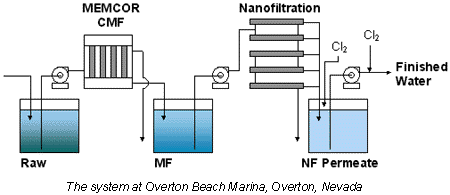
Overton Beach Marina system details
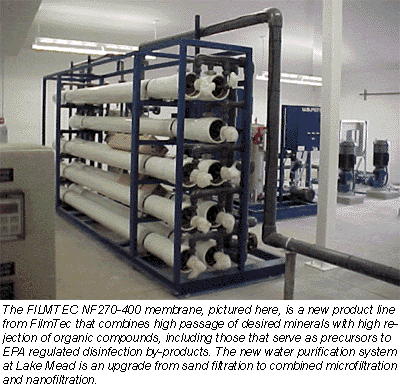
The microfiltration system at Overton Beach Marina uses the U.S. Filter CMF technology, while the nanofiltration system uses FILMTEC NF270-400 membrane elements. Raw water from Lake Mead has 570 parts per million of total dissolved solids. The treatment goals are to achieve a high rejection of organic carbon to meet EPA standards and a low rejection of calcium and alkalinity to maintain corrosion control and taste. Early results were very encouraging.
Three weeks after start-up, the system produced up to 100,000 gallons of water per day at a nanofiltration trans-membrane pressure of just 50 psi. The FILMTEC NF270-400 membrane elements provided increased mineral passage, eliminated the need for blending, and provided 94% rejection of total organic carbon (TOC). In addition, the FILMTEC NF 270-400 membrane element was shown to be energy efficient providing high productivity at low pressures.
How nanofiltration works
Nanofiltration is a liquid separation membrane technology that is positioned between reverse osmosis and ultrafiltration. While reverse osmosis can remove the smallest solute molecules in the range of 0.0001 micron in diameter and smaller, nanofiltration removes particles down to the 0.001 micron range. Nanofiltration is a low pressure membrane compared to reverse osmosis and is used in applications where partial passage of minerals is desired. The level of dissolved solids to be removed is less than what is typically encountered in brackish water or seawater. As such, nanofiltration is especially well suited for treatment of well water or water from surface sources like rivers and lakes.
Nevertheless, nanofiltration is capable of partially removing hardness elements such as calcium or magnesium. (Like reverse osmosis, nanofiltration is also capable of removing bacteria, viruses, and color as well as organic compounds that may lead to the generation of chlorinated hydrocarbons.) Nanofiltration is also used to remove pesticides and other organic contaminants from surface and ground water to help ensure the safety of public drinking water supplies. Sometimes referred to as membrane softening, nanofiltration is an alternative to lime softening or sodium chloride zeolite softening technologies. Since nanofiltration operates at lower pressures than does reverse osmosis, energy costs are lower than comparable reverse osmosis treatment systems.
Dow is a leading science and technology company that provides innovative chemical, plastic and agricultural products and services to many essential consumer markets. With annual sales of approximately $30 billion, Dow serves customers in more than 170 countries and a wide range of markets that are vital to human progress, including food, transportation, health and medicine, personal and home care, and building and construction, among others.
Source: The Dow Chemical Company, www.dow.com
Subscribe to our free e-mail newsletter.