
Microbial And Disinfection Byproducts Regulations: Paving The Way For Efficient Compliance
By Alan Roberson, PE, Caroline Russell, PhD, and Kathryn Lopez, PhD
Given the ongoing regulatory activity in the water industry, it’s hard to imagine another major drinking water rule on the horizon. But the U.S. Environmental Protection Agency is planning revisions to the microbial and disinfection byproducts (MDBP) regulations.
MDBPs are unintended chemical compounds formed when disinfectants like chlorine or ozone react with organic matter in water. Proposed regulatory changes are anticipated in the summer of 2027, with finalization in mid-2028, and compliance expected in mid-2031.
Carollo is focused on helping utilities prepare for these changes with minimal disruption to their operations. While the scope of revisions is still evolving, utilities can benefit from understanding these potential changes now and evaluating how they could affect distribution system operations, staffing, and capital planning in the future.
What Changes Are Most Likely?
The EPA is using three of the thirteen recommendations from the National Drinking Water Advisory Council (NDWAC) MDBP final report as a starting point for these revisions. Given the data gaps in the other ten recommendations, it's likely to focus on revisions to secondary disinfectant residuals, compliance monitoring, and storage tank inspections.
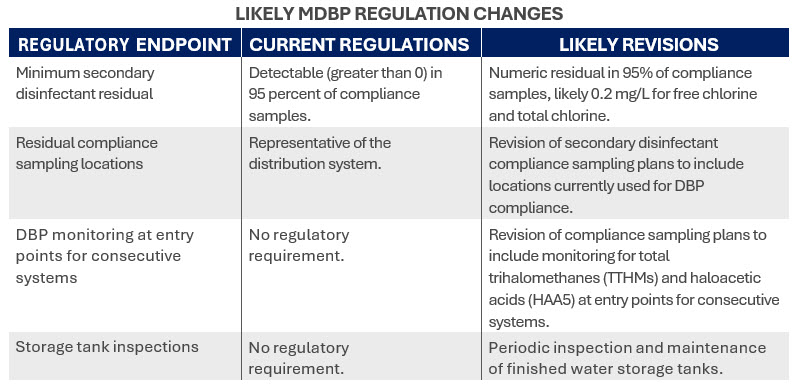
Click for a detailed summary of U.S. EPA’s potential MDBP revisions.
Click to view NDWAC’S MDBP final report.
What Other Issues Are Under Consideration?
Range of numerical residuals. For the minimum secondary disinfectant residual, EPA could propose a range of numerical residuals, or it could propose different numerical residuals for free chlorine and total chlorine.
Range of numerical percentage for compliance. The agency could also propose a range of percentages for the minimum secondary disinfectant residual (> 95%).
New consequences for repeat low residuals. EPA could propose operational consequences for repeat low residuals at a single compliance sampling location, even if the system meets the percentage requirement. Low-residual events could trigger required actions, such as flushing or operational adjustments, and may lead to non-compliance if they recur.
Nitrification action plans for chloramines. The agency is also considering requiring nitrification action plans for systems that use chloramines. These plans would likely need to be approved by primary agencies and would require DBP compliance sampling whenever free chlorine is used, such as during chlorine conversion periods.
Click for guidance on nitrification action plans.
Click to review strategies to maintain system residuals.
What Changes Are NOT Expected?
Revisions to existing maximum contaminant levels (MCLs) or any new MCLs for additional DBPs are not expected in the proposal in 2027 due to gaps in health effects, occurrence, and treatment data.
Early Actions Can Prepare Utilities For Compliance
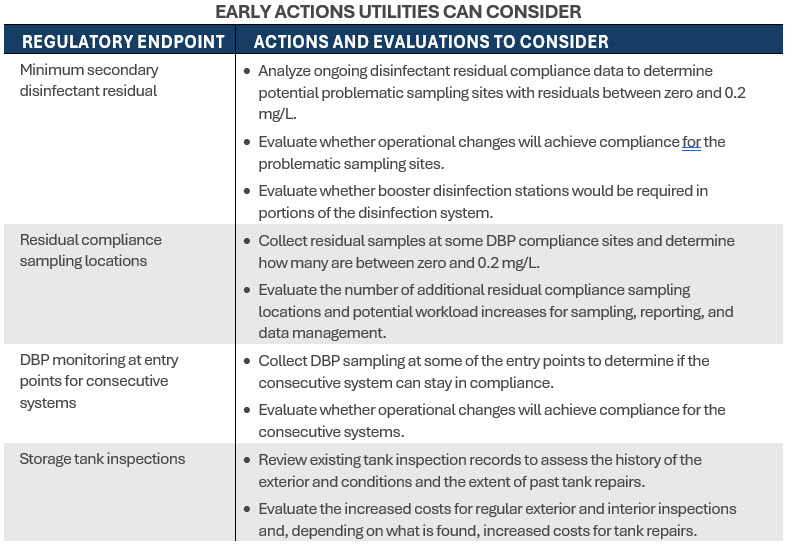
Although the proposed revisions are a few years away, utilities can begin preparing by:
- Evaluating current distribution system residual performance.
- Identifying areas vulnerable to low residuals or DBP formation.
- Reviewing staffing, sampling, and data management capacity.
- Considering whether modeling or planning tools could help assess future compliance scenarios.
Looking Ahead
While the scope of the MDBP revisions is still evolving, the direction is clear: greater emphasis on numeric residuals, expanded monitoring, and proactive distribution system management. Utilities that begin evaluating these potential impacts now will be better positioned to adapt efficiently once the proposed rule is released in 2027.
 Alan Roberson, PE, joined Carollo Engineers in 2026. He is the former executive director of the Association of State Drinking Water Administrators and director of federal regulations at the American Water Works Association (AWWA). The recipient of AWWA’s 2025 Fuller Award and author of more than 40 peer-reviewed publications, Alan has offered strategic insights on emerging regulations, legislative developments, and funding opportunities to clients throughout the water industry for nearly 40 years.
 Caroline Russell, PhD, PE, BCEE, is a vice president and chief technologist specializing in drinking water regulations at Carollo. She has more than 20 years of experience addressing water supply and treatment challenges across the U.S.
 Kathryn Lopez, PhD, is a Carollo staff technologist specializing in drinking water contamination challenges. She has worked on water and chemical policy in association with the U.S. EPA and U.S. Senate and offers a deep understanding of policymaking and communicating science to decision-makers.