
Meeting Demand, Ensuring Compliance: A Success Story In Executing Fast-Paced Water System Improvements In Missouri City, Texas
By Keval Satra, PE, and Nicholas Cook
A Rapid, Multi-Phase Response To Unprecedented Growth
The Mustang Bayou Service Area (MBSA) Water System Improvements project delivered a fast-tracked, multi-phase response to rapid development and critical capacity challenges in one of the Missouri City’s fastest-growing regions. Through accelerated water system planning, a successful Texas Commission on Environmental Quality (TCEQ) Alternative Capacity Requirement (ACR), a detailed groundwater supply feasibility study, and fast-paced well capacity upgrades, the City expanded system capacity, secured regulatory compliance, and maintained uninterrupted service during peak water demand and development pressure.
Leveraging hydraulic modeling, historical operational data, phased construction, American Rescue Plan Act (ARPA) funding, innovative project delivery, and strategic use of emergency interconnects, the City increased groundwater production at Water Plant No. 1 from 2,100 to 2,700 gpm in just six months and is currently working on expanding groundwater production at Water Plant No.2. These improvements provided immediate capacity relief, supported approximately 1,000 additional connections, and positioned the MBSA for long-term growth while enhancing system resiliency, operational flexibility, and protection of public health.
A Complex Service Area Under Growing Pressure
The MBSA is a complex, multi-jurisdictional public water system serving rapidly expanding portions of Missouri City and Fort Bend County. It integrates the Mustang Bayou Water System, Fort Bend County MUD No. 47 Water System, and Fort Bend County MUD No. 48 Water System. Through long-standing Regional Joint Water Facilities Agreements, these systems are fully integrated into a unified service area relying on shared supply, treatment, and distribution infrastructure.
As of 2023, the system supported 4,832 connections, with long-term projections nearing 8,500 — almost double the existing demand. Pandemic-era low-interest market conditions further accelerated development interest, bringing the system close to the capacity thresholds tied to elevated storage requirements under TCEQ rules.
Without timely upgrades, Missouri City faced the possibility of a development pause, a scenario that risked stalling residential and commercial projects, slowing economic growth, and eroding developer confidence during a period of strong regional momentum. Recognizing this urgency, the City launched a strategic and technically rigorous set of projects to maintain regulatory compliance, safeguard public health, and ensure that growth could continue.
Milestone 1: Water System Planning and TCEQ Alternative Capacity Requirement (ACR) (September 2023 – February 2024)
The City completed a comprehensive water system planning effort and pursued an extension to the ACR to address TCEQ elevated storage requirements, which are triggered when a water system exceeds 2,500 connections. A TCEQ ACR is a regulatory mechanism that allows a water system to demonstrate, through engineering analysis, that it can meet required pressure, storage, and supply standards without constructing the elevated storage normally mandated once a system exceeds 2,500 connections.
With the MBSA already above this threshold, the City conducted a detailed technical evaluation including 36 months of operational data, field hydrant flow testing, creation and calibration of a hydraulic WaterGEMS model, desktop calculations of all water system components (supply, storage, pumping, backup power, and distribution piping), and analysis of six (6) planning scenarios, to demonstrate that adequate capacity could be maintained without constructing an elevated storage tank.
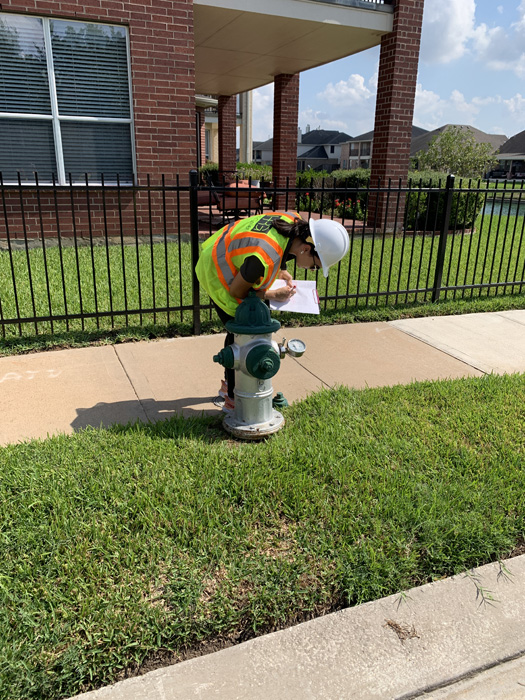
Field hydrant flow testing
Based on this analysis, the City submitted an ACR application demonstrating that hydropneumatic pressure tanks and an emergency generator could support up to 5,133 connections as an interim solution. TCEQ approved the request, allowing development to continue. Concurrently, the City prepared a long-range capital improvement roadmap to support expansion to approximately 8,500 connections, which was formally incorporated into the City’s Capital Improvement Plan.
As part of this planning effort, the City identified the need for a new water source. While long-term plans called for supplying the MBSA with surface water, the associated transmission line project had an extended implementation timeline. Therefore, as an interim measure, the City initiated a feasibility study for the design and construction of a new groundwater source capable of providing additional supply within 12 months.
Milestone 2: New Groundwater Well Feasibility Analysis (Feb 2024 – May 2024)
The purpose of the feasibility study was to rapidly identify viable groundwater supply options that could be implemented within a short timeframe and with minimal disruption to the existing MBSA water system. The study evaluated available aquifers in the area, assessed potential production capacities, and reviewed required separation distances between wells to allow simultaneous and reliable operation. In total, five (5) alternatives for a new groundwater well were developed and analyzed under an accelerated schedule to support the City’s urgent capacity needs.
The feasibility study identified two improvements capable of providing the necessary additional groundwater supply while maintaining continuous service to customers:
- Recommended Improvement #1: Upsizing the well pump at Water Plant No. 1 providing additional 600 gpm capacity.
- Recommended Improvement #2: Installing a new 2,700 gpm groundwater well at Water Plant No. 2 and repurposing the existing 1,100 gpm well to provide redundancy.
Both recommended alternatives required associated chemical feed upgrades, electrical improvements, and site/civil modifications. Collectively, these improvements were selected because they could be executed quickly, integrated into the existing system with minimal interruptions to water service, and aligned with the City’s short-term and long-term capacity goals.
Milestone 3: Mustang Bayou Water Plant No. 1 – Well Capacity Improvements and ACR (November 2024 – April 2025)
The City and its stakeholders successfully completed the well capacity improvement project at Mustang Bayou Water Plant No. 1 within an accelerated six-month window that included design, permitting, and construction. The project increased groundwater production from 2,100 to 2,700 gpm (3.0 to 3.9 MGD) to support rapid development demands and maintain compliance with regulatory capacity requirements.
This fast-paced project was executed through a two-phased approach that leveraged a unique project delivery method utilizing an existing interlocal agreement, federal funding from the American Rescue Plan Act, and strategic use of water system interconnect to maintain uninterrupted service. To meet the aggressive timeline, the City and its engineering consultant developed a rapid, phased implementation plan.
Phase 1 involved installing a temporary rental pump to provide immediate capacity while ensuring continuous service. This temporary pumping phase also confirmed key findings from the feasibility study by demonstrating that the existing well could produce additional supply without requiring the construction of a new well. Phase 1 also included a complete video inspection of the existing well to verify structural integrity, followed by well cleaning and disinfection, and improvements to the disinfection system to ensure proper chloramine treatment prior to distribution. Concurrently with Phase 1, the project team performed similar engineering and regulatory work as completed during Milestone 1 and successfully obtained an extension to the ACR. This ACR extension was secured following substantial completion of Phase 1 improvements and allowed development within the MBSA to continue without any delays or interruptions, enabling the City to provide water services for an additional 1,000 connections in the MBSA. Phase 2 consisted of permanent upgrades to install permanent well pump and associated equipment. This construction was made possible through the use of the City’s existing interlocal agreement and the utilization of ARPA funds, which allowed the project team to bring contractors on board with minimal procurement time.

Installation of new well pump at the Mustang Bayou Water Plant No.1
Throughout construction, the City coordinated closely with the Contractor which operates the MBSA water system, to manage operational adjustments and maintain system reliability. Additional coordination with a neighboring public water system enabled the City to utilize an existing emergency interconnect during periods when the well was offline. Before removing the well from service, both systems were trial-tested to verify that the MBSA system and the neighboring utility could reliably supply water through the interconnect. This testing gave City leadership real-world operational assurance that use of the interconnect would not pose any risks to either water system. Because the two systems used different disinfectant residuals (chlorine and chloramine), the City also conducted community outreach and was prepared to address customer concerns as the system transitioned between disinfectant types. The well-planned disinfection transition combined with hydrant flushing didn’t result in any customer complaints.
To meet regulatory and construction deadlines, the project team secured expedited approvals from the TCEQ. The Phase 1 permit application received approval in just four (4) calendar days, enabled by comprehensive, technically sound engineering and permitting documents and close coordination among all stakeholders. The project was completed on time and ensured continued service reliability for all MBSA customers without disruption.
Milestone 4: Mustang Bayou Water Plant #2 - Water Well Improvements. (June 2025 – Ongoing)
The City is currently executing this critical $5.7 million well improvement project. The proposed improvements include the design and construction of a 2,700-gpm, high-capacity groundwater well (approximately 3.90 MGD), a new electrical control building, an emergency generator, and associated site and civil improvements on an expanded water plant site. This project is vital to the City’s long-term water infrastructure strategy because it supports regional growth and significantly enhances system resiliency and redundancy by establishing dual sources of supply: groundwater and surface water for the Mustang Bayou Service Area
Innovation And Technical Excellence
The project showcased multiple examples of innovation and engineering excellence, including:
- Creative Regulatory Strategy: Successfully used the regulatory mechanism (i.e. ACR) to meet system pressure requirements without constructing an elevated tank, supported by hydraulic modeling, operational data analysis, system performance calculations, and well-crafted engineering documentation.
- Fast-Paced Capacity Expansion: Completed a two-phased well-capacity upgrade at Water Plant No. 1 in only six months, increasing well production from 2,100 to 2,700 gpm.
- Risk-Reducing Field Validation: Implemented a temporary rental pump to verify feasibility study findings in real time, confirming actual well production and water performance prior to major capital investment. Additional field validation, including a 36-hour well pump test, water quality sampling, and system pressure measurements, ensured that the water system could meet operational and regulatory performance requirements
- Operational Innovation: Maintained uninterrupted water service through strategic use of emergency interconnect, coordinated field trial operations, and careful management of chloramine-to-chlorine disinfection transitions.
- Accelerated, Cost-Effective Delivery: Leveraged interlocal agreements to streamline procurement, reduce project overhead costs, and strategically use available ARPA funds to initiate the project immediately, avoiding funding delays and maintaining the construction schedule.
- Enhanced System Resiliency: Improvements provided immediate capacity relief, supported over 1,000 additional connections, and strengthened long-term reliability for one of the City’s fastest-growing service areas.
- Technical Excellence: A data-driven, strategically phased engineering approach to planning and capital improvements that effectively leveraged regulatory pathways to expedite development and deliver timely interim capacity solutions
Lessons Learned: Delivering Complex Infrastructure At Speed
The project demonstrated how water utilities can successfully deliver major system upgrades under accelerated timelines and regulatory constraints.
Key lessons include:
- Early and continuous engagement with regulatory entity accelerates approvals.
- Phased implementation reduces risk and validates assumptions from desktop studies.
- Water system interconnects are powerful tools for resiliency and reliability both during system failure and planned construction improvements.
- Innovative procurement strategies save time and money.
- Multi-jurisdictional coordination is essential.
- Clear public communication strengthens customer confidence.
- Data-driven planning improves decision-making and supports CIP development.
- Structured construction sequencing prevents service disruptions.
Together, these lessons position Missouri City, TX, to deliver water infrastructure improvements with greater speed, confidence, and resilience. By effectively executing short-term capacity projects while simultaneously planning long-term system expansions, the City is strengthening public health protection, supporting sustained regional growth, and building a scalable, forward-looking water system rooted in innovative project delivery, strong stakeholder collaboration, and data-driven hydraulic modeling.
Keval Satra, PE, is a Project Manager and an Associate at HR Green, Inc., based in the Houston office. He has 10 years of experience in water and wastewater treatment and conveyance projects for municipal clients. Satra holds a Master’s degree in Civil Engineering from Texas A&M University and a Bachelor’s degree in Civil Engineering from Veermata Jijabai Technological Institute (VJTI), India. He actively contributes to the water industry through his involvement in several volunteering and leadership roles with both the Water Environment Association of Texas (WEAT) and the Water Environment Federation (WEF).
Nicholas Cook is the Assistant Utilities Director for the City of Missouri City, Texas. Nicholas started his career in Water and Wastewater in 2008 as an operator. He holds an A Water license and a D Wastewater license. Nicholas earned his Bachelor of Science in Biology at the University of Texas of the Permian Basin in Odessa, TX, and an MBA in Environmental Management at the University of Houston-Clear Lake. Nicholas has taught at multiple Texas Water Conferences, AWWA OpShow, and through the Texas Water Utilities Association.