
Massachusetts' Infrastructure In Poor Condition, Receives 'D+' Grade On ASCE Report Card
Aging Infrastructure, Extreme Weather, Funding Shortfalls, and Workforce Challenges Threaten Reliability
Boston - The Boston Society of Civil Engineers Section (BSCES), which covers American Society of Civil Engineers (ASCE) membership for all of Massachusetts, released the inaugural 2026 Report Card for Massachusetts’ Infrastructure today, assigning the Commonwealth’s infrastructure a grade of ‘D+’. A grade of ‘D+’ means the infrastructure is in poor condition, at risk, and investment is urgently needed to ensure the reliability and future success of the state’s infrastructure systems. This grade is two steps below the national infrastructure grade of ‘C’ in the 2025 Report Card for America’s Infrastructure. The report covers seven categories of infrastructure: bridges, dams, drinking water, roads, stormwater, transit, and wastewater.
Individual chapter grades are below.
Massachusetts Grades
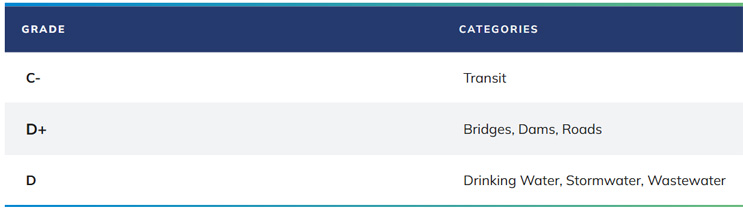
The report card finds that Massachusetts’ infrastructure is aging faster than it is being repaired. Many systems are decades older than their intended design life and are facing extraordinary strain from increasingly severe weather, coastal exposure, and other factors. Recent funding at the federal and state level has helped stabilize some infrastructure assets, particularly in the transportation sector. However, sustained, predictable investment is needed to prevent further deterioration and expand an engineering workforce that is currently not large enough to carry out all necessary projects.
“Massachusetts’ ‘D+’ grade should serve as a call to action that investment is needed now to ensure the Commonwealth has infrastructure systems that are reliable well into the future,” said Boston Society of Civil Engineers Section (BSCES) President Richard A. Matson, PE. “While recent federal and state investment has benefitted families and businesses across Massachusetts, thousands of roads, bridges, pipes, dams, and other infrastructure assets have exceeded their design life by decades. Prioritizing these vital infrastructure systems will protect public safety and drive Massachusetts’ economy.”
Massachusetts’ bridges received a ‘D+’ grade, compared to the national grade of ‘C’. While billions of dollars have been invested to improve bridges across the Commonwealth, bridges are deteriorating faster than they can be repaired. Massachusetts has the oldest bridge inventory in the nation at 65 years. One out of every nine bridge crossings in the state occurs on a bridge that is in poor condition, and more than 500 bridges statewide either have weight restrictions or are closed. MassDOT estimates approximately $1 billion annually over the next decade is needed to address a growing inventory of aging bridges and address a backlog of maintenance projects.
Massachusetts drivers spend countless hours stuck in traffic on crowded roads across the Commonwealth. The ‘D+’ grade for Massachusetts’ roads is the same as ASCE’s national road grade. Road conditions have deteriorated statewide between 2021 and 2024, with 13.1% of local roads in poor condition in 2024, compared to 9.9% in 2021. While 82.2% of state and interstate highways in Massachusetts are in good condition as of 2024, it is a sharp decrease from 90.7% in good condition in 2021. Deteriorating road conditions cost drivers valuable time and money, approximately $3.8 billion every year in added vehicle costs.
Transit systems in Massachusetts received a ‘C-’, the highest grade in the report card, and is the only category that received a better grade than the national report card. People across Massachusetts have benefited from recent improvement projects that have extended rail service, replaced miles of rail lines, and removed areas where trains faced speed restrictions. Despite this progress, the MBTA still has a $24.5 billion backlog of projects to get systems into a state of good repair.
Water infrastructure in Massachusetts is also at a turning point as aging systems threaten their long-term reliability. Drinking water received a ‘D’ grade in the report card. Massachusetts needs more than $15 billion in drinking water investment over the next 20 years to tackle aging pipes, emerging contaminants like PFAS, and lead service line replacement. Wastewater also received a ‘D’ grade because of aging pipes, some of which were installed in the 1800s, and an estimated $21.7 billion in funding needs, according to the Environmental Protection Agency.
Massachusetts’ dams received a ‘D+’ grade largely due to one of the highest average ages in the nation, 111 years. The design life of a dam is typically 75 years, and 208 dams in the Commonwealth were built before 1900.
The report includes three overarching solutions to raise the grade. They are:
- Establish Sustainable, Long-Term Funding Mechanisms: Create predictable transportation, water, wastewater, stormwater, and dam safety funding that keeps pace with rising construction costs and targets the Commonwealth’s growing maintenance backlogs.
- Modernize Regulatory Standards, Project Development, and Performance Metrics: Update permitting, design criteria, asset inventories, and performance metrics so infrastructure projects move faster and are built to withstand today’s climate, safety, and resilience challenges.
- Proactively Invest in Workforce Recruitment and Retention: Invest in recruitment, training, competitive wages, and retention strategies to ensure state and local agencies have the skilled personnel needed to operate, maintain, and improve critical systems.
The report card is a public service to inform citizens and policymakers about the infrastructure needs in Massachusetts. Civil engineers use their expertise and school report card-style letter grades to condense complicated data into an easy-to-understand analysis of Massachusetts’ infrastructure network. ASCE state report cards are modeled after the Report Card for America’s Infrastructure, which is released once every four years.
About the American Society of Civil Engineers
Founded in 1852, the American Society of Civil Engineers represents more than 160,000 civil engineers worldwide and is America's oldest national engineering society. ASCE works to raise awareness of the need to maintain and modernize the nation's infrastructure using sustainable and resilient practices, advocates for increasing and optimizing investment in infrastructure, and improve engineering knowledge and competency. For more information, visit www.asce.org or www.infrastructurereportcard.org and follow us on X (Formerly Twitter), @ASCETweets and @ASCEGovRel.
Source: American Society of Civil Engineers