
Keeping Corrosion At Bay
By T.R. Gregg, Huber Technology, Inc.
A metallically-pure, stress-free surface provides optimum corrosion protection for wastewater treatment plants. Here’s how to get there.
cor·ro·sion /kəˈrōZHən/ the process of impairing or deteriorating; the process of wearing away gradually
A condition such as this — in no way, shape, or form — could be good in a wastewater treatment facility environment.
And that is why so much attention is focused on its prevention, because once it starts, corrosion is a process that cannot be reversed; it can only be prevented, and equipment damaged from it replaced. Because of this, it is an absolute necessity to prevent corrosion at as many points as possible.
It is possible to successfully combat corrosion in wastewater treatment facilities. Huber Technology uses a comprehensive treatment process for the stainless steel from which it manufactures its components to ensure this.
There are many levels of corrosive damage that can attack several materials, including metals and concrete — both of which are key components in wastewater treatment plants. For this exploration, we will focus on the corrosion of metal.
Wastewater treatment plant (WWTP) mechanisms experience two types of corrosion: atmospheric and immersion. These corrosion intensive components include buried piping, handrails, gratings, ladders, electrical junction boxes, clarifier rake arms — basically any metallic mechanism that works within the treatment system, or even just in the vicinity of the channels. The usually present hydrogen sulfide (H2S) has wide-ranging effects in wastewater systems — the most notable cause corrosion and odor problems.
As an example, note that when severe immersion corrosion of components was recently identified in and around the primary and secondary clarifiers at two Army Installation WWTPs, the culprit was identified as H2S in the atmosphere, in addition to moisture and high humidity.
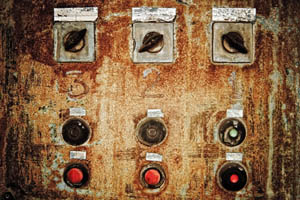
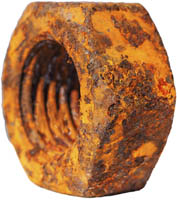
This degraded control panel and rusty nut tell the story of corrosion.
The corrosion problems were mitigated by several actions, including the careful selection and implementation of corrosion-protected treatment system components such as screens and fine screens, grit separators, and screw presses. It has been proven that the installation of components that are already corrosion-protected give the WWTP the highest potential for maintaining a treatment system that is at low risk for corrosion. A low-corrosive environment positions WWTPs for optimum operating condition, reduced maintenance, and increased safety.
“Huber’s fine screens are amazing solutions. They work just as well today as when brand new. Clean as a whistle since day one.” Greg Lemahieu, Oostburg Wastewater Treatment Plant Operator
The metallic components in WWTPs are subjected to a uniquely corrosive environment. In addition to corrosion from H2S, components endure microbiologically-induced corrosion from the microorganisms that thrive in the wastewater as it enters the headworks. They are also corroded by chlorine (Cl) used to treat the wastewater before it is released as clean effluent into creeks and rivers.
Protection Process
The process used to corrosion-protect stainless steel components is as important as the fact that they are treated at all. So the question becomes, “How do you attain optimal corrosion protection?”
The answer: By creating a metallically-pure, stress-free surface that is as smooth as possible.
This requires the elimination of:
- Oxide layers, cinder, and traces of tarnish
- Even trace amounts of other metals
- Chloride, bromide, and iodine ions
- Stresses stemming from mechanical processing
Four surface treatments help to achieve corrosion protection for your surface:
- Blasting requires that the surface be blasted with glass beads, however with this method there is a danger of introducing contamination through the blasting materials.
- Abrasion is a technique where the coarse grain is worn away mechanically. The risk here is the introduction of new surface tension.
- Pickling chemically wears off coarse grain using acid. This process produces spent acid that must be disposed of safely.
- Polishing uses an electrochemical wear-off process where there is a risk of actually wearing away too much of the surface.
When each of the processes is analyzed, pickling rises to the top as the most efficient and least risky process for attaining corrosion protection, and the pickling bath is the superior method for completing the pickling process.
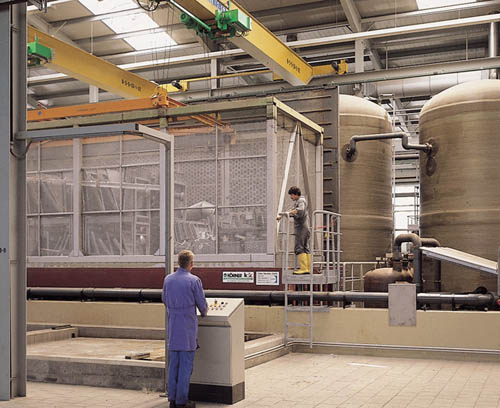
The pickling process creates smooth surfaces that resist corrosion.
Within pickling there are several techniques:
- Spray pickling adds acids and detergents and is best for larger containers and work pieces.
- Pickling paste uses diluent and pickling acid and works well for the treatment of welding joints and local corrosion.
- Surface pickling uses detergents and orthophosphoric acid to treat already pickled surfaces.
- The pickling bath uses pickling acids and detergents to give corrosion protection to complete stainless steel components.
Of these processes, the pickling bath is the most beneficial in a central pickling plant.
The pickling bath produces even treatment into hard-to-reach areas, reduces emission loads and environmental pollution, uses automation that frees the process of human errors, and can be accomplished at a reasonable cost.
To use pickling, the plant must have a qualified and well-trained staff, state-of-the-art installations and wastewater treatment, and the orderly disposal of residual wastes.
How does it happen?
First of all, the stainless steel item gets fully immersed into the pickling bath. When this happens, it is important to observe the concentration of the mixed acids (hydrofluoric acid, nitric acid), the addition of acid-resistant detergent at the exact concentration, and the temperature and duration of the pickling bath.
The All-Important Passive Layer
After each pickling process, it is important to flush the item thoroughly with water. (Drinking water with a Cl content of less than 50 ppm is well-suited for this purpose.) In order to avoid the drying of acid residues (which prevents the formation of a passive layer), all residues of acids have to be removed.
High-pressure washing equipment using cold water is best to use because dissolved cinder and other surface deposits are removed effortlessly and drying the surface too quickly is avoided. (Too-fast surface drying allows stains to form on the surface.)
The oxygen content in the air allows a passive layer with a thickness of about 0.005 µm (five to 10 molecule layers) to be formed. This passive layer is the requirement for the long life of stainless steel.
The ‘Perfect World’ Pickling Plant
Of course, in the perfect world our pickling plant would be ecologically-sound.
With a processing capacity of about 2,500 tons of stainless steel per year, this ideal plant would likely be among the world’s leading stainless steel processing facilities. All finished products made of stainless steel would be required to undergo an appropriate surface treatment, which consists of pickling and passivation of the surface. In order to guarantee a constant and consistent treatment, pickling and passivation would also be required to take place in a pickling bath using the immersion method.
The actual pickling process would take place in a pickling pool with a volume of 45 m³. This pool volume is necessary in order to pickle even the largest items with the bath method.
This pickling bath:
- Produces processing-related material changes;
- Reverses alterations caused by edging, welding, or contact with other materials;
- Eliminates ferritic inclusions, chromium-carbide formations, and changes in the crystalline surface structures; and
- Avoids later-occurring types of corrosion that are associated with stainless steel (in particular intercrystalline corrosion, grain-border corrosion, and contact corrosion).
What Makes Up The Pickling Solution In The Ideal Plant?
The pickling solution would consist of nitric acid and hydrofluoric acid. The nitric acid would cause the oxidation of undesired materials and inclusions, while the hydrofluoric acid would keep the developing oxides in the solution.
The content of the etching bath would be constantly circulated, kept at a constant temperature of 20 to 30°C through a heat exchanger, and kept free of mechanical pollution by the action of a filter.
The pickling bath in the ideal plant always would be kept closed — opened only for loading and unloading. Before the cover is removed, waste air would be sucked off through slots on the side. The waste air would be first cleaned by passing it through filters before it is released into the atmosphere, thus preventing the formation of foul-smelling odors.
In a room next to the pickling plant, the pickled stainless steel items would be passivated and cleaned of acid residues using spray- and steam-pressure installations.
The flushing water would be collected in a collection pool and, later, centrally removed. Before removal, the flushing water would be neutralized with calcium hydroxide. The addition of the neutralization agent would take place in portions, while the pH of the flushing solution is continuously monitored.
Once neutralized, the flushing water would pass through a heavy metal separator where heavy metals are secreted through the action of four consecutive inclined treatment groups that have flocculation compounds (polyacrylamid, polyacrylate) added to them. The heavy metals would then be removed and drained in a chamber filter press. The resulting filter cake would be disposed of in a hazardous waste facility.
Finally, the cleaned wastewater would be taken from the neutralization plant. Once again, the pH of the water would be measured automatically and recorded. Additional samples (examined for their pH values and heavy-metal contents) would be taken discontinuously from the effluent stream. This would guarantee a supplementary running control.
The bottom and the side walls of the entire pickling and passivation bath in this ideal plant would be coated with shock-resistant and acid-proof plastic to shield the water from the bath sprays outside.
The residues that would reach the canalization with the effluent water would comply with regulations:
- Chromium (Cr) ≤ 0,5 mg/L
- Hexavalent chromium (Cr+6) ≤ 0,1 mg/L
- Nickel (Ni) ≤ 0,5 mg/L
- Nitrite (NO2) ≤ 5 mg/L
- Fluorine (F2) ≤ 20,0 mg/L
This ideal pickling plant would require a considerable investment (more than 600,000 discount margin [DM]).
Making this investment in the ideal pickling plant is, however, the only way to achieve a professional, necessary surface treatment of stainless steel that is also ecologically-sound.
The difference in overall performance and durability of products manufactured from treated stainless steel is evident in comments from the plant operators and supervisors using them. Durability for process critical components can, after all, impact the plant’s financial health, operational continuity, and ultimate performance within its municipal network.
“Many of these technologies are similar. I mean, it’s a pretty simple concept. For that reason, you have to look at other qualifiers to make the best choice. The EscaMax was, by far, the preferred fine screen because of its reputation of durability and reliability. It works and keeps working.” Bill Erwin, Greenville Wastewater Treatment Plant Supervisor
“The Huber Screw Press has become the premiere piece of equipment in this plant. If we had known the quality of Huber’s solutions, we would have chosen their fine screens over the ones that we selected a few years ago.” Barton W. Atwood, Water & Wastewater Utilities Foreman
Long-Term Benefits
While some want to believe that stainless steel is stainless steel, treated or not, the track record for components manufactured with adequately and correctly treated stainless steel, such as Huber’s, illustrates quite the opposite. Those who invest in such solutions reap benefits far beyond simple resistance to corrosion. They see smoother operational processes, high and more consistent performance, increased continuity in contribution to their plant and their municipality’s service network, and long-term cost savings.
 T.R. Gregg has a 25-year history in the wastewater treatment technology industry, including 10 years as Huber Technology’s Director of Business Development & Marketing. Huber Technology (www.huber-technology.com) serves the municipal and industrial wastewater treatment market with high-quality liquid-solid separation technology.