
Inside Zero Liquid Discharge Systems: The Technology Driving Industrial Water Reuse
By Raksha Sharma
Zero liquid discharge (ZLD) is evolving from a wastewater-compliance strategy into a high-recovery separation platform built around reverse osmosis (RO), high-pressure membranes, thermal concentration, membrane distillation (MD), crystallization, sensors, and process controls. Its objective is measurable: maximize water recovery while converting dissolved salts into solids rather than producing a final liquid reject.
The global ZLD system market is experiencing robust expansion, valued at USD 12.4 billion in 2025 and projected to reach USD 23.8 billion by 2034, reflecting a compound annual growth rate (CAGR) of 8.7% during the 2026–2034 forecast period, according to MarketIntelo's Zero Liquid Discharge System Market Research Report.
The engineering challenge becomes more severe as total dissolved solids (TDS) increase. RO can recover large water volumes efficiently at moderate salinity, but osmotic pressure rises as dissolved ions accumulate. At higher concentrations, pressure requirements, scaling potential, and concentration polarization increasingly constrain membrane performance. ZLD therefore relies on staged separation rather than a single treatment technology.
RO Creates The First High-Recovery Barrier
RO normally performs the bulk water-recovery function because it separates water without requiring phase change. Feed pressure drives water through a semipermeable membrane while salts and other dissolved constituents are rejected.
The economic value of this stage comes from reducing the volume that must enter energy-intensive downstream equipment. For example, reducing a 100 m³/day concentrate stream to 50 m³/day before thermal treatment cuts the downstream liquid load by 50%. A reduction from 100 m³/day to 30 m³/day would decrease the thermal-treatment volume by 70%.
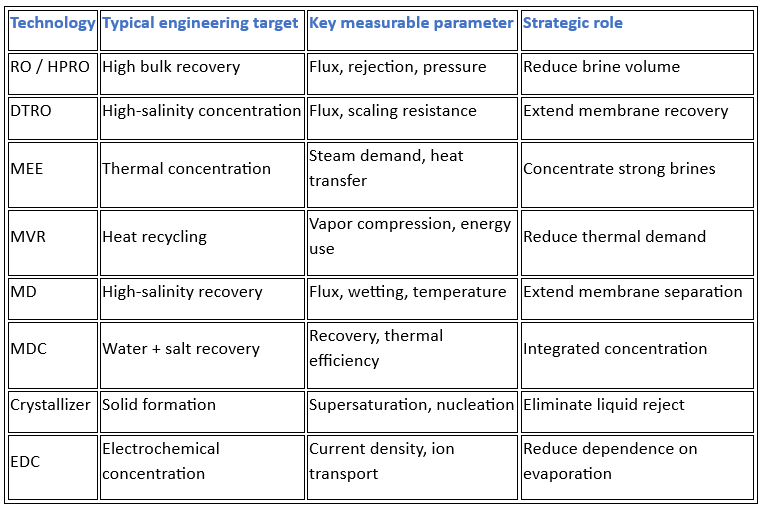
High-pressure RO, disc-tube reverse osmosis (DTRO), and other concentrate-tolerant membrane systems can extend recovery when conventional RO approaches its practical concentration limit. Their key operating metrics include permeate flux, salt rejection, recovery percentage, transmembrane pressure, pressure drop, and normalized performance over time.
Membrane fouling and scaling remain critical because a decline in flux directly reduces production capacity. Calcium sulfate, silica, carbonate minerals, organic compounds, and suspended material can all influence membrane stability. Consequently, pretreatment and real-time monitoring become increasingly important as recovery rises.
Thermal Concentration Handles Stronger Brines
When pressure-driven membranes approach their concentration limits, evaporation becomes more useful. Multiple-effect evaporators reuse vapor from one effect as the heating source for another, reducing the amount of external thermal energy required.
Mechanical vapor recompression (MVR) adds another efficiency mechanism. Generated vapor is compressed to increase its temperature and then reused as a heating medium. This creates an internal heat-recycling loop rather than treating generated vapor as waste.
The critical engineering metric is therefore not simply evaporation capacity but specific energy consumption in kWh/m³. Every cubic meter of water recovered through thermal equipment represents a measurable energy burden. Reducing the volume entering the evaporator can therefore have a disproportionate effect on total ZLD operating cost.
Heat integration can further improve performance. Waste heat from boilers, turbines, furnaces, engines, and industrial process streams can supply part of the thermal requirement, while MVR can recycle latent heat generated within the process.
Membrane Distillation Extends Recovery
Membrane distillation provides another separation pathway for high-salinity streams. A hydrophobic microporous membrane allows water vapor to pass while retaining liquid water and dissolved salts. The driving force is generated by a vapor-pressure difference, commonly produced through a temperature gradient.
Its importance increases when RO becomes constrained by osmotic pressure. MD can process solutions at substantially higher salinity because it does not rely on hydraulic pressure as the primary separation mechanism.
Membrane distillation crystallization (MDC) combines water removal with controlled salt precipitation. Experimental seeded-MDC systems have demonstrated more than 95% water recovery, more than 95.5% salt recovery, and approximately 61.5% average thermal efficiency. Seed crystals can also provide controlled nucleation sites and reduce uncontrolled precipitation on membrane surfaces.
These values demonstrate why MDC is being considered as a bridge between membrane separation and crystallization rather than simply as another desalination membrane.
Crystallization Converts Concentrate Into Solids
Crystallization is the final separation step that enables true liquid-discharge elimination. Instead of concentrating a brine indefinitely, the system pushes dissolved compounds beyond their solubility limits and converts them into solid phases.
The engineering challenge is controlling where and when nucleation occurs. Uncontrolled crystallization can foul membranes, coat heat-transfer surfaces, reduce heat-transfer coefficients, and increase cleaning frequency. Controlled crystallization can instead generate recoverable solids with defined particle characteristics.
Feed composition strongly influences performance. A stream containing predominantly sodium chloride behaves differently from wastewater containing calcium sulfate, silica, carbonates, magnesium, metals, and organic compounds.
The objective is therefore not simply to maximize salt precipitation. Operators must manage supersaturation, nucleation rate, crystal growth, residence time, temperature, recirculation rate, and solids withdrawal to maintain stable operation.
High-Salinity Produced Water Demonstrates The Potential
The performance envelope becomes clearer when ZLD is applied to extremely saline wastewater. Integrated direct-contact membrane distillation and crystallization has demonstrated 98.9% overall water recovery from produced water containing approximately 156,700 mg/L TDS.
The same configuration increased recovery from approximately 42% with standalone DCMD to 98.9% after crystallization was integrated. Crystal formation began at approximately 45.8% water recovery, illustrating the point at which dissolved salts become sufficiently concentrated for precipitation.
The recovered solid phase contained approximately 91% sodium chloride, while calcium sulfate represented less than 5%. Such results show that ZLD can potentially transform a concentrated waste stream into two outputs: recovered water and solid materials.
Economic performance remains equally important. A system may technically achieve near-total liquid elimination but still be unattractive if energy, cleaning, chemical, and maintenance costs are excessive.
ZLD Technology Stack
Energy Is The Critical Performance Metric
A ZLD plant achieving 99% water recovery is not automatically superior to a system achieving 97% recovery. The higher-recovery system may require substantially more energy, chemicals, cleaning, or equipment.
Specific energy consumption in kWh/m³ therefore provides a more meaningful performance indicator when comparing system configurations. Hybrid ZLD configurations combining brine concentration, high-pressure RO, and membrane-promoted crystallization have demonstrated approximately 97.04% water recovery at 17.53 kWh/m³.
This illustrates the central optimization problem: increasing recovery while controlling energy intensity. The best design is the one that minimizes the combined cost of water recovery, thermal energy, membrane replacement, chemical consumption, maintenance, and solids handling.
Electrodialysis Could Reduce Evaporation
Electrodialytic crystallization (EDC) introduces an electrochemical route for concentrating dissolved ions. Electrical potential drives charged species through ion-exchange membranes, allowing concentration and precipitation without depending entirely on thermal evaporation.
Its potential advantage is energy diversification. Instead of supplying the entire separation duty through heat, part of the process can be powered electrically. EDC could therefore complement RO, MD, and crystallization in hybrid ZLD configurations.
The critical parameters include current density, ion transport, membrane selectivity, electrical consumption, concentration factor, and crystal formation rate.
Digital Monitoring Turns ZLD Into A Control Problem
As recovery approaches its upper limit, small chemistry changes can produce large operational consequences. A modern ZLD plant can continuously monitor TDS, conductivity, pH, temperature, pressure, differential pressure, flow, turbidity, oxidation-reduction potential, permeate quality, and membrane performance.
Digital control systems can use these measurements to identify changing saturation conditions before severe scaling occurs. Operators can then modify feed flow, pressure, temperature, antiscalant dosing, cleaning intervals, crystallizer seeding, and recirculation rates.
Predictive control can also connect upstream membrane performance with downstream thermal and crystallization behavior. This creates an integrated operating model instead of treating RO, evaporation, MD, and crystallization as isolated units.
The Next Generation Optimizes The Entire Train
The strongest ZLD systems will not necessarily contain the greatest number of treatment stages. They will optimize measurable variables across the entire process: water recovery, kWh/m³, membrane flux, pressure, chemical consumption, heat recovery, solids production, uptime, and lifecycle cost.
The technology is moving toward integrated systems in which membranes remove the lowest-cost water first, thermal systems handle increasingly concentrated streams, MD extends recovery, and crystallizers convert the final concentrate into solids.
The defining question is no longer simply whether a facility can achieve zero liquid discharge. It is whether it can reach that target while maintaining high recovery, controlled energy intensity, stable membrane performance, predictable crystallization, and useful solid-product quality.
That shift transforms ZLD from an end-of-pipe disposal solution into a quantitative water-resource engineering platform. The future system will be judged not only by how much liquid it eliminates, but by how efficiently it converts every cubic meter of industrial wastewater into recovered water, reusable energy, and potentially valuable solid resources.
Reference: https://marketintelo.com/report/zero-liquid-discharge-system-market
Raksha Sharma is a Principal Analyst at Market Intelo, specializing in market research and business intelligence across healthcare, technology, agriculture, consumer goods, energy, and emerging industries. With an M.Pharm and MBA from NMIMS, she provides data-driven insights into global business trends and industry developments.