
Innovative wastewater plant expansion may include largest tank of its kind in U.S.
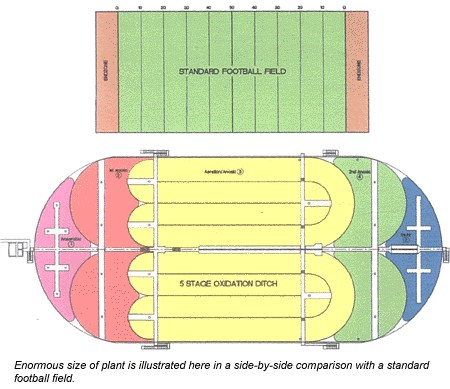
Daytona Beach's latest wastewater treatment expansion included the incorporation of a prestressed concrete structure, which dwarfs a standard football field. The huge structure was built to help accommodate the dramatic flow fluctuations, which occur each tourist season.
A half million or more people have been known to descend upon Daytona Beach, FL, during any single of several well-known events hosted annually. The influx of tourists into this coastal resort city of little more than 70,000 permanent residents can cause severe strains on the town's wastewater treatment system.
The local economy depends on these tourists dollars, so city fathers set out to create a system that was capable of accommodating a seasonal demand of an additional half million people. They commissioned a team of consultants, led by McKim & Creed, to expand and upgrade Westside Regional Wastewater Treatment Plant. The team's solution resulted in the innovative structure, which is one of the entrants this year in the American Society of Civil Engineers' 2001 Outstanding Civil Engineering Achievement Awards Program.
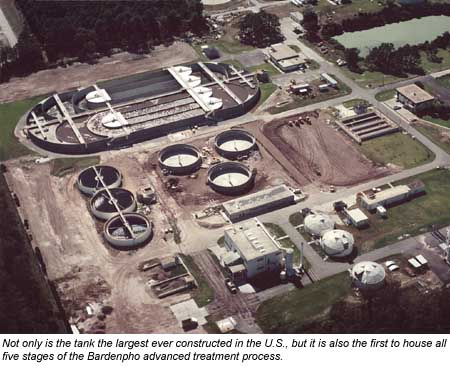
Structure is one of a kind for two reasons
The designers claim the structure is the first of its kind because:
- It includes the largest prestressed elongated tank ever built in the U.S. (538 ft., 8 in. long; 243 ft. wide, 20 ft. tall), and
- It is the first vessel to house all five stages of the Bardenpho™ advanced treatment process in one structure.
According to Director of Public Works Stan Lemke, the expansion provides for logical, economical expansion of the city's wastewater treatment, collection, and disposal facilities for the next 20 years.
Task was to expand capacity and upgrade treatment
The design team was tasked with expanding the existing facility's capacity from 10 to 15 mgd, and upgrading the process to advanced treatment.
To reduce the necessary treatment tank footprint, McKim & Creed designed a tall, compact, single prestressed vessel capable of housing all five stages of the biological nutrient removal process. They specified the prestressed tank because, with its thinner walls and floor, it is more cost-effective than conventional cast-in-place concrete, and it precluded a repeat of the previous problems the city had experienced with leaks in poured-in-place concrete tanks.
Concentrating process in one tank saved $1 million
Concentrating the process in one tank, rather than in several separate structures, the designers explained, not only maximizes the available real estate, but also makes the overall process operate more efficiently, and reduced the project's costs by about $1 million.
The five stages of the advanced treatment process housed in the huge tank include:
Stage 1: Anaerobic zone for biological selector
Stage 2: Anoxic low oxygen zone for nitrogen removal
Stage 3: Oxidation/aeration zone
Stage 4: Anoxic for nitrogen polishing
Stage 5: Reaeration for polishing and dissolved oxygen boost
The reaction zones are arranged in two parallel treatment trains to provide for redundancy. The structure's use of gravity, instead of traditional pumping, precludes the need for the expense of pumping for internal recycle (IRQ), moves the recycle more efficiently, and removes more nitrogen.
Cleaner effluent benefits river and contributes to reuse program
All of this ultimately provides a cleaner effluent, which helps preserve the nearby Halifax River and its marine life as well as making the water safer for contact recreational activities.
The clean effluent also benefits the city's reuse program. The Westside plant is the city's main source of reuse water and recycles, on average, 50 percent of the water it receives and up to 100 percent during dry months. It is used for irrigating golf courses, athletic fields, parks, and flowers, as well as for minor industrial purposes.
SRF low-interest loan helped save money in long run
To finance the expansion, the city originally planned to use revenue bonds but McKim & Creed suggested instead applying for lower-interest State Revolving Funds. Hopping on the fast track, they were able to meet deadlines and the funds were approved saving the city an estimated $3.5 million over the life of the 20-year loan. Final project cost was $17 million, which was $1 million under budget.
For its work on the project, McKim & Creed was awarded a Grand Award from the Florida Institute of Consulting Engineers, and was named Wastewater Consultant of the Year by the Florida Chapter of the American Public Works Association.
Winners of the ASCE award will be announced in April.
By Joyce Everhart
Content Manager, Public Works Online
jeverhart@vertical.net