
Industrialisation Is Putting The World's Water Resources Under Huge Pressure
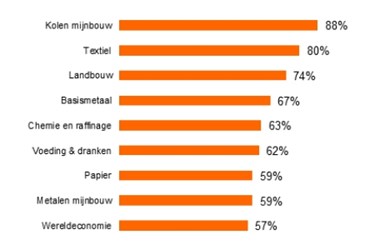
Half of the 60 largest economies face a serious risk of water shortages in the future unless climate policy changes
With consumption expected to grow by 2% a year, demand for fresh water is rapidly approaching the currently available supply. By 2040, this could lead to a gap of 50% between the available (sustainable and reliable) supply of fresh water and demand. If no change is made to climate policy, 29 of the world’s 60 largest economies, countries that currently make up 57% of the world economy, will face a serious risk of water shortages. This emerged from research published recently by the ING Economics Department.
Rising demand for fresh water as a result of industrialisation
As a result of industrialisation, industry around the world is expected to use 4% more water each year in the future. Consequently, industry’s share of global water consumption will rise from 21% to an estimated 38% in 2040. Power stations in particular are driving water consumption and for this reason are increasingly being located on the coast in order to be able to use seawater.
Water-intensive sectors are in countries with a serious risk of ‘water stress’
Agriculture is by far the most water-intensive sector globally, consuming 800 litres of water to add value of $1. In the energy sector the figure is 300 litres and in industry 11 litres. Most production in these sectors takes place in the 29 countries at serious risk of ‘water stress’, meaning that demand for water is at least temporarily greater than supply or that insufficient good quality water is available. For example, 88% of coal mining, 80% of the textile industry and 74% of global agriculture is located in these countries. The traditional conflict between water for energy and water for food will extend to other sectors such as metals and clothing.
Dutch agriculture leads the way in water consumption; energy sector uses relatively large amounts
While agriculture worldwide uses 800 litres of water to create $1 of value, in the Netherlands it uses less; about 7.5 litres. This efficiency cannot be seen in the energy sector, meaning that the Netherlands uses more fresh water per $1 of added value than the global average industrial consumption. As well as lower CO2 emissions, investment in wind and solar power also creates a sharp reduction in water consumption. For more information, visit www.ing.nl/nieuws.
About ING
With over 8.9 million account holders, ING is one of the largest and most prominent financial service providers in the Netherlands. ING is a global financial institution with a strong European base, offering banking services through its operating company ING Bank and holding a significant stake in the listed insurer NN Group N.V. The purpose of ING Bank is empowering people to stay a step ahead in life and in business. ING Bank’s more than 52,000 employees offer retail and commercial banking services to customers in over 40 countries. ING Group shares are listed (in the form of depositary receipts) on the exchanges of Amsterdam (INGA NA, ING.AS), Brussels and on the New York Stock Exchange (ADRs: ING US, ING.N). Sustainability forms an integral part of ING’s corporate strategy, as evidenced by ING Group shares being included in the FTSE4Good index and in the Dow Jones Sustainability Index (Europe and World) where ING is among the leaders in the Banks industry group.
Source: ING