
How To Bring Quiet To Pump And Pipeline Systems
By Johannes Büker and Paul Werner
Modern pumping systems are used in a wide range of industrial and municipal applications. In wastewater treatment, drinking water supply, district heating, and building services, they ensure the transport of fluids under varying load conditions. Requirements such as high availability, energy-efficient operation, and integration into densely populated areas mean that both hydraulic performance and noise and vibration behavior must be considered in system design.
One example is the Greifswald (Germany) wastewater management company, which implemented an adaptive damping system equipped with AI-based counter-phase technology that compensates for pressure waves in real time — comparable to active noise cancellation in headphones — to address long-standing issues with vibrations and noise from the main pumping station and to reduce energy consumption.
The Problem: Noise And Vibration In The Pumping Station
Greifswald’s wastewater management company, designed for 96,000 population equivalents, operates the entire sewer network as well as the treatment plant. The pumping station sits immediately adjacent to residential neighborhoods in the city center and plays a critical role in conveying wastewater to the treatment plant. Five high-performance pedestal pumps are installed: two 55-kW base-load pumps and three 132-kW peak-load pumps.
Despite the importance of reliable conveyance, the plant struggled for years with vibration and noise. Vibrations were clearly perceptible at ground level and inside nearby homes. They were not only annoying — they materially affected the residential environment. Vibration origin could be directly attributed to pump operation. The pumps excited the pressure pipework — and with it the building and surrounding structures. Residents perceived this as a significant nuisance.
The Challenge Of Vibration Transmission
The core of the problem lies in pump physics. Impeller blades create uneven discharge flow into the discharge line, generating periodic pressure fluctuations. These propagate as waves through the liquid into all connected pipelines. The pressure waves excite the pipeline system to vibrate — and radiate as airborne sound inside and outside the pumping station.
Typical effective vibration velocities during pump operation exceeded values considered acceptable for long-term operation of the steel structures. In addition to resident complaints, repeated mechanical damage led the operator to seek further mitigation measures.
Conventional Approaches And Their Limitations
Over the years, various measures were implemented: compensators, elastic supports, structural reinforcements, and adjustments to pump control. These interventions reduced individual symptoms but did not eliminate the fundamental excitation of the pipe system. In order to limit noise emissions, the pumps were increasingly operated in start–stop mode, which reduced efficiency and raised operating costs.
A New System Concept
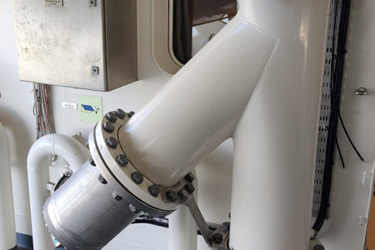
The operator ultimately selected a system developed by Hydronauten GmbH — called QuietHydro — which is based on active damping that directly counteracts pump-induced pressure fluctuations in the pipeline system. Instead of relying solely on elastic elements or Helmholtz resonators, the system uses sensors and actuators in combination with control algorithms. It generates counteracting pressure waves within the hydraulic circuit, analogous to active noise control in headphones but implemented inside the pipework.
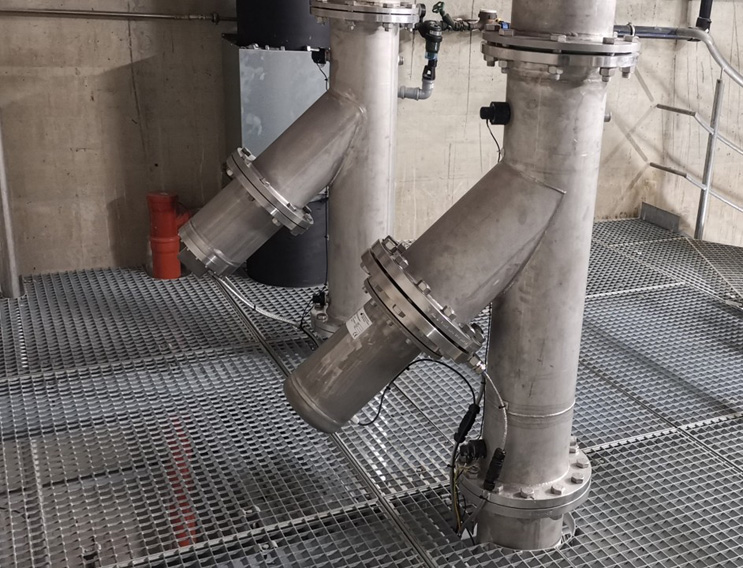
Installed QuietHydro units
Integration And Results In The Greifswald Wastewater Plant
The innovative damping units were installed in the discharge lines of the base-load pumps. Measurements showed that pump-induced pressure waves were reduced by more than 90%. Dominant vibration components near 25 Hz and 50 Hz, previously the main sources of disturbance for residents, were substantially attenuated.
After commissioning, the number of noise-related complaints from residents decreased. The lifetime of pumps and pipelines increased due to lower mechanical stress, according to the operator’s observations.
With the additional implementation of Hydronauten’s AI-supported pump control, measurements at the site indicated energy savings of up to 35%. The algorithm identifies energy-efficient operating points and adjusts the operating speed accordingly while maintaining the required hydraulic performance of the station.
Energy efficiency increased because adaptive damping enables continuous variable-speed operation without exceeding permissible vibration levels. Over the long term, this reduces operating costs and allows more efficient use of the existing infrastructure.
Outlook
In Greifswald, the introduction of adaptive damping technology addressed both the immediate technical issues of vibration and noise and contributed to lower specific energy use at the pumping station. Similar approaches could be examined for other wastewater facilities and pump infrastructures where dynamic pressure fluctuations are critical. Current development work focuses on further improving the efficiency and environmental performance of pump control strategies.
Conclusion
For Greifswald and its residents, the installation has resulted in lower noise and vibration levels and more stable plant operation. The case study suggests that such systems can contribute to operational reliability and energy efficiency and may help reduce operating costs and associated CO₂ emissions in pumping stations, depending on local boundary conditions.
Bibliography
- Büker, J. et al. (2021): Investigation of dynamic pressure fluctuations in closed hydraulic circuits as a function of centrifugal pump speed gradients. IOP Conference Series: Earth and Environmental Science, Lausanne
- Büker, J. et al. (2021): Active noise cancellation applied to a centrifugal pump in a closed loop piping system. Journal: Applied Acoustics. DOI: https://doi.org/10.1016/j.apacoust.2021.108003
- Büker, J. et al. (2021): On the effect of an ANC system towards the transient pressure fluctuations caused by smart-grid controlled centrifugal pumps. Journal: Applied Acoustics. 2023. DOI: https://doi.org/10.1016/j.apacoust.2023.109372