
How Industrial Facilities Are Rethinking Wastewater Treatment And Water Reuse As Discharge Rules And Operating Costs Tighten
By Shammi Thakur
Industrial facilities are under pressure to reduce freshwater consumption, control wastewater discharge costs, and maintain reliable production. Water reuse can help address all three concerns, but recovering water does not automatically make a facility more efficient. Poorly matched treatment systems can increase energy consumption, chemical use, maintenance requirements, and residual-waste disposal costs.
The most effective projects begin with a facility-specific understanding of water quality, discharge obligations, and process demand. Rather than selecting equipment first, operators should identify where wastewater originates, what contaminants it contains, and which applications can use recovered water without compromising product quality, equipment reliability, or compliance.
Map The Discharge Before Buying Equipment
Industrial wastewater requirements depend on the facility’s discharge route, industrial category, and pollutant profile. Facilities that discharge directly to surface waters generally operate under a National Pollutant Discharge Elimination System (NPDES) permit. Facilities sending wastewater to a publicly owned treatment works may instead need to satisfy federal pretreatment requirements, local discharge limits, and conditions established by the receiving utility.¹
The U.S. EPA also establishes industrial Effluent Guidelines for specific industry categories and pollutants. Those standards are technology-based, but they do not prescribe one universal treatment system for every facility. Applicable permits and local requirements determine the limits an operator must meet.²
Regulatory monitoring also matters when evaluating emerging contaminants. EPA’s effluent guidelines program has examined issues including per- and polyfluoroalkyl substances (PFAS) in industrial wastewater. However, the inclusion of an industry or contaminant in a study program does not, by itself, establish a new enforceable discharge limit. Operators should distinguish proposed or ongoing regulatory work from requirements already applicable to their facilities.³
Before selecting treatment technology, establish a reliable baseline:
- Measure water flows: Record intake, process consumption, wastewater generation, cooling-tower blowdown, cleaning losses, and seasonal variations.
- Characterize wastewater: Test relevant parameters such as pH, total dissolved solids, suspended solids, organic loading, nutrients, oils, metals, and industry-specific contaminants.
- Identify variability: Account for production changes, equipment cleaning, batch operations, chemical changeovers, and occasional high-strength wastewater streams.
- Confirm discharge obligations: Document permit limits, pretreatment conditions, sampling requirements, and restrictions on the receiving sewer or water body.
- Match supply with demand: Identify where recovered water could replace freshwater, such as utility systems, cooling towers, floor washing, or suitable process applications.
Source segregation deserves particular attention. A relatively clean cooling-water stream should not automatically be combined with concentrated process wastewater if doing so increases the volume and complexity of treatment. Separating streams at the source can preserve more reuse options and reduce the treatment burden.
The objective is to understand both the quality of water available for recovery and the quality required by its next use. That distinction determines the appropriate treatment train.
Design Treatment Around The Reuse Application
Different industrial applications require different water characteristics. Cooling towers may tolerate some dissolved constituents under controlled operating conditions, while boiler feedwater and high-purity manufacturing processes can require extensive contaminant removal. Reusing water successfully therefore depends on matching treatment performance to the application rather than pursuing the highest possible purity in every case.
A treatment train may combine several stages. Equalization tanks help manage flow and concentration swings. Oil separation, pH adjustment, and solids removal can protect downstream equipment. Biological treatment can reduce biodegradable organic loads, while membrane filtration, reverse osmosis, and disinfection may provide additional quality control where the reuse application requires them. Not every facility needs every stage.
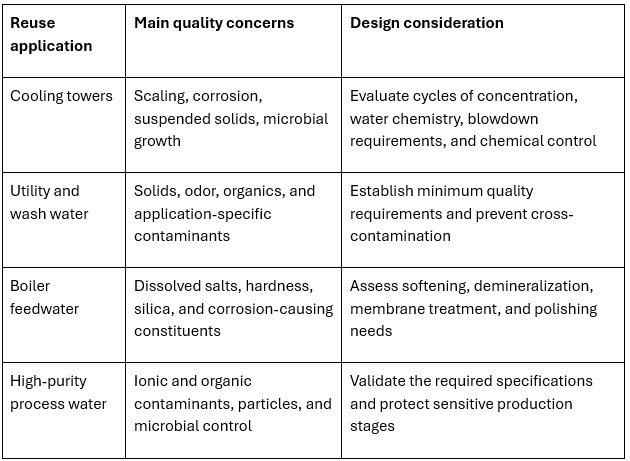
A full-scale case study published in Water Practice & Technology in 2026 illustrates how application-led design can work in practice. At a petrochemical complex in Tarragona, Spain, operators blended reverse-osmosis permeate from reclaimed municipal wastewater with river water at proportions of up to 40% for cooling-tower makeup. The reported operating results included an increase in cooling-tower cycles of concentration from four to as many as seven, a 22% reduction in total makeup-water demand, and a 50% reduction in blowdown. The study also reported controlled corrosion and microbiological conditions under the conditions evaluated.⁴
Those results demonstrate a potential operational benefit, not a guaranteed performance level for other sites. Wastewater composition, cooling-system design, climate, source-water characteristics, and chemical-treatment practices can all change the outcome. Facilities should verify performance through testing and, where appropriate, a pilot or controlled operating trial before committing to full-scale deployment.
A broader industry estimate illustrates the scale of investment in membrane-based treatment. Vyansa Intelligence’s Global Membrane Water and Wastewater Treatment Market Report estimates the sector at USD 8 billion in 2025 and projects it to reach USD 12.85 billion by 2032, representing a compound annual growth rate of 7%. Reverse osmosis accounts for an estimated 35% of the product-category share.⁷ These figures cover membrane treatment across multiple applications, including municipal treatment, industrial process water, and desalination, rather than industrial water reuse alone. They provide broader industry context but do not establish the suitability or economic value of reverse osmosis for an individual facility.
Operators also need to account for what treatment leaves behind. Reverse osmosis concentrates dissolved constituents into a smaller residual stream. That concentrate still requires a suitable management route, which may include further treatment, recovery, permitted discharge, or off-site disposal. Zero liquid discharge (ZLD), which aims to eliminate liquid waste discharge through additional concentration and recovery steps, can be appropriate in some settings. It should not be treated as the default solution: evaporation, crystallization, energy consumption, maintenance, and solids handling can significantly increase operating complexity.
Evaluate Reuse As A Long-Term Operating Decision
Water reuse should be evaluated across the life of the system, not simply by comparing equipment quotations. A sound business case accounts for capital expenditure, energy, treatment chemicals, membrane replacement, cleaning, labor, sampling, residual-waste management, maintenance downtime, and future upgrades. Potential savings include lower freshwater purchases, reduced wastewater volumes, avoided discharge costs where applicable, and improved resilience during supply constraints.
The wider U.S. industrial water treatment sector provides useful context for these decisions. A September 2026 industry estimate from Markntel Advisor places the U.S. industrial water treatment sector at USD 10.27 billion in 2026, with a projected value of USD 12.85 billion by 2032, representing a CAGR of 3.8%. Water treatment chemicals account for approximately 41% of offering share, while power generation represents 25% of end-use share.⁶
Those figures cover industrial water treatment broadly, not water reuse alone, and they do not predict the return on any individual project. They nevertheless reinforce why operators should assess recurring treatment requirements alongside initial equipment costs. Chemical demand, cooling-system operations, and ongoing monitoring can materially affect lifecycle economics, even when a system performs well during commissioning.
Policy developments also signal increased attention to reuse. In April 2026, EPA released Water Reuse Action Plan 2.0, an initiative supporting water reuse across industry, technology, and energy applications.⁵ The plan provides a broader policy context for evaluating reuse opportunities; it should not be mistaken for a new industrial discharge regulation or a substitute for checking applicable permits.
Facilities can make a more defensible investment decision by following a staged approach:
- Establish the baseline. Calculate current freshwater use, wastewater volume, treatment costs, and the variability of both supply and demand.
- Choose a practical first application. Start with a reuse opportunity whose water-quality requirements can be met reliably, rather than designing for every possible use at once.
- Validate treatment performance. Test representative wastewater conditions and assess whether output quality remains acceptable during production changes and system disturbances.
- Calculate the cost per usable unit of water. Include energy, chemicals, maintenance, monitoring, residual management, and downtime. Compare the result with the cost and reliability of the existing supply.
- Build in operational safeguards. Define quality limits, monitoring frequency, alarms, diversion logic, backup supply arrangements, and the response to off-specification water.
- Review results after commissioning. Compare actual recovery rates, chemical use, energy consumption, water savings, and maintenance requirements against the assumptions used in the investment case.
Monitoring should continue after commissioning. Flow meters, conductivity measurements, pressure differentials, pH, and application-specific quality indicators can help detect performance changes before they cause production problems. Operators should also review chemical dosing, membrane cleaning frequency, and residual volumes against expected values. Early intervention can prevent a modest deterioration in water quality or recovery from developing into a costly operating issue.
Make Reuse Fit The Plant
Industrial water reuse is most effective when compliance, engineering design, and operating economics are treated as connected decisions. A system that produces the right water quality but consumes excessive energy, creates difficult-to-manage concentrate, or struggles with fluctuating wastewater loads may deliver limited practical value.
Facilities should begin with a verified water balance, confirm the limits that apply to each discharge and reuse route, and test treatment performance against the demands of the intended application. Lifecycle costing should then determine whether the proposed recovery system offers a credible advantage over current practice.
The aim is not to recover every possible gallon at any cost. It is to recover water where the quality, reliability, compliance position, and operating economics make reuse a durable part of the facility’s water-management strategy.
References:
- U.S. Environmental Protection Agency. “NPDES Permit Limits.” https://www.epa.gov/npdes/npdes-permit-limits
- U.S. Environmental Protection Agency. “Learn About Effluent Guidelines.” https://www.epa.gov/eg/learn-about-effluent-guidelines
- U.S. Environmental Protection Agency. “Preliminary Effluent Guidelines Program Plan.” https://www.epa.gov/eg/preliminary-effluent-guidelines-program-plan
- Gilabert-Oriol, G., Massons, G., and Montserrat, D. “Wastewater Reuse for Industrial Cooling Towers: A Full-Scale Case Study.” Water Practice & Technology, 21(5), 2061–2071, 2026. https://doi.org/10.2166/wpt.2026.290
- U.S. Environmental Protection Agency. “Water Reuse Action Plan 2.0.” Released April 16, 2026. https://www.epa.gov/waterreuse/water-reuse-action-plan-20
- Markntel Advisor. “U.S. Industrial Water Treatment Market Research Report: Trends, Forecast & Opportunities (2026–2032).” September 2026. https://www.marknteladvisors.com/research-library/us-industrial-water-treatment-market-study.html
- Vyansa Intelligence. Global Membrane Water and Wastewater Treatment Market Report: Trends, Growth and Forecast (2026–2032). https://www.vyansaintelligence.com/industry-report/membrane-water-wastewater-treatment-market-forecast
 Shammi Thakur is Research Director at Vyansa Intelligence, where he works on industry research, technology trends, and strategic analysis. His work covers industrial technologies, infrastructure, and sustainability-related developments, translating complex market and operational issues into evidence-based insights for decision-makers across diverse sectors.