
How Automation And Smart Food Processing Equipment Are Reshaping Water Efficiency Across Global Manufacturing Plants
The Digital Transformation of Water Management
Water is one of the most valuable resources in global food and beverage manufacturing. It supports critical operations including ingredient preparation, food processing, equipment sanitation, cooling, steam generation, and quality control. However, increasing water scarcity, rising utility costs, and stricter environmental regulations are encouraging manufacturers to adopt advanced technologies that improve water efficiency.
Modern food processing plants are moving beyond traditional water management practices based on manual monitoring and fixed consumption patterns. Automation, artificial intelligence (AI), Industrial Internet of Things (IIoT), robotics, and smart processing equipment are creating intelligent manufacturing environments where water usage can be measured, analyzed, and optimized in real time.
Research by Market Intelo highlights that, the global food processing equipment market is valued at $115.6 billion in 2025 and is projected to reach $178.9 billion by 2034, representing a steady compound annual growth rate (CAGR) of 6.3% throughout the forecast period. This expansion reflects increasing investments in automated production lines, intelligent processing systems, and resource-efficient manufacturing technologies. As food manufacturers modernize their facilities, smart equipment integrated with water monitoring, AI-driven controls, and automation capabilities is becoming essential for improving operational efficiency and reducing environmental impact.
Research indicates that beverage manufacturing can require approximately 1.7 to 4.2 liters of water to produce one liter of packaged beverage, depending on production processes, cleaning requirements, and operational efficiency. These numbers highlight the urgent need for intelligent solutions that reduce water intensity while maintaining food safety standards.
Smart Food Processing Equipment Enabling Water Optimization
Traditional food manufacturing facilities often depend on manual inspections, fixed cleaning schedules, and operator adjustments for controlling water usage. These approaches can lead to overconsumption because they do not respond dynamically to changing production conditions.
Smart food processing equipment addresses these challenges by integrating advanced technologies such as:
- IoT-enabled water flow sensors
- Automated valves and pumps
- AI-powered process monitoring
- Digital twin systems
- Smart Clean-in-Place (CIP) solutions
- Cloud-based analytics platforms
These technologies allow machines to automatically adjust water supply according to production requirements. For example, intelligent flow sensors can identify unusual water consumption patterns caused by leaks, equipment failures, or inefficient processes.
A manufacturing plant processing thousands of tons of food products annually can save millions of liters of water by identifying small inefficiencies across multiple production stages. Automated monitoring converts water from an uncontrolled expense into a measurable production resource.
Artificial Intelligence Improving Water Decision-Making
Artificial intelligence is becoming a major driver of water efficiency in smart factories. AI systems analyze large volumes of operational data collected from production equipment and provide recommendations for reducing unnecessary consumption.
AI algorithms evaluate factors including:
- Production speed
- Equipment performance
- Water pressure
- Temperature conditions
- Cleaning requirements
- Wastewater quality
For example, AI-powered CIP systems can determine the exact cleaning duration and water volume required for different equipment. Traditional systems often use excessive water because cleaning cycles are based on fixed assumptions rather than actual conditions.
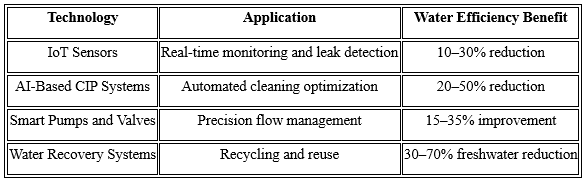
AI-based optimization can improve industrial resource efficiency by approximately 15% to 35%, depending on facility design and process complexity. These improvements help manufacturers reduce operational expenses while supporting sustainability goals.
Automated CIP Systems Reducing Water Consumption
Cleaning-in-Place systems are among the largest water-consuming operations in food and beverage manufacturing. Processing tanks, pipelines, mixers, and filling equipment require frequent cleaning to prevent contamination and maintain regulatory compliance.
Conventional CIP systems typically follow predetermined cleaning cycles, which may result in unnecessary water usage. Smart CIP technology improves efficiency by using sensors and automation to control:
- Cleaning temperature
- Chemical concentration
- Water pressure
- Rinse duration
- Recovery cycles
Advanced CIP solutions can reduce water consumption by 20% to 50% compared with traditional cleaning methods. For large-scale beverage and dairy plants, these savings can represent millions of liters of conserved water annually.
By optimizing cleaning procedures, manufacturers achieve both operational efficiency and improved environmental performance without compromising food safety.
IoT-Based Monitoring Creating Water-Smart Factories
Industrial Internet of Things technology is transforming how manufacturers understand and control water usage. Connected sensors installed throughout production facilities provide continuous information about water consumption, equipment performance, and recycling opportunities.
IoT monitoring systems help identify:
- Excessive water consumption
- Hidden leaks
- Equipment inefficiencies
- Wastewater trends
- Recycling opportunities
Real-time dashboards allow plant managers to make faster decisions based on accurate operational data. Instead of waiting for monthly utility reports, manufacturers can immediately identify problems and implement corrective actions.
Studies show that digital monitoring systems can help industrial facilities achieve 10% to 30% water savings by improving visibility and controlling unnecessary consumption.
Robotics Improving Manufacturing Precision
Robotics is expanding beyond packaging and assembly applications. In modern food processing facilities, robotic systems are improving resource efficiency through precision-based operations.
Automated washing robots can control spray patterns, pressure levels, and cleaning movements to ensure that only necessary areas receive water. This reduces waste caused by inconsistent manual cleaning methods.
Robotic processing systems also improve production accuracy by reducing material losses. Lower product waste means fewer resources are required for processing, cleaning, and disposal activities.
Smart packaging automation further reduces contamination risks, which decreases the frequency of intensive sanitation operations.
Water Recovery and Circular Manufacturing Systems
Smart manufacturing is also accelerating water recycling and reuse practices. Instead of treating wastewater as a disposal problem, advanced facilities are adopting circular water management approaches.
Common technologies include:
- Reverse osmosis systems
- Membrane filtration
- Automated wastewater monitoring
- Condensate recovery
- Closed-loop cooling systems
These solutions allow manufacturers to recover and reuse water for secondary applications. Depending on process design, water recycling systems can reduce freshwater demand by 30% to 70%.
For example, recovered water from cooling operations can be reused for equipment washing, cleaning external surfaces, or other non-product contact applications.
Technology Impact on Water Efficiency in Food Manufacturing
The Future of Intelligent Water Management
The next generation of food manufacturing plants will rely on autonomous water management systems powered by AI, automation, and advanced analytics. Digital twins, predictive maintenance, and machine learning platforms will enable factories to simulate processes, identify inefficiencies, and continuously improve performance.
Future smart factories will combine production automation with sustainability intelligence, allowing manufacturers to increase output while reducing environmental impact.
Digital transformation will also support better compliance with global sustainability standards by providing accurate water consumption reports, environmental performance tracking, and automated resource management.
Human-Centered Smart Manufacturing
Although automation is transforming food production, human expertise remains essential. Smart technologies provide employees with accurate information, allowing them to focus on improving processes rather than manually monitoring equipment.
Operators can use digital dashboards to identify problems quickly, optimize workflows, and support sustainability initiatives. The combination of human decision-making and intelligent technology creates safer, more efficient, and environmentally responsible manufacturing environments.
Building Sustainable Food Manufacturing Systems
Automation and smart food processing equipment are reshaping water efficiency across global manufacturing plants. Through AI, IoT monitoring, robotics, and advanced recycling technologies, manufacturers can reduce waste, improve productivity, and manage water resources more responsibly.
As global demand for processed food continues to increase, efficient water management will become a competitive advantage. The future of food manufacturing will depend on intelligent systems where every drop of water is monitored, optimized, and reused, creating a more sustainable and resilient food production ecosystem.
Reference: https://marketintelo.com/report/food-processing-equipment-market
Source: Market Intelo