
How AI-Powered Predictive Maintenance Is Reducing Downtime In Water Treatment Plants
Water treatment plants are under growing pressure to deliver uninterrupted, high-quality water while operating with aging infrastructure, tighter regulatory standards, and rising energy costs. A single unexpected failure of a high-capacity pump, blower, membrane system, or chemical dosing unit can interrupt treatment processes, increase operating costs, and risk environmental compliance.
Artificial intelligence (AI)-powered predictive maintenance is changing this operational model. Rather than relying on fixed maintenance schedules or reacting to equipment failures after they occur, utilities are now using machine learning, Industrial Internet of Things (IIoT) sensors, and predictive analytics to identify potential failures days or even weeks before they happen.
Industry research shows that AI-enabled predictive maintenance can significantly reduce unplanned downtime, improve equipment reliability, optimize maintenance budgets, and increase treatment plant efficiency through continuous monitoring of operational assets.
DataIntelo research indicates that, the global digital twin for water treatment plants market size reached USD 1.32 billion in 2024. The market is experiencing robust expansion, supported by a compelling CAGR of 15.7% from 2025 to 2033. By the end of 2033, the market is projected to attain a value of USD 4.78 billion. This rapid growth reflects increasing investment in AI-driven asset management, predictive maintenance platforms, Industrial IoT (IIoT) infrastructure, and digital twin technologies that help utilities reduce downtime, optimize maintenance schedules, and improve operational efficiency across water treatment facilities.
Why Traditional Maintenance No Longer Works
Most water treatment facilities still depend on one of two maintenance approaches:
- Reactive maintenance (repair after failure)
- Preventive maintenance (scheduled inspections)
Although preventive maintenance is an improvement over reactive repairs, it often results in unnecessary component replacement or fails to detect unexpected degradation occurring between inspection intervals.
For example:
- Pump bearings may deteriorate gradually.
- Aeration blowers develop abnormal vibration.
- Reverse osmosis membranes begin fouling.
- Chemical dosing pumps lose calibration.
- Valve actuators experience torque fluctuations.
Without continuous monitoring, these issues often remain invisible until they trigger operational disruptions.
The Rise Of AI-Powered Predictive Maintenance
Predictive maintenance combines AI algorithms with real-time operational data collected from thousands of sensors installed throughout a treatment plant.
Typical monitored parameters include:
- Vibration
- Motor current
- Temperature
- Pressure
- Flow rate
- Acoustic emissions
- Energy consumption
- Pump efficiency
- Membrane differential pressure
- Dissolved oxygen trends
Machine learning models continuously compare current equipment behavior with historical operating patterns.
Instead of waiting for failure, the AI identifies subtle anomalies that indicate component degradation.
This transforms maintenance from calendar-based servicing into condition-based decision-making.
Core Technologies Behind AI Maintenance
Modern predictive maintenance platforms integrate multiple Industry 4.0 technologies.
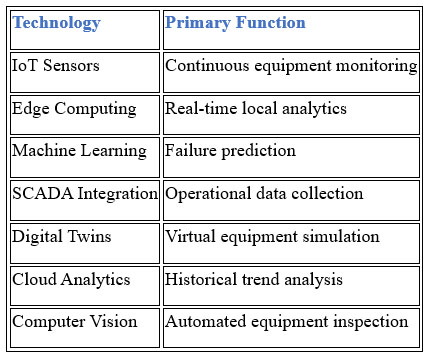
Together, these technologies enable operators to detect equipment abnormalities before production is affected.
How Machine Learning Predicts Equipment Failure
AI systems learn from years of maintenance records alongside operational sensor data.
Typical workflow:
- Continuous sensor monitoring
- Data cleaning and normalization
- Feature extraction
- Pattern recognition
- Remaining Useful Life (RUL) estimation
- Maintenance recommendation
For instance, if an aeration blower consistently exhibits:
- increasing vibration,
- higher motor temperature,
- declining airflow efficiency,
the AI estimates the probability of bearing failure and recommends maintenance during planned shutdowns.
Recent studies demonstrate that AI models combining LSTM neural networks, CNN architectures, and transformer models can predict equipment degradation several days in advance while improving maintenance planning accuracy.
High-Value Equipment For Predictive Maintenance
Water treatment facilities contain numerous mission-critical assets.
These include:
- High-lift pumps
- Raw water pumps
- Booster pumps
- Aeration blowers
- Clarifier drives
- Chemical dosing systems
- Membrane filtration units
- UV disinfection equipment
- Sludge dewatering centrifuges
- Motor control centers
- Variable frequency drives (VFDs)
AI prioritizes maintenance activities based on equipment criticality and operational risk rather than simply following maintenance calendars.
Business Benefits Beyond Downtime Reduction
Predictive maintenance generates measurable operational improvements.
Benefits include:
- Reduced emergency repairs
- Improved plant availability
- Lower maintenance costs
- Better asset utilization
- Extended equipment lifespan
- Reduced spare inventory
- Higher energy efficiency
- Improved regulatory compliance
- Greater workforce productivity
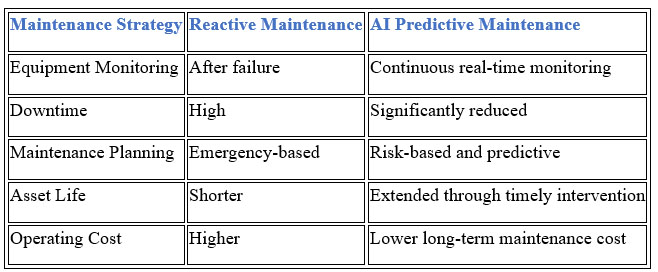
Research has reported maintenance cost reductions exceeding 25%, earlier fault warnings, improved treatment compliance, and lower energy and chemical consumption through AI-enabled optimization.
Small Comparison Table
AI Detects More Than Mechanical Failures
Modern AI platforms monitor entire treatment processes rather than only rotating equipment.
Examples include:
Membrane Fouling Prediction
AI tracks pressure differential, permeate flow, and conductivity to predict membrane cleaning requirements before filtration performance declines.
Pump Cavitation Detection
Machine learning detects abnormal vibration signatures associated with cavitation long before physical damage occurs.
Chemical Dosing Optimization
Predictive algorithms correlate water quality fluctuations with dosing system performance to identify calibration drift.
Energy Optimization
AI identifies inefficient pump operation, blower overloading, and excessive power consumption while maintaining treatment performance.
Digital Twins Enhance Predictive Maintenance
Many advanced water utilities now deploy digital twins alongside AI.
A digital twin creates a virtual replica of the treatment plant using real operational data.
Operators can:
- simulate equipment failures,
- evaluate maintenance scenarios,
- forecast asset degradation,
- optimize maintenance schedules, and
- test operational changes without disrupting production.
This combination significantly improves maintenance decision-making while reducing operational risk.
Challenges Utilities Must Overcome
Despite its advantages, predictive maintenance implementation requires careful planning.
Common challenges include:
- Legacy equipment lacking sensors
- Poor historical maintenance records
- Data quality issues
- Cybersecurity requirements
- Integration with existing SCADA systems
- Workforce training
- Initial implementation costs
Utilities that establish strong data governance and phased deployment strategies typically achieve faster returns on investment.
Future Outlook
The next generation of predictive maintenance will integrate:
- Generative AI maintenance assistants
- Autonomous inspection robots
- Drone-based infrastructure inspection
- Explainable AI for operator confidence
- Federated learning across multiple treatment facilities
- Self-optimizing maintenance scheduling
- Carbon-aware operational optimization
As sensor costs continue to decline and computing power becomes more accessible, AI-powered predictive maintenance is expected to become a standard capability in both municipal and industrial water treatment plants.
Moving Toward Intelligent Water Operations
Artificial Intelligence is transforming maintenance from a reactive operational expense into a strategic reliability function. By continuously analyzing equipment health, operational trends, and process performance, AI enables utilities to anticipate failures before they disrupt operations. The result is reduced downtime, improved asset longevity, lower maintenance costs, enhanced regulatory compliance, and more resilient water treatment infrastructure. As digital transformation accelerates across the water sector, predictive maintenance will play an increasingly central role in delivering efficient, sustainable, and uninterrupted treatment operations.
Reference: https://dataintelo.com/report/digital-twin-for-water-treatment-plants-market
Source: DataIntelo