
Hanyang University Researchers Reveal How PFAS Chain Length Influences Environmental Fate And Water Treatment
Short-chain PFAS move farther in water and resist treatment, offering a new roadmap for safer drinking waterPFAS, often called “forever chemicals,” are a growing global concern because they persist in water, are difficult to remove, and have been linked to health risks, including certain cancers. A new review by researchers from Hanyang University shows that the length of a PFAS molecule’s fluorinated carbon chain is a key predictor of its environmental behavior and treatment response. The study found that short-chain PFAS are generally more mobile and harder to remove, providing a practical framework for improving water treatment and contamination cleanup.
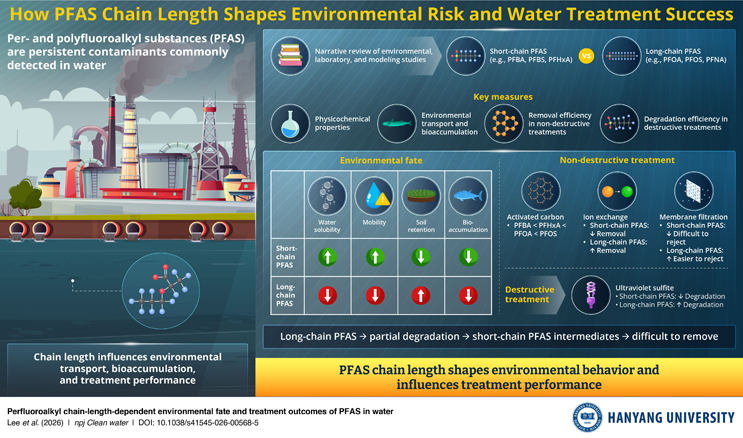
PFAS, often called “forever chemicals,” do not all behave the same way in water. The length of a PFAS molecule's fluorinated carbon chain can influence how far it travels, where it accumulates, and how easily it can be removed. Understanding these differences could help improve water treatment technologies and support efforts to reduce PFAS contamination in drinking water and the environment.
Per- and polyfluoroalkyl substances (PFAS), often referred to as “forever chemicals,” are among the most persistent contaminants found in water systems worldwide. Their strong carbon–fluorine bonds make them highly resistant to degradation, allowing them to remain in the environment for long periods. While PFAS are often treated as a single group of pollutants, growing evidence suggests that differences in their molecular structure can significantly influence both their environmental behavior and their response to treatment technologies.
In a new review, a team of researchers led by Professor Eilhann E. Kwon from Hanyang University, South Korea, examined how the length of a PFAS molecule’s fluorinated carbon chain affects its environmental fate and treatment outcomes. By synthesizing findings from environmental, laboratory, and modeling studies, the researchers sought to identify patterns that could help improve PFAS monitoring, remediation, and water treatment strategies. Their findings were made available online on 5 March 2026 and have been published in Volume 9 of the journal npj Clean Water.
“PFAS, often referred to as ‘forever chemicals,’ should not be viewed as a single uniform group,” said Prof. Kwon. “The length of the fluorinated carbon chain controls behavior of PFAS in water.”
PFAS have become a growing concern because they persist in the environment and are difficult to remove once released. However, thousands of PFAS compounds exist, making it challenging to predict their behavior and identify the most effective treatment approaches.
To address this challenge, the researchers reviewed studies comparing short-chain and longchain PFAS across environmental settings and treatment technologies. The review evaluated physicochemical properties, environmental transport, bioaccumulation, removal efficiency in non-destructive treatment processes, and degradation efficiency in destructive treatment systems. Technologies examined included activated carbon adsorption, ion exchange, membrane filtration, and advanced destruction methods designed to break down PFAS molecules.
The analysis revealed clear differences between short-chain and long-chain PFAS. Long-chain compounds tend to bind more strongly to sediments, organic matter, and biological tissues, increasing their potential for environmental accumulation. At the same time, these stronger interactions generally make long-chain PFAS easier to capture using conventional treatment materials. In contrast, short-chain PFAS remain more soluble in water and can travel farther through rivers, groundwater, and drinking-water systems, making them more difficult to remove and degrade.
These findings are particularly important because many short-chain PFAS are increasingly being used as replacements for older long-chain compounds. Understanding chain-lengthdependent behavior could help utilities and remediation projects select more effective treatment approaches.
“Over the next 5 to 10 years, this knowledge can support more predictive and customized water treatment systems that can capture and destroy a broader range of PFAS, including the short-chain compounds,” said first author Dr Youn-Jun Lee.
As regulations continue to evolve and new PFAS compounds emerge, treatment systems may need to move beyond one-size-fits-all approaches and become more tailored to molecular characteristics.
“Our work suggests that treatment strategies should be designed based on the molecular structure of PFAS, especially chain length,” said Dr Lee.
Although treatment performance can vary depending on local conditions, the findings highlight chain length as a useful framework for understanding PFAS behavior and improving future treatment strategies.
Reference
Title of original paper: Perfluoroalkyl chain-length-dependent environmental fate and treatment outcomes of PFAS in water Journal: npj Clean Water DOI: https://doi.org/10.1038/s41545-026-00568-5
About Hanyang University
Hanyang University traces its roots back to 1939 when the Dong-A Engineering Institute was established. By 1948, the institute had transformed into the nation’s first private university, evolving into Hanyang University in 1959. At its core, Hanyang University upholds the Founding Philosophy of “Love in Deed and Truth,” and its mission is to provide practical education and professional training to future experts and leaders. With a rich history spanning nearly a century, Hanyang University continues to uphold its core values while adapting to the evolving landscape of education and research, both domestically and internationally. Website: https://www.hanyang.ac.kr/web/eng
About the authors
Prof. Eilhann E. Kwon is a Professor in the Department of Earth Resources and Environmental Engineering at Hanyang University. He currently serves as an editor of the Chemical Engineering Journal. He was named a Highly Cited Researcher in the Cross-Field category in 2020 and 2021. He was elected as a member of the Korean Academy of Science and Technology in 2022. His group develops sustainable environmental technologies, including waste-to-energy conversion, catalysis, and water treatment.
Dr. Youn-Jun Lee is a postdoctoral researcher in the Department of Earth Resources and Environmental Engineering at Hanyang University. His research interests include advanced oxidation processes and environmental nanotechnology.
Source: Hanyang University