
Geomembrane Liner Selection For Municipal Wastewater Lagoons: HDPE vs. LLDPE vs. RPP — A Field Installer's Perspective
By Mark Potts
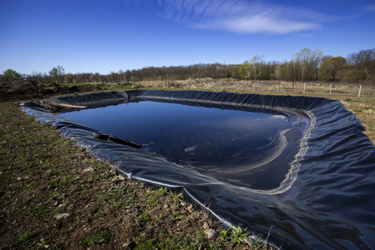
My first job in this industry was as a field supervisor in 1981. I spent the next seven years on liner install crews before moving into project management, and that time in the field, rolling out panels, fusion-welding seams, working around weather that didn't care about the schedule, still shapes how I think about material selection and installation quality today.
Municipal wastewater engineers specifying a lagoon liner for a stabilization pond, aerated lagoon, equalization basin, or sewage lagoon work from a construction specification: thickness, material type, texture, color, seam requirements, often written to U.S. EPA and Natural Resources Conservation Service (NRCS) design guidance. Those specs exist for good reason. What I want to add here is what does not show up on the spec sheet, how these materials actually behave once a crew is standing on them, in real weather, on real ground.
Why The Material Matters, Not Just The Spec
High-density polyethylene (HDPE), linear low-density polyethylene (LLDPE), reinforced polypropylene (RPP), and reinforced polyethylene (RPE) all show up on municipal wastewater and manure lagoon liner projects, along with companion materials like geosynthetic clay liner (GCL) and, on the earthwork side, the dirt and rock that round out the lagoon containment system. Each of these lagoon liners has a place, and the differences aren't just chemistry on a datasheet; they show up physically on site.
One of the clearest examples is how a material handles contours. RPP and RPE lay down against irregular grades and side-slope contours far more readily than HDPE does. HDPE, by comparison, tacks and holds much more easily when a crew is moving material up a containment slope, so on projects with complex geometry, that flexibility difference is often the deciding factor, independent of chemical resistance or cost.
Working With The Ground, Not Against It
Subgrade preparation isn't typically the scope of geomembrane line installers, that's handled upstream of us, but subgrade quality determines almost everything about how an installation goes. A good work site starts with a subgrade free of standing water and mud; when groundwater infiltrates, and on many lagoon sites it will, the crew has to pump it out and line around the wet area rather than over it, which changes sequencing and can add real time if it isn't planned for.
Weather is the other constant. You cannot fusion-weld a geomembrane seam in the rain, full stop, and you cannot seam below 32 degrees Fahrenheit unless trial welds, done on-site under the actual ambient conditions, demonstrate a passing sample first. None of this is exotic knowledge, but it's the difference between a schedule that holds and one that doesn't, and it's a big part of why experienced crews matter as much as the material spec itself.
Reading The Material
Every geomembrane expands and contracts with temperature, and the rate is different for every material. After enough years working with HDPE, LLDPE, RPP, and RPE, you learn how much a given sheet will move overnight. Liner panels often get rolled out one day and welded the next, and if a crew doesn't account for that movement, the overlap won't be right at seam time. Getting the panel layout, sizing, and overlap correct up front is what keeps a seam schedule on track instead of sending a crew back to re-lay panels, and that judgment comes from deploying liner in the field, not from a data sheet.
The Install Is The Foundation
There's a tendency to think of the liner itself as what determines a lagoon's long-term performance, chemical resistance, thickness, and UV rating. In my experience, installation is just as often the real determining factor, and problems that trace back to a sloppy install rarely show up on day one. They show up years later, far more expensive to fix.
Wrinkles are a good example. A liner laid out and welded without the material's expansion and contraction properly accounted for can end up with excess material bunched into folds. Those wrinkles create stress points and, depending on where they fall, can compromise seam integrity or become the first place a liner fails under load. Water caught underneath a liner is another one: if a subgrade isn't properly drained, or groundwater intrusion isn't fully managed during installation, moisture trapped beneath the geomembrane can lead to ballooning, uneven bearing, and added stress on seams once the lagoon is operating. Both problems are avoidable, and both come down to a crew that understands the material and takes the time to do the layout, welding, and site prep correctly the first time.
A properly lined lagoon is effectively maintenance-free for the life of the containment system. One that goes in wrong may perform fine for a season or two before problems surface, and by then you're talking about draining an operating wastewater treatment lagoon and remobilizing a crew for repairs, far more costly than getting it right the first time. The value of an experienced crew isn't how fast they finish. It's what doesn't go wrong five or ten years later.
Lessons The Field Teaches You
Some of the most useful lessons come from mistakes. I've seen GCL laid out and left uncovered ahead of a storm, and once that material takes on water it's compromised before it's even part of the system. It points to something bigger: materials storage and handling has to be actively managed and communicated across the crew, not assumed, the same as staging HDPE, LLDPE, RPP, or RPE rolls on site before deployment. Success on an install is decided in the pre-construction planning, not the day welding starts.
Safety And Pace
None of this works without a crew that can sustain the pace over a long installation. On a typical 9-hour day with a crew of 9 to 12, we work in 30-minutes-on, 30-minutes-off intervals, a rhythm that's a safety measure first but also what keeps a crew productive across a full day. Knowing the common pitfalls and building the schedule around them keeps a project on its construction timeline instead of losing days to preventable problems.
What This Means For Material Selection
Specifying a wastewater liner is a legitimate engineering exercise where thickness, chemical resistance, texture, and color all matter and are properly driven by the construction specification and, where it applies, EPA and NRCS guidance. But specification and field performance are two different conversations; a material that's technically correct on paper can still create real problems if its handling characteristics, welding temperature range, and flexibility on grade weren't considered alongside the site conditions it will actually face.
The best outcomes come from specifications written with real field input, paired with installation teams experienced enough to execute them without surprises. Material and installation costs are visible on day one. The cost of a wrinkle that becomes a seam failure, or water trapped under a liner that isn't discovered until the lagoon is drawn down for another reason, shows up years later, and it's almost always larger than the cost of doing it right the first time.
Mark Potts is Director of Special Projects at Plastic Fusion Fabricators, Inc. (PFF). He joined PFF as a field supervisor in 1981, the year the company was founded, and spent seven years on liner installation crews before moving into project management. Learn more about PFF's wastewater lagoon liner systems here.