
From Possibility To Practice: 10 Key Takeaways From SWAN 2026

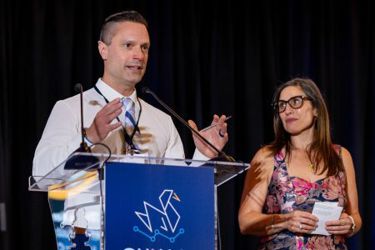
Impressions from the emcee of the 16th Annual SWAN Conference, held June 2-4 in Tampa, FL.
If SWAN 2026 proved anything, it’s that the smartest ideas in water aren’t theoretical — they’re operational, hard-earned, and often messy. What stood out most wasn’t just the themes, but who said them and how clearly they reflected where this industry actually is currently.
There were a few different keynote speakers featured; one of them is noted in the following top 10 list, but I wanted to also point out two others specifically. Both are relatable and poignant in relation to the digital transformation every utility is going through.
- Keri Lane, author of The 100-Year ROI (sounds relevant to the water industry, doesn’t it?!!?), said: “Humans are the undercurrent and that starts with all of us. Your job is not only to manage the flow but to make the system safe enough for people to enter change without fear. That is the work.”
- Dr. Kasi Lacey said: “Skepticism is not stubbornness, it’s scar tissue.” Once we understand that, we can begin acknowledging the scars and why AI and digital transformation this is not a threat.
Here are 10 takeaways, anchored in the voices that brought them to life:
1. The “messy middle” is where transformation actually happens.
Georges Gonzalez (Hillsborough County) set the tone early: digital transformation isn’t linear — it’s iterative, uncomfortable, and ongoing. The takeaway? Stop waiting for clarity and start managing ambiguity.
2. The best digital strategies are built, not bought.
Luiz Renato Fraga Rios (Sabesp) walked through a large-scale transformation that wasn’t about tools — it was about building a repeatable framework for decision-making across the organization.
3. Resilience is the real ROI of digital.
Joana Araújo (Águas e Energia do Porto) showed how crisis conditions forced smarter, more adaptive systems — proving that resilience, not efficiency, is becoming the north star.
4. Transformation fails when it’s treated as a technology project.
Jaime Parson and Emma Petke (Arcadis) made it clear: digital success happens “behind the water” — in governance, workflows, and organizational alignment — not just in software.
5. The “human gap” is bigger than the technology gap.
Silvia Amparano (Tucson Water) highlighted that IT modernization is only as strong as the people adopting it — making workforce readiness the true bottleneck.
6. Customer experience is becoming spatial, not transactional.
Nate Adams (Santa Margarita Water District) shared how geospatial data is transforming customer communication — from reactive service to proactive, location-based engagement.
7. AI is powerful — but only if utilities trust it.
Across sessions and workshops (especially the Digital Twin + AI discussions), a consistent message emerged: utilities are experimenting fast, but adoption hinges on explainability and governance — not just capability.
8. Small utilities are forcing the industry to rethink “scalable.”
Workshops on bridging the digital divide reinforced that innovation isn’t just for large systems — constraints are driving some of the most creative, practical solutions.
9. Interoperability remains the silent blocker.
From roundtables to hallway conversations, one theme kept surfacing: fragmented systems are still slowing progress more than any lack of innovation.
10. Collaboration — not competition — is accelerating progress.
Whether it was SWAN-led initiatives, utility partnerships, or cross-regional learning, the most advanced organizations weren’t going it alone — they were learning faster together.
Final thought:
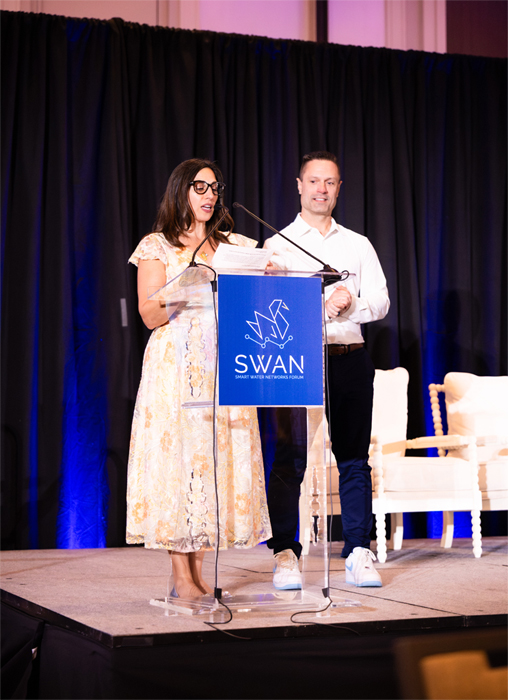
As emcee, you get a unique vantage point — you hear everything, connect the dots, and feel the energy shifts. This year’s shift was clear: the industry is moving from “what is possible?” to “what actually works?”
And the people on that stage proved we’re closer than we think.