
Energy Costs Surge To 40% Of Utility OPEX, Accelerating Digital Optimization
Barcelona, Spain – Energy is among the top three operating expenses for water and wastewater utilities globally, accounting for roughly between 11% to 40% of total operating expenditures (OPEX) depending on region and system characteristics. This large and increasingly volatile cost burden is accelerating utilities’ investment in digital optimization tools that can generate measurable savings in a matter of months.
According to a new Insight Report, Energy Optimization for Water Utilities: A Digital Playbook for Cost and Carbon Reduction, Bluefield Research forecasts US$135.5 billion in cumulative spending on digital water solutions enabling energy optimization from 2025 to 2030—more than 60% of total digital investment in the sector—as utilities prioritize near-term operating cost reductions, including energy and carbon emissions.
Utility energy expenses—made up of electricity and natural gas—is becoming a sharper pressure point for water and wastewater system operators. Influenced by geopolitics and scaling demand for power, electricity prices range from roughly $0.10 per kWh in North America to more than $0.20 per kWh in parts of Europe. In this environment, data-driven optimization solutions become more viable and represent one of the fastest pathways to reduce OPEX.
“This is fundamentally an OPEX-driven market,” explains Maria Cardenal, a senior analyst at Bluefield Research. “Digital tools cut energy costs, improve reliability and asset performance, support predictive maintenance, and position utilities for future carbon reduction requirements.”
According to Bluefield’s analysis, digital solutions deliver the greatest energy savings in three areas:
- Pump optimization within the network: 15% to 30% reductions; pumps are the largest energy users in distribution networks and treatment plants, representing 70% to 80% of electricity use in water production and distribution.
- In-plant process optimization (e.g., aeration in wastewater treatment): 15% to 40% savings. Aeration alone consumes 50% to 70% of energy consumption at wastewater treatment plants.
- Load shifting and demand response: 5% to 15% savings by scheduling energy-intensive operations during off-peak hours when electricity rates are lower.
“If utilities want fast, defensible savings, pump operations are the first place to look,” says Cardenal. “Pumps represent the largest share of electricity demand across most systems, and optimization can deliver meaningful reductions without a major infrastructure overhaul—especially when Supervisory Control and Data Acquisition (SCADA) systems and variable speed drives are already in place.”
Exhibit: International Electricity Consumption in the Water Sector, by Process
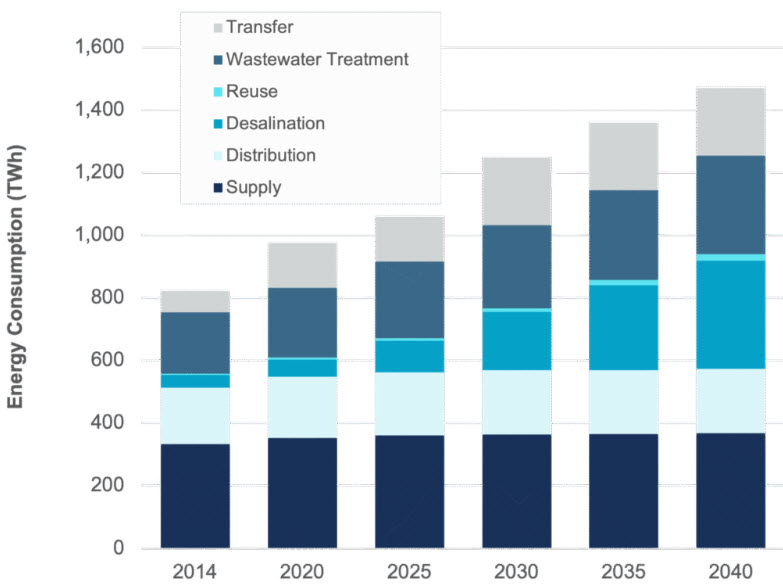
Note: Supply includes ground and surface water treatment
Source: International Energy Agency, Bluefield Research
Going forward, this will benefit companies like Siemens, Xylem, Rockwell Automation, Suez, ABB, and Schneider Electric, which now offer end-to-end digital capabilities to improve energy efficiency within utility systems. These technology suppliers are moving beyond standalone monitoring to embed real-time sensing, automation, and advanced control directly into pumps, blowers, and plant operations.
As utilities modernize legacy infrastructure and seek faster OPEX reductions, integrated platforms are increasingly replacing point solutions—linking SCADA, variable speed drives, and operational analytics into closed-loop optimization. “The opportunity isn’t just better data—it’s better control,” Cardenal notes. “Utilities are prioritizing solutions that automate decisions across high-energy assets and integrate directly with existing operations, rather than adding another standalone dashboard.”
About Bluefield Research
Bluefield Research supports strategic decision-makers with actionable water market intelligence and data in the global municipal and industrial sectors. With expertise spanning infrastructure, policy, and technology, Bluefield helps companies understand where the market is going—and why.
The Insight Report, Energy Optimization for Water Utilities: A Digital Playbook for Cost and Carbon Reduction, explores strategic areas where digital energy optimization solutions can have the most significant impact, particularly in pumping, aeration, and load shifting, highlighting offerings from leading players in the industry. The full report is available for purchase and can be downloaded immediately from Bluefield’s website.
Source: Bluefield Research