
Emergency Water Main Break Repair: Rapid Response For Small And Mid-Sized Utilities
By Stephen Chavez, Joseph Ortiz, and Khalid Talaat
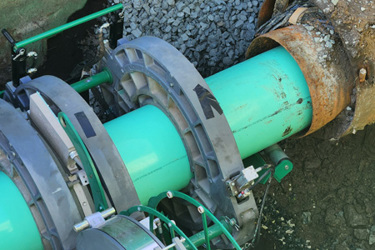
An emergency water main break rarely happens at a convenient time. It is more likely to start with a call in the middle of the night, after a pressure alarm, a sudden loss of supply, or reports of flooding near a roadway. For many utilities, especially small and mid-sized ones, there is very little time to pause and decide what to do next.
Emergency water main breaks are not rare, one‑off events. Across North America, aging infrastructure, limited maintenance budgets, and competing priorities are making failures more frequent and disruptive. A 2025 report from the US Water Alliance and Stantec states that “much of the country’s water and wastewater systems are well past their intended lifespan, and the risks of failure are growing.”
When a water transmission line failure or main break occurs, utilities personnel must move quickly to protect public safety, restore service, and communicate clearly with decision‑makers and the public. At the same time, utilities are often working with limited staff and resources.
Emergency water main break repair involves more than fixing a pipe. It requires fast decision-making under pressure, having the right partners ready, and using lessons learned from emergencies to reduce the risk of future ones. Our team has responded to many emergency water main breaks over the years, including frozen, broken, and failed pipes. We’ve provided remedies tailored to each emergency’s level and time frame, with lots of lessons learned along the way.
In this article, let’s look at how emergency water main break repair works, what to do during an emergency water main break, and how planning and partners help small and mid-sized utilities restore service and reduce risk.
When A Water Main Break Becomes An Emergency
Water mains break all the time. Not every leak is an emergency. But some failures escalate quickly, especially when they involve large‑diameter transmission lines, raw water supply, or critical pressure zones.
For example, a break can turn into an emergency when it’s a water main that serves as a large principal supply to a community. One of our clients in California had a main break of their principal supply pipeline. Without it, they only had around three weeks’ worth of water supply for their entire community, plus neighboring industrial plants.
It is also important to be aware of possible secondary damage, such as the possibility for a large break to wash away an entire hillside, which can then cause property damage and flooding.
Other times, breaks can become emergencies when raw water supply to treatment plants is disrupted. This has the potential to cut off water to entire communities.
Nonetheless, when it’s a real emergency, you need to deal with it immediately.
In some cases, utilities know about aging or problematic pipelines but may lack resources or funding to address them proactively. When those assets finally fail, the response shifts from long‑term planning to immediate crisis management.
The First Call: Why Relationships Matter
Emergency water main break repair often begins with a single phone call. That call usually goes to someone the utility already knows and trusts. Existing engineering and construction agreements can speed up that emergency response.
For small and mid‑sized utilities, established relationships and on‑call contracts can make the difference between hours and days lost to procurement and approvals. When an emergency response plan already includes access to engineers and contractors, the utility can move straight to problem‑solving.
In emergency situations, there is no time for long design phases or formal evaluations. Utilities need partners who can assess conditions quickly; understand the system context; work with whatever material, equipment, and personnel are available; and help coordinate a response in the field. Aside from technical skills, this is about confidence, trust, and a shared understanding of how to act under pressure.
In the absence of a pre-existing contract, a utility can also use an emergency requisition to bring an engineering firm on board. Stantec helped one of our clients in Minnesota with a main repair when one of their 24-inch pipes froze and burst underneath a bridge. We didn’t have a pre-existing contract, but the emergency requisition allowed us to move quickly.
What Happens In The Field After An Emergency Water Main Break
Once a break has been identified, the priority is understanding what happened, looking at the consequences of the break and its impacts, and seeing what potential solutions are available.
Emergency water main break repair typically follows a rapid, on‑the‑ground process, starting with a field assessment. Utility staff usually perform the first assessment and investigate and stabilize the situation before external engineers are called in. In most cases, our clients have already started digging up a pipe when they call our team. Engineering firms are engaged when the situation goes beyond the utility’s capacity.
At that point, we focus on containment and restoration of service. The utility will have shut off the water to keep it from flowing out and often implement road closures and detour measures if necessary. Then it’s up to the response team to figure out how to immediately bandage the system to turn the water back on, at least temporarily.
In urgent situations, there is rarely time for a full design. Instead, teams develop practical, concept‑level repair options that can be applied quickly with available materials and contractors.
It’s important to know trusted contractors as well, as they can confirm feasibility, availability of materials, construction timing, and equipment needs.
Once the emergency is under control and water has been restored, utility staff and engineers can provide a permanent solution, whether via a full repair or replacement.
Emergency Declarations And Accelerated Action
Emergency water main break repair often requires more than technical solutions. In many places, utilities must formally declare an emergency to accelerate contracting and construction. Utilities often have limited emergency funds available through on-call contracts, and larger emergencies require formal declarations to access additional resources.
This process may involve:
- Council or board approvals
- Legal review
- Issuing emergency declaration(s), which would allow utilities to expedite any permitting requirements
- Written justification explaining the impacts
For utilities, this can be a holdup. External technical justification, explaining what could happen if repairs are delayed, will help decision‑makers understand the urgency and approve emergency actions quickly.
On one of our California projects, our team helped a utility by preparing a high-level assessment that outlined the urgency, explained the impacts to their water supplies, estimated repair duration, and recommended water use restrictions. This supported the case for an emergency declaration. We made sure to document the magnitude of the emergency in accessible language to help justify the funding request to the local council. It all made the required approval process quicker.
Without this step, utilities may be forced to pursue slower procurement paths or attempt repairs with limited internal resources. This increases both cost and risk.
Why Emergency Water Main Breaks Keep Happening
Many emergency water main breaks share common root causes. While each failure is unique, several themes appear repeatedly:
- Aging infrastructure: Pipelines designed for 50‑year lifespans are often still in service decades beyond their useful life. In some cases, materials that were supposed to have long lifespans failed prematurely. Over time, materials degrade, corrosion continues unabated, and failure risk increases.
- Deferred maintenance: Cathodic protection is useful but rarely maintained long‑term. Corrosion is often silent and invisible until a pipe fails.
- Funding competition: Capital projects tend to attract more attention and funding than operations and maintenance. Routine maintenance can only be deferred until an emergency forces action, often at a much higher cost.
- Geotechnical and environmental factors: Some regions are prone to land movement or unstable soils. Heavy rainfall, seismic movement or slope failures can cause failures along pipeline corridors.
Sometimes a combination of factors will cause an emergency water main break. One of our projects in the northern U.S. involved a combination of freezing temperatures and human error. The utility accidentally turned the water off to a pipeline suspended from the bottom of a bridge during the winter, which led to the pipe freezing and then bursting.
These challenges can be heightened for smaller utilities with limited staff and budgets. While large utilities may track failures and proactively replace assets, smaller systems are often forced into a reactive cycle, fixing breaks as they happen.
Turning Emergency Repairs Into Long‑Term Improvement
While emergency water main break repair is disruptive, it can also become a turning point.
Utilities that document what happened after an emergency can strengthen their systems in lasting ways. Practices that make a difference include:
- Documenting repairs and conditions: Creating clear records and drawings of emergency repairs helps utilities understand where failures are occurring and why.
- Tracking failure history: Repeated failures along the same pipe or corridor are strong signals that replacement or rehabilitation should be prioritized.
- Updating master plans and capital programs: Emergency repairs often reveal risks that were underestimated or delayed. Incorporating those lessons into capital improvement planning helps reduce future emergencies.
- Strengthening emergency response plans: Clarifying roles, contacts, contracting mechanisms, and communication pathways improves readiness for the next event.
We also advise our clients that repairs in critical locations, such as under highways, should be designed for long-term durability. Over time, these steps can move emergency response from a reactive activity to part of a broader asset management strategy.
Preparing For The Next Emergency Water Main Break
It’s impossible for utilities to eliminate all risk. But utilities and water service providers can take practical steps to be better prepared when the next water main break occurs.
Emergency water main break repair will always carry pressure and uncertainty. But preparation, trusted relationships, and informed decision‑making can reduce disruption, protect communities, and make the most of limited resources.
Our team is proud to help utilities in their times of need. After fixing what breaks, we encourage utilities to learn, adapt, and prepare for what comes next.
Stephen Chavez, Joseph Ortiz, and Khalid Talaat are based out of Stantec’s office in Sacramento, California.