
DEXSORB® For PFAS And Organic Micropollutants
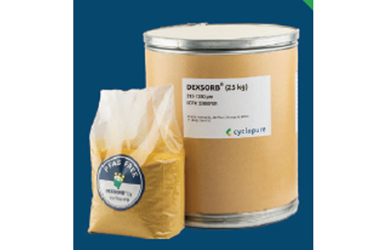
DEXSORB is a novel adsorbent made from crosslinked β-cyclodextrin polymers. The media features uniform 0.78 nm hydrophobic cavities that selectively adsorb organic contaminants in the 150 – 1000 Dalton molecular weight range. DEXSORB is available in two formulations to adsorb (A) PFAS exclusively, or (B) PFAS + organic micropollutants (OMPs) in combination. While DEXSORB and GAC operate by the same mechanism of adsorption, and share similar physiochemical properties, DEXSORB possesses multiple properties that provide for superior PFAS removal and waste handling.
DEXSORB is a crosslinked cyclodextrin polymer engineered for the selective removal of PFAS from a variety of water matrices. The media is compatible with industry standard vessels and infrastructure to support packed bed and gravity fi ltration. DEXSORB granules feature: a high uniformity coeffi cient, spherical shape, and hydrophilic macro surface, to ensure smooth operating hydraulics and low pressure drop.
DEXSORB molecular selectivity derives from uniform 0.78 nanometer hydrophobic cyclodextrin cavities, making the media well-suited for PFAS and other contaminants in the 150–1000 Dalton range. Unlike legacy adsorbents, DEXSORB performance is not impacted by matrix effects of TOC, TDS, FOG, hardness, inorganic ions, iron, manganese, and biological activity.
With molecular selectivity, DEXSORB provides superior properties of: (i) rapid kinetics, (ii) high treatment capacity, (iii) resistance to fouling, (iv) spent media processing, and (v) concentration of PFAS waste for safe destruction.
Get unlimited access to:




Enter your credentials below to log in. Not yet a member of Water Online? Subscribe today.