
Competitive Water Utilities Can Benefit from Mainstream Supply Chain Management Concepts
Contents
Competitive Water Utilities
Supply Chain Management in Competitive Markets
Water Utilities and Supply Chain Management
Case in Point: Electric Power Supply Chain Management
Path Forward to Competitive Water Utilities
The water utility industry is fast approaching an inflection point—a time, as Intel's long- time CEO Andrew Grove puts it, ". . . in the life of a business when its fundamentals are about to change" (Only the Paranoid Survive, Andrew S. Grove, 1996).
U.S. EPA has estimated that a minimum of $280 billion of investment in the US water and wastewater infrastructure will be needed over the next twenty years in order to meet the requirements of the Safe Drinking Water Act (Future Infrastructure Workshop: Call for Proposals, Environmental Protection Agency, January l999). Capital markets are aware of this need and have begun to compete with the public sector for these investment opportunities.
Concurrent with a massive capital investment in the water utility industry on the horizon, global competitive markets in the private sector have fueled the astounding pace of information technology development and its creative application to achieving increasing levels of productivity and efficiency. The steady decline of regulation has pushed one industry after another into either government or self-induced restructuring aimed at fostering a competitive marketplace, and productivity and efficiency have consequently increased at an historically unprecedented pace outside of the utility industry. Regulated utilities simply do not operate under a system that rewards or motivates similar gains. It is not unfair to say that, as a general rule, the water utility industry is 10 to 20 years behind competitive industries in their application of information technology.
Competitive Water Utilities
The inflection point on the horizon for the water utility industry is inevitable because the capital markets (i.e., the public) will compete for the opportunity to fund the $280 billion of investment required in the industry, and will demand productivity and efficiency in return. The restructuring of the electricity and natural gas industries leaves the water utility industry as the last natural monopoly in the U.S. economy. The life-sustaining nature and sheer size of the $96 billion U.S. water industry indicate that its business performance metrics will be brought into alignment with the rest of the economy. The educated public—which in this information age has increasing expectations and decreasing inhibitions in demanding timely and accurate information about all products and services that they buy—will not tolerate long-term underperformance.
The promising news is that information about the globalization of competitive markets and the role of information technology (IT) throughout this process is plentiful. Even better, the research, development and market validation of both the practices and information technology have already been, and continue to be, largely funded by the Fortune 500. The distressing news is that there are very few instances of information technology solution providers from outside the water utility industry involved in the water business. This inward-turning tendency will delay the pace of progress. We expect to see partnerships forming that will effectively combine the historically technical focus of this industry with the commerce and business management capabilities that have provided the commercial sector with accelerating productivity and efficiency gains during the past 10 years.
Supply Chain Management in Competitive Markets
We are living in the "information age," when advances in computing and communications technology provide opportunities for acquiring and sharing huge quantities of raw data, and for applying knowledge and insight to deriving valuable information from raw data. Information has always been critical to success in competitive markets. The need to either excel in a competitive environment or to cease conducting business has produced a high level of innovation in the application of IT to commerce. One of the most significant IT developments to take place over the past 10 years is the progressive step from the enterprise model to the supply chain model.
Table 1. Progression of IT in Competitive Markets
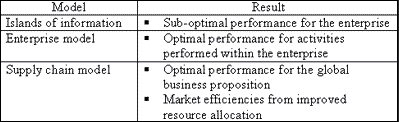
The popularization of the enterprise model generated productivity gains by establishing business processes that optimized key performance metrics for the enterprise as a whole. The gains were the result of eliminating the waste produced by aggregating the results of individually optimized entities within the enterprise in an uncoordinated manner. Implementing an enterprise business model and the accompanying IT infrastructure was a demanding process requiring a new, higher level of information management.
The logical progression from the enterprise model to the supply chain model was principally the result of a trend in highly competitive market sectors that led companies to focus resources on core competencies, while contracting with suppliers for products and services to meet requirements in non-core areas. The implication of this restructuring is that the number of supplier entities involved in the end-to-end process that delivers product or service to the customer increases (hence, the terminology of supply chain) and requires management. Each link in a supply chain represents a transaction in which value is exchanged for compensation. Under a managed supply chain model, marketplace efficiencies and overall productivity increase because the resources of each supplier, focusing on excellence in a core competency, are available to supply multiple supply chains. In competitive markets, enterprises providing an equivalent non-core supply function with only one group of customers (themselves) cannot match the efficiencies generated by suppliers allocating resources to multiple supply chains.
Supply chain management entails managing the interaction between supplier and customer along every link in the chain. Notably, it also can imply that one or more links can be removed from the chain. This happens when the value/cost ratio gets so small that an innovation is eventually introduced enabling elimination of the low value/high cost supplier from the chain. It is actually somewhat analogous to enterprise management, with the notable exception that there is generally no controlling authority over the suppliers in the chain. The "enterprise" is all of the organizations involved in a combined effort to produce an end-user product or service. Information and communications technologies are key components that integrate suppliers with customers so that they can cooperatively optimize their combined processes.
Water Utilities and Supply Chain Management
Many people tend to limit their view of supply chain management to a hard goods environment such as manufacturing and distribution. In fact, a supply chain can be abstracted to a series of transactional boundaries where value is exchanged for compensation, and it may consist of only a single supplier and customer. Supply chain optimization is the process of suppliers and customers within a chain working to increase the value/compensation (cost) ratio. Value may be delivered in the form of a hard good, information or a service. For example, the transaction costs of banking have been reduced from $1.70 per transaction in a branch banking environment to less than one cent per transaction for internet banking transactions. In the airline industry, the cost per ticket issued has been reduced from $8.00 per ticket using a travel agent to under a dollar per ticket through direct internet bookings (The Emerging Digital Economy, U.S. Department of Commerce Report, May, 1999). In both examples, links were removed from the supply chain to achieve drastic performance improvements.
Water utilities receive billions of dollars of hard goods, information and services every year, yet they are not the last link in the supply chain: utility customers are the end-users. There are clearly significant transactional boundaries with major suppliers to the water utility industry, where application of supply chain management concepts can improve the value/cost ratio. There are also potential opportunities for interfacing with customers to optimize the last link in the supply chain. However, due to the greater leverage that exists with suppliers relative to customers in bringing change to a business relationship, competitive water utilities should focus on their major suppliers as a matter of priority in pursuing supply chain management opportunities.
As information technology for business-to-business supply chain management continues to proliferate, major suppliers to the water industry (e.g., electric power, natural gas, chemicals, professional engineering services) will become increasingly interested and capable of implementing supply chain management solutions with their water utility industry clientele. The timing couldn't be better for the water utility industry, as it faces a new competitive era.
Case in Point – Electric Power Supply Chain Management
Analyzing the supplier-customer relationship between electric power suppliers and water utility customers reveals substantial opportunity for supply chain management. Restructuring of the electric power industry has resulted in a highly competitive wholesale power market, which will be extended to the retail level throughout much of the U.S. during the next three to seven years. The instantaneous nature of electricity results in a highly volatile commodity market. Recent years have witnessed extreme volatility, with peak prices in excess of $7,000/MWh for a commodity normally trading at $30/MWh. Normal ranges typically cover a price range from $14/MWh to $200/MWh. This kind of volatility will pose serious difficulty to retail electric customers as retail competition proliferates.
Striking similarities exist between the operation of electric power grids and water supply networks:
- Both systems operate to meet fluctuating end-user demands.
- Both system types consume energy in the process of delivering their products.
- Both face operational constraints posed by the physical limitations of their infrastructure.
- Both have a paramount need to meet demand with the highest possible reliability and quality.
As much as the two industries have in common, one dramatic difference between them makes the manner in which they interface of particular interest: most water utilities can utilize water storage tanks to store their product for use at a later time, whereas electricity is an instant commodity that cannot be stored. Indirectly, water utilities can store power in the form of the potential energy that lies within water stored in elevated facilities.
From a supply chain perspective, there are substantial efficiency gains to be developed in the supply/demand process in electricity markets. There is value to be gained on both sides of the transaction between power suppliers and water utilities by making an effort to manage the supply chain. Water utilities will need value-added services from energy service providers for risk management and other energy related matters that are not core competencies of the water industry. Electric power suppliers, alternatively, have the potential to increase the efficiency of the energy purchase transaction substantially by effectively integrating water storage capabilities into their transaction decision processes. Accomplishing such a feat involves integrating information and engineering technologies between supplier and customer that combine financial supply-related decisions with demand-side actions to arrive at the best overall business solution across the electric power supply chain.
The more advanced the power supplier is at finding an outlet for selling excess load and at finding sources for buyers of load at premium prices, the more intense will be its interest in managing load proficiently through supply chain management, as these activities represent opportunities to increase profit and/or lower costs.
Path Forward for Competitive Water Utilities
Competitive water utilities have an opportunity to leverage the practices and information technology developed and practiced in global competitive markets. The path forward for managers in the water utility industry entails undertaking a re-examination of the hard goods focal point (treatment plants, pipe, tanks, etc.) that typifies the industry. The goal of such an exercise should be to develop an understanding of the impact that mainstream supply chain management practices and IT can have on the competitive stature of water utility operations. All major supply transactions should be evaluated, with priorities for action developed from a combination of impact and timeliness perspectives. A greater proportion of thought and resources devoted to the long-term operation and performance of assets that supply chain management offers will yield disproportionately large gains to investors, whether they are public or private sector utilities.
The water utility industry faces unique technical challenges that stem from the extremely critical, highly regulated nature of water and wastewater treatment and distribution issues. Therefore, any evaluation of supply chain management's impact on utility operations must be approached with components that integrate the technical, process-related requirements for supporting the core utility mission with the business-related requirements for supporting objectives aimed at competitive business operations. Failure to integrate these requirements will result in failure to move forward.
The water utility industry is the last regulated monopoly in the U.S. The massive $280 billion capital investment over the next 20 years, coupled with the impressive track record that supply chain management concepts and IT tools are building in competitive global markets, points to a fundamental change in how the water utility industry conducts business. The success of the public sector in meeting this "inflection point" will be directly proportional to its ability to study and adopt current competitive business practices found within the commercial sector, particularly with respect to the efficient use of information technologies that support concepts such as supply chain management.
About the Authors:
Richard A. Jamieson, Ph.D., CEO, co-founded Powerware Solutions, Inc., College Station, TX, in March 1994. Rich manages the strategic direction of the firm and works with marketing initiatives, financing issues, business-to-business efforts and key clients. He received a Doctor of Philosophy in Operations Research from Texas A&M University.
William E. Page, president and COO, joined Powerware Solutions, Inc., in July 1999. Bill has 24 years of experience in high technology firms. Bill manages day-to-day operations at PSI and contributes to the strategic vision of the firm, while dealing with financing and capitalization efforts. He received a Bachelor of Business Administration in business management from Texas A&M University.
Editor's Note: This article was submitted as part of the The U.S. Water Report, which analyzes current and future needs of the U.S. water industry, detailing infrastructure and technology requirements, operations, financial and economic practices, regulatory and government concerns.