
Coastal Restoration Is In All Our Hands
By JoAnne Castagna, Ed.D.
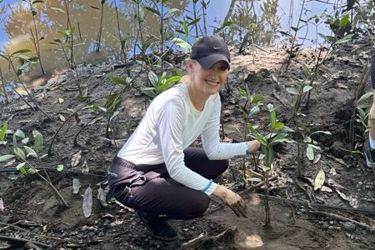
When I woke up that morning in Costa Rica, I had no idea I would soon find myself standing ankle-deep in mud on a tropical coast, cradling a baby-sized mangrove seedling in my arms under the warm sun — and getting emotional.
While on vacation, my tour group visited the Palo Seco Mangrove Reforestation Project, where we spent a morning planting mangrove seedlings as part of its coastal restoration program.
As I lowered my seedling into a hole, it hit me: As a writer, I had covered coastal restoration projects many times, but this was the first time I was actually taking part in one.
I had always observed these projects from a distance. Now, I found myself deeply invested in the survival of this little seedling, even as I realized I would have to leave it to grow on its own.
That personal connection reflects the project's goals: to educate the public about the importance of coastal restoration through hands-on environmental volunteerism, foster social responsibility, and demonstrate how restoration can help protect local communities, wildlife, and our planet's future.
The project is located on Playa Palo Seco, a secluded barrier island approximately six miles long and 400 meters wide on Costa Rica's Central Pacific coast, near the town of Parrita in Puntarenas Province.
A palm tree-lined beach stretches along the island's southern shore, while the Palo Seco Estuary borders its northern shore. Along the estuary's rivers and inland waterways grow thousands of acres of mangrove forests, forming one of the region's important coastal ecosystems.
Protecting these forests matters for several reasons. Mangroves are salt-tolerant trees that help buffer coastal communities from storms, flooding, and erosion. They provide habitat for a wide variety of plant and animal species, including sea turtles that nest on the island, and supply local communities with valuable natural resources, including food and medicinal materials.
Mangroves also help fight climate change by capturing and storing carbon dioxide from the atmosphere in their trees, roots, and surrounding soils, the greenhouse gases that are responsible for global warming. Some estimates indicate that mangrove forests can store substantially more carbon per acre than many terrestrial tropical forests.
Yet these forests face threats from the very coastal forces they help buffer. Storms, erosion, and rising sea levels associated with climate change can damage mangrove ecosystems, putting nearby communities and wildlife at risk.
Costa Rica's coast is not alone in facing these challenges. Coastal erosion is a global problem. A study by the European Commission's Joint Research Centre projected that up to 50% of the world's sandy beaches could be at risk of disappearing by 2100 as a result of climate-driven coastal erosion and sea-level rise.
In response to local coastal challenges, the Palo Seco Mangrove Reforestation Project was established in 2008 through collaboration among the community, the Municipality of Parrita, the Embassy of Japan, the Ministry of Environment and Energy, the Costa Rica Electricity Institute, and private-sector partners.
Since then, hundreds of volunteers have contributed hours and days to caring for mangrove seedlings, propagating them, planting them, and monitoring their growth.
As a volunteer, I felt good about helping strengthen the coast. But the experience also brought my tour group closer together. Like a well-oiled machine, we worked together to carry seedlings from the nursery to the coast, carefully descend muddy slopes to the water's edge, dig holes, and plant the seedlings.
It was a team effort that energized me and gave me a sense of community — another goal of the project. In fact, even after returning home, I continued meeting members of my tour group socially.
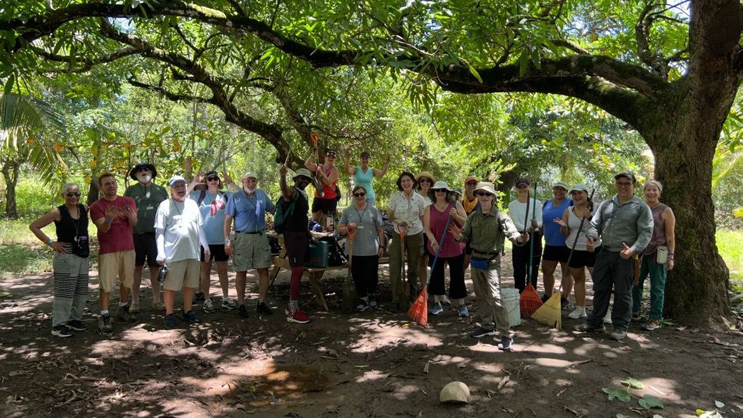
Castagna with her tour group at the Palo Seco Mangrove Reforestation Project
I imagine many volunteers have experienced that same sense of connection. Their contributions have helped advance the project's restoration goals, with approximately 80% of the targeted forest areas reportedly restored.
After our volunteer work, our group was graciously welcomed into a family home up the road overlooking the Pacific Ocean. We learned how to make empanadas, a popular food in Costa Rica, then sat outside to eat while watching the family's farm animals graze nearby, as comfortable in their surroundings as members of the family.
As I took in the scene, I thought about the work we had just done. Restoring the coast can help protect the places where families like this live and make their livelihoods.
Now back home in the U.S., I still think about my mangrove seedling. I remember digging a hole, hoping it was deep enough for the roots to take hold; carefully lowering the seedling into the ground; and patting the moist soil around its stem, hoping it would remain upright amid the strong coastal waves and wind.
I wonder whether it is surviving, perhaps even thriving. I'll never know. But I do know that participating in this coastal restoration project expanded my perspective as a writer and helped me grow as a person.
For many of us, myself included, global warming can seem like a problem so vast that we have little control over it. This experience taught me that while no single person can solve it alone, it's in all our hands, as a community, to take meaningful steps to address its effects. Sometimes, this begins with something as simple as planting a seedling.
Would you like to volunteer for a coastal restoration project in your community?
Contact your local government agencies, regional nonprofits, or national conservation organizations to find opportunities near you. If you plan to visit Costa Rica and would like to volunteer with the Palo Seco Mangrove Reforestation Project, email info@laislahotel.com.
 Dr. JoAnne Castagna is founder of 2 Bourkes PR, a public relations service specializing in writing and marketing environmental articles. She can be reached at Joanne@2bourkespr.com or www.2bourkespr.com.