
City develops predictive modeling for sewer rehabilitation

Rather than relying on a reactive as well as a preventive approach to sewer line repair and rehabilitation, the City of Moorhead, MN, has taken it one step further and developed a predictive model. Read how this plan reduces repair costs and stabilizes maintenance fees while maintaining a reliable sewer system.
By Robert A. Zimmerman, Ph.D.
Public Works Director
City of Moorhead, MN
In many cities, a reactive approach is taken to sewer repair and  rehabilitation. When problems become evident, repairs are undertaken. In many instances, these problems may become extremely severe before detection. This type of repair can be very costly, particularly in northern climates where wintertime repairs are difficult.
In other cities, a preventive maintenance approach is used. This may include routine sewer cleaning programs, sewer televising programs, etc. In these programs, efforts are made to prevent problems and detect those, which already exist.
Predictive modeling allows budgeting rehabilitation costs in advance
In very few cases, if any, are predictive approaches taken to sewer rehabilitation programs. However, this type of approach can be extremely beneficial in that rehabilitation requirements and expenditures can be planned in advance thereby reducing costs, and ultimately, stabilizing sewer maintenance rates.
Predictive maintenance focuses on potential problems, which can be identified by several failure indicators including pipe age and pipe material.
The City of Moorhead, MN, launched a program to develop a methodology for timely, planned sewer system repairs and rehabilitation, and therefore, to preserve the city's gravity sanitary sewer system and minimize or avoid major unplanned and costly repairs.
Model tells lengths of pipe that will need repair
To develop the program, existing gravity sewer pipe conditions were assessed and this information manipulated to develop a model, which provides insight for prediction, and projection of rehabilitation needs. Utilizing the model, lengths of sewer pipe that will need rehabilitation can be predicted.
From this information, anticipated annual costs for sewer rehabilitation can be estimated and appropriate funding mechanisms established. The program lends itself readily to continual updating and refinement and is universally applicable.
Program projects a positive public works image
The program projects a positive public works image and has proven to be an essential tool in managing and maintaining this element of the city's infrastructure.
The City of Moorhead has a population of about 32,000. The sanitary sewer, collection system consists of more than 160 kilometers (100 miles) of gravity sanitary sewer and 29 sanitary lift stations. The average age of the existing sewer system is approximately 40 years. An inventory of the system indicates that approximately 6O% of the gravity sewers are vitrified clay pipe (VCP) commonly subject to fracture. Other major components include polyvinyl chloride (PVC) and reinforced concrete pipe (RCP).
Prior to 1999, the city practiced preventive sewer maintenance. Approximately one-half of all gravity sewers were cleaned each year. In addition, suspected trouble areas were televised to identify and verify existing problems. Problem areas detected through televising were repaired as needed. In 1999, a predictive approach to sewer rehabilitation was developed.
Info from preventative maintenance program used
In order to develop the program, information available from the existing routine preventive maintenance program was utilized. All gravity sewers in the system were inventoried with respect to pipe location, pipe diameter, pipe material, pipe length, pipe vintage, televised status, pipe condition, type of rehabilitation required, and length of pipe in need of rehabilitation.
Information from several different sources was used to develop this inventory including sewer cleaning reports, sewer wye cards, sewer inspections, and sewer televising reports.
Basis of program development is routine cleaning
However, the basis for the program is routine sewer cleaning. During sewer cleaning, observations of potential sewer problems are noted. These problem areas are subsequently televised to assess pipe condition. This information is then used to evaluate and predict future rehabilitation requirements.
In the accumulation of the data included in the sewer inventory, a convenient method for access and manipulation became necessary. To accommodate this need, a database on a personal computer was established.
Ratings are assigned to sewer lines
After development of the database, the information obtained was evaluated so that sewer rehabilitation needs could be assessed, evaluated, and ultimately predicted. Data evaluation was performed by rating existing sewers (which have been televised) with regard to condition. Condition ratings of 1, 2 or 3 were assigned to all televised sewers.
From the sewers found to be in condition 3, required rehabilitation needs were assessed and evaluated. Data obtained from this evaluation were manipulated to develop a model for prediction and projection of rehabilitation needs.
Age and material are major factors
Major factors affecting the need for rehabilitation were found to be sewer pipe age and material. A statistical relationship between the percent of sewer lengths needing rehabilitation and sewer pipe age resulted in the development of the model shown in the following table and described by the following:
Y = 0.00183exp (0.070x)
Y = percent of the total length of sewer lines requiring rehabilitation
x = age of sewer pipe in years
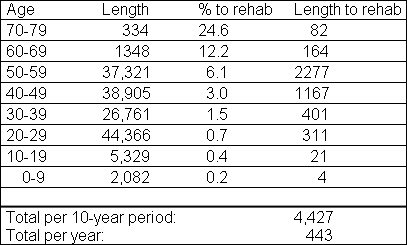
With this model, lengths of sewer pipe that will need rehabilitation can be predicted for any given time increment. As an example, utilizing a ten-year period (1990-1999), estimated sewer rehabilitation needs for the City of Moorhead are shown in the above table. With this information, anticipated annual costs for sewer rehabilitation can be estimated and appropriate funding mechanisms established.
Practical value of the predictive model clear
With the implementation of the annual sanitary sewer rehabilitation program utilizing the predictive model, sewer maintenance rates have been established such that funding for sewer rehabilitation is available as needed. To date, funds received from service charges have been sufficient to fund all necessary rehabilitation. Bonding for major repairs has been unnecessary. Very few sewer back-ups have been experienced and essentially no major unplanned rehabilitation or repair has been needed.
Therefore, the program has stabilized sewer rates and system repairs follow a systematic approach, being planned in advance and limiting costly emergency repairs. The program lends itself readily to continual updating and refinement and is universally applicable.
The program projects a positive public works image and has proven to be an essential tool in maintaining this element of the city's infrastructure.
Edited by Joyce Everhart
Managing Editor, Public Works Online