
Brackish Water Desalination: A Strategic Imperative For Sustainable Water Stewardship Across The American Water Landscape
By Ghazi Ozair, Andrew Zaske, and Fadey Kassim
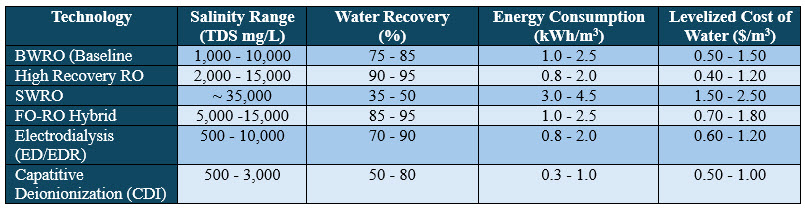
Desalination is not a new process, nor is confined to the coasts of the United States. Its performance, cost, and viability vary significantly depending on the source water and treatment technology. As droughts intensify, groundwater depletes, and climate extremes worsen, many water-stressed regions are increasingly turning to brackish groundwater desalination, for both potable use and industrial applications where water quality demands are less stringent. The brackish water reserves are emerging fast as a strategic priority, ensuring a supplement for long-term national water security. While seawater desalination gets the maximum attention, brackish water, moderately salty groundwater found across the inland U.S., offers a more energy-efficient, cost-effective, and scalable solution. Any water having total dissolved solids (TDS) concentration between 1,000 and 10,000 mg/L is termed as “brackish water”, whereas seawater usually contains a TDS concentration of 35,000 mg/L.1
Brackish water is potentially abundant and constitutes a large fraction of the earth’s freshwater but represents only a part of the total groundwater resources. This resource is relatively accessible in many areas around the globe. Brackish groundwater is typically present at less than 500 feet below ground surface throughout most of the Great Plains. Groundwater in basin-fill aquifers of the Southwest U.S. often increases in dissolved-solids content as it travels along its flow path as a result of geochemical interactions with the aquifer matrix and through evaporative processes. At the end of its flow path, groundwater may be brackish or saline and discharges to the surface through springs, such as found in the Death Valley.2
Early studies indicated that mineralized groundwater underlies most of the U.S., as indicated below in the.3
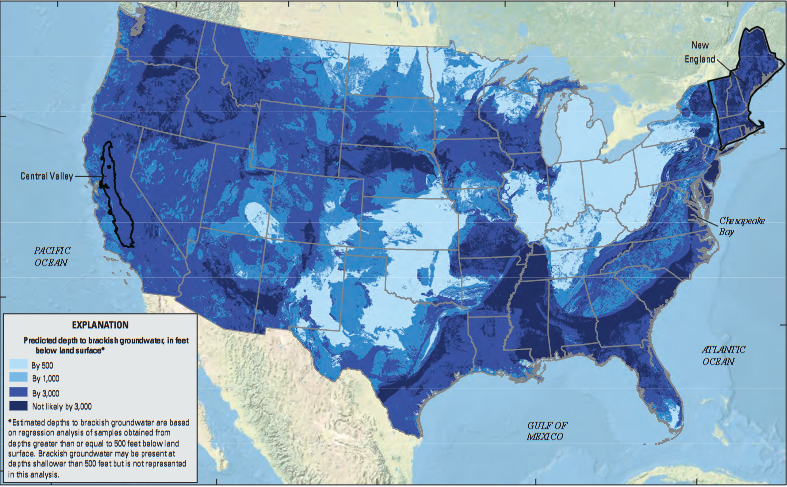
Although brackish water lies outside conventional potable water standards due to its salinity, and in some cases exceeding seawater, it remains a valuable groundwater resource, especially as treatment technologies advance. Advances in desalination technologies are making the treatment of brackish groundwater more feasible for potable water supply. Using brackish water will certainly increase the amount of groundwater in storage that is usable, however uncontrolled extraction of the groundwater might lead to serious concerns about the future availability of water and groundwater management. In many parts of the country, groundwater withdrawals exceed recharge rates and have caused groundwater-level declines, reductions to the volume of groundwater in storage, lower streamflow and lake levels, or land subsidence. According to John Bredehoeft pumped groundwater must be balanced by an increase in recharge, a decrease in discharge or reduction of storage. But typically, brackish water systems do not receive large amounts of recharge, nor are they connected to surface waterbodies.4 Therefore, a better understanding of the location and characteristics of brackish groundwater is needed for the development of the resource and to provide a scientific basis for making policy decisions. To address this need, the DOI’s (Department of the Interior) initiative, WaterSMART, conducted a national assessment of brackish aquifers.5
From a technology perspective, brackish water desalination (BWRO) typically requires significantly lower pressure and energy requirements than seawater desalination (SWRO), making it inherently a more efficient and viable technology for inland drought resilience, especially when coupled with smart recovery and energy-saving technologies. But as demand rises, even brackish systems must evolve to reduce overall cost and environmental impact. The following table represents a comparison of different desalination technologies:
The opportunity of BWRO is immense in the regions like West Texas, California’s Central Valley, and the Desert Southwest that sit atop vast aquifers of brackish groundwater that could provide a reliable alternative to freshwater extractions. But tapping this resource efficiently, economically and sustainably requires innovation, materials science, process engineering, renewable integration, and regulation. This article explores where we stand, where we should head, and how the U.S. federal government helps through investments to transform brackish desalination from a niche technology into a critical infrastructure solution.
Unlike the majority of the rest of the world, most of the desalination capacity in the U.S. is brackish water desalination with an installed capacity of 7.6 million m3/day. With the preference for brackish water treatment, most projects are small-scale, producing less than 10,000 m3/day, with a small number of larger exceptions. In 2023 - 2024, the largest Hadnot Point WTP (replacement) at Camp Lejeune, North Carolina had a capacity of 30,283 m3/d. Texas’ landmark BWRO project in the City of Alice, the state’s first RO PPP, has a capacity of 2.7 million gallons/day, with an additional BWRO PPP project to serve the counties of Kleberg and Nueces with a capacity of 3 million gallons/day is expected to come in operation by 2027.6
On exploring the technologies, challenges, and federal momentum driving the next wave of scaling up brackish water desalination nationally in the U.S., some of the key shifts include:
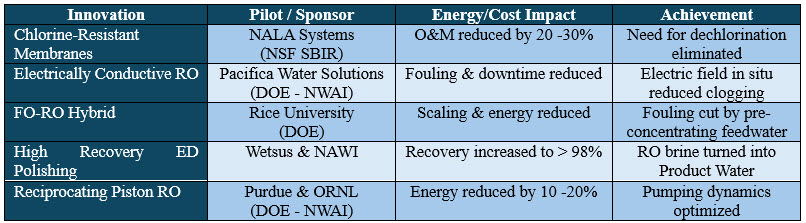
- Continued Technology Innovations: Innovations in membranes (i.e., chlorine-tolerant and nanostructured membranes), materials, energy recovery systems, and AI-augmented operations drive toward efficiency and resilience thereby reducing the two major operational burdens, e.g., energy use and membrane maintenance. The modern desalination isn’t just about pushing water through membranes but it’s about integrating sensors, advanced materials, and hybrid processes that anticipate fouling, optimizing recovery, and reducing waste. The recent U.S.-funded pilots and startup breakthroughs are redefining how we treat saline water with reduced chemical costs and extended system lifespan.
- Energy-Efficient System Configurations: From batch-mode reverse osmosis to hybrid forward osmosis-reverse osmosis (FO-RO) and electrodialysis (ED) systems, process design is becoming more intelligent and energy-efficient. The following energy-efficient desalination technologies are not just lab experiments, but field pilots, funded by DOE and USBR (United States Bureau of Reclamation), validating real performance improvements that will soon be available to water utilities.
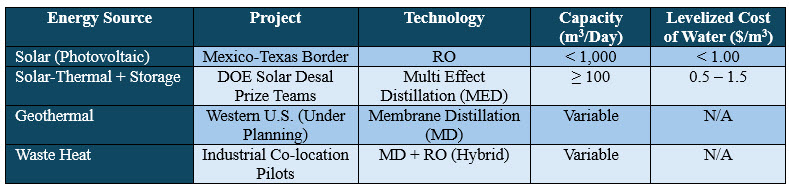
- Renewable Energy Integrations: As the U.S. pushes toward carbon reduced infrastructure, desalination is evolving to operate by integration with viable renewable sources of energy, such as solar-thermal, photovoltaic-RO, geothermal-powered systems, and the use of waste heat are turning desalination into climate-aligned infrastructure with lowered lifecycle emissions. This shift cuts operating costs over time and allows for inland and off-grid or remote operations, a game-changer for rural and tribal communities. Some desalination projects coupled with renewable energy are as follows:
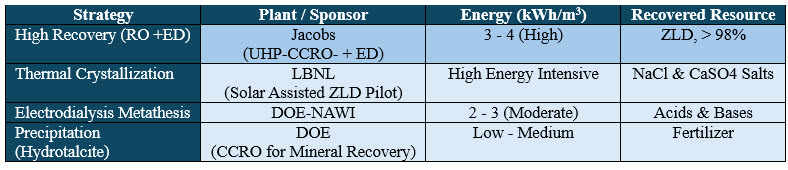
- Brine from Liability to Opportunity: Brine disposal is a top environmental and cost concern. Traditional approaches, like deep-well injections are expensive and sometimes legally restricted. Policy support for brine reuse and resource recovery has made it possible to turn what was once waste and liability into emerging as a valuable resource to produce more water, valuable salts, minerals, fertilizers, and other industrial inputs supporting the goals of brine management through minimum-liquid-discharge (MLD), zero-liquid-discharge (ZLD), and circular models. This new scheme reduces disposal costs while simultaneously creating new revenue streams, as mentioned below, for the desalination operators.
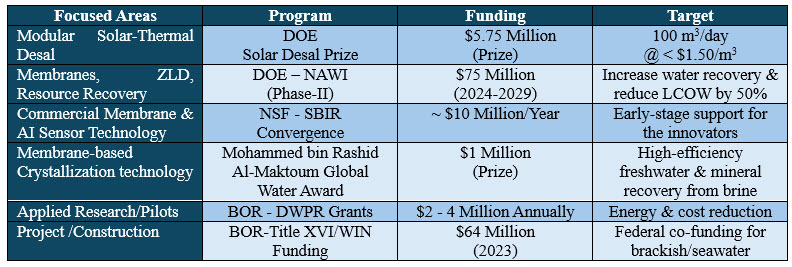
- Rise in Public Investments: State-federal alignment is vital for fast-track permitting and co-investment. The U.S. federal government is playing a critical role in accelerating the change by moving brackish desalination forward from fundamental R&D to infrastructure-scale construction. Expanded pilot-to-deployment funding for small and mid-size utilities, the Department of Energy (DOE), Bureau of Reclamation (USBR), and NSF (National Science Foundation) are supporting innovations and deployment through R&D, and infrastructure grants. Programs, such as DOE’s NAWI Hub and USBR’s WaterSMART are strategically designed to push the technologies out of labs into full-scale demonstrations, de-risking new systems for public utilities and investors alike. Some key U.S. Federal desalination programs during the years 2023-2025 are as follows:
The U.S. water treatment market always had and still has an affinity for using membrane technologies, such as RO, NF, UF, MBR, etc., and hence brackish water desalination is no longer a theoretical solution, but a mature technology with a scalable future undergoing rapid reinvention, while the concentrate is either discharged to the nearest waterbody or used in deep well injections. With costs falling, recovery rates rising, and energy inputs declining, it is uniquely positioned to provide regional-scale resilience and local-scale independence.
It is recognized that, although currently a bit complex, there is possible additional value in the seawater brine solution, especially at larger economic scale, due to the valuable concentrations of salts, rare minerals and metal concentrations. The practicality of concentrate valorization of BWRO comes into questions from the off-takers’ viewpoint, which are usually the municipalities and industries, considering their location and up-concentration of micropollutants and other persistent and emerging pollutants, like PFAS and heavy metals in the same concentrate stream.
From this point of view it would be more “valuable” to regulate BWRO discharge requiring an RO concrete treatment before any discharge using, e.g., advanced oxidation process (AOP) + biological activated carbon (BAC) and possibly ion exchange (IX) for PFAS/heavy metals removal or any other applicable technology to discharge clean concentrate, which would make more sense due to limited economic potential for mineral recovery due to low concentrations within the BWRO concentrate.
At BW-Water Americas, we work at this intersection every day, helping our valued clients to move from strategy to system, and from concept to commissioning. Whether it’s advising on maximum water recovery through UHPRO or other competitive technologies, scoping next-gen reuse systems, or positioning new technologies for market, our mission is simple to turn complexity into clarity, and brine into value. If one navigates this shift, from water stress to opportunity, BW-Water Americas would be glad to share its perspectives.
References:
- Brackish Groundwater Assessment, U.S. Geological Survey: https://www.usgs.gov/mission-areas/water-resources/science/brackish-groundwater-assessment
- Brackish Groundwater Discharge Through a Spring in Death Valley, CA: https://www.usgs.gov/media/images/brackish-groundwater-discharge-through-a-spring-death-valley-ca
- USGS WAUSP Water Census: Paper 1833.
- Brackish Groundwater Resources: Is Development Advisable? https://blogs.egu.eu/network/water-underground/2016/09/09/brackish-groundwater-resources-is-development-advisable/
- USGS Water Availability & Use Science Program: https://www.usgs.gov/programs/water-availability-and-use-science-program
- IDRA Desalination & Reuse Handbook (Year: 2024-2025), published by GWI, IDRA, DesalData, p. 10-12.
 After completing the university education at AMU, Ghazi Ozair (ghazi.ozair@bw-water.com) joined the Saudi Ministry of Environment, Water & Agriculture and served there for 30 years as Project Engineer and Head of the Department of Research & Development. In 2009, he joined AcwaPower International as a Senior Technical Manager and served for 3+ years. From 2012 onwards, he worked as Environmental Consultant with Saudi Royal Commission's Power & Water Utility Company (Marafiq) until 2020. During 2021, he worked as Project Director with Tahliyah Desalination & Water Treatment Company in the KSA. From 2021- 2023, he worked as Technical Research Director with Effluent Free Desalination, Spokane, USA. Then worked as Senior Consultant (Desalination/Water Treatment) with Brine Consulting, Netherlands, and as Advisor (Water) with Tyrosine Consulting, Canada. Currently, Ghazi has been working as Senior Technical Advisor with BW-Water Americas since June 2025. To his credit, Ghazi has 38+ Research Publications, 90+ Technical/Research Reports and a U.S Patent Application entitled, "Procedure for the Assessment of Environmental Impacts of Concentrated Brine Discharge on Marine Environment".
 Andrew (Andy) Zaske is a seasoned executive with extensive experience in sales and marketing within the water technology industry. Formerly served as the Vice President of the Americas at BW Water, Andy was responsible for developing strategic initiatives to drive growth and enhance market share. Previously, at WaterSurplus, Andy led sales processes and product commercialization efforts. During ten years at Tolomatic, Andy significantly increased sales and integrated teams as VP of Sales and Marketing. Andy's career also includes leadership roles at RWL Water, GE Water & Process Technologies, and Osmonics, where innovative strategies resulted in substantial revenue growth and successful team development. Educationally, Andy holds a Master of Science in Environmental Engineering from the University of Minnesota and a Bachelor of Science in Physics, Math, and Business from Concordia College.

 Fadey Kassim is the Vice President of BW-Water Americas (Interim) and Senior VP for Global Operations. Fadey is responsible for BW Water’s operational functions globally, with a focus on enhancing project delivery capabilities and ensuring excellence in service. Prior to BW-Water, Fadey held the position of CEO at Aqualyng in Singapore. He has also held key positions at TÜV SÜD and Acwa Emirates LLC. Fadey has over 20 years of experience in the water sector, having dedicated his career to helping governments and industries globally, and tackling the evolving demands of water management sustainably. Throughout his career, Fadey has tackled complex water and wastewater challenges across various roles, including engineering, project management, business development, and operations across the globe, including Australia, New Zealand, China, Southeast Asia, India, the Middle East, and West Africa. Fadey holds a Bachelor of Engineering from the University of Sydney, Australia.