
Blue Or Red – Award-Winning Snohomish WWTP Continues To Shine
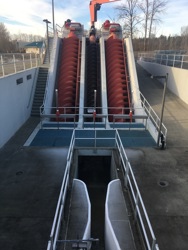
At the Wastewater Treatment Plant (WWTP) in Snohomish, WA (just north of Seattle), nothing has really visibly changed with the Lakeside Screw Pumps that were installed in 1995 – apart from the color!
Two 72” Screw Pumps and one 42” Screw Pump from Lakeside Equipment Corporation, IL, are now red (from their original blue), simply to match the plant’s color scheme, and more than three decades are on, with the help of new lower sealed bearings, are still happily working away. The paint job came about after 17 years of service in 2012 when the highly robust screw pumps were treated to a sandblast and clean up. The 30-years-plus of service is testament not only to Lakeside as the manufacturer, but to the diligent team of three at the City of Snohomish Wastewater Treatment Plant for their maintenance regime, especially in light of increasingly changing and challenging weather conditions.
Serving a population of 10,000, the plant has, in recent years, had to endure more and more instances of flooding that effectively leave the facility on an ‘island’. Heavy rain that melts the winter snow on the nearby Cascade mountain range sends excessive volumes of water rushing into the river that the facility discharges to. The Snohomish River can also be adversely affected by tides from the Salish Sea as well.
‘Problems we face with the thawing snow’
Duane Leach, Senior Wastewater Treatment Plant Operator for the City of Snohomish, said: “We get plenty of rain here anyway, but warmer winters and a spring that seems to be arriving earlier and earlier, causes the problems we face with the thawing snow.
“We’re gradually separating the flows in our pipe network, of which about half still contains a mix of sewage and stormwater. With fifty per cent of that stormwater now going directly to our old lagoon, we’re under slightly less pressure, but during many eventful challenges that the plant has faced, the Lakeside screw pumps have always been a constant, working away, especially the 42” unit, which is in use 24/7. Depending on flows, our SCADA system and our PLCs (Programmable Logic Controllers) will make one or both of the 72” screw pumps kick in, but the 42” runs all the time.”
Duane, who has been at Snohomish WWTP since 2013 and working in sewer department prior for the City since 2007, added:
“Once per month we grease the upper bearings. Once a year we grease everything. We clean the headworks and the screw pumps once per week to make sure that there’s no build up of odors. We use a fire hose to spray down all the built up of FOG (fats, oils, grease) along with the dreaded flushable, oh wait (!), not to be flushed wipes, while any gravel or rocks are carefully removed. During that weekly clean, we simultaneously run all three screw pumps to again check that everything is running smoothly.
“We changed out a motor quite some time ago, along with the upper gear box has been refurbished, and when we took them out for sandblasting in 2012, we switched to sealed bearings. So long as we routinely maintain the screw pumps, they work great. We love them – and their reliability is perfect with only three of us on site.”
Every day without fail, Duane and one his colleagues dutifully walk around the entire plant, with eyes, ears and noses wide open.
“It’d be much easier to go round in the truck,” says Duane, “but on foot we can see and hear everything.”
Duane is usually joined on the daily inspection round by Frank Schorsch (Maintenance Worker/Operator), who has worked at the plant since 2007, or sometimes by Karen Allen (Lab Technician/Operator), who joined in 2004. The team’s long-standing service continuity allows a vast amount of experience and knowledge to be called upon.
‘Popular for recreation and salmon fishing’
Despite being open (uncovered) screw pumps, the City of Snohomish WWTP lives in harmony with its neighbors, free from noise and odor complaints. In fact, there is a popular walking trail for residents and visitors around the plant, which prior to its construction, was basically a 25-acres settling pond.
“Our Snohomish River is very popular for recreation and salmon fishing, so we are very proud of our work to protect it,” added Duane.
In 1996, stringent new Total Maximum Daily Loads (TMDL) immediately challenged the plant to handle its ammonia levels, but the installation of a submerged fixed film solved the problem. Since then, the WWTP has won multiple ecology awards for its good practices, including its most recent accolade: The Lakeside Equipment Corporation Plant of the Year.
“This was totally unexpected,” continued Duane. “A real honor. You have to be spot-on with your site maintenance to be considered.”
Lakeside’s long-standing wastewater equipment representative for the region, Goble Sampson, also sang the praises of the City of Snohomish WWTP.
Based at numerous locations across the Western United States, Goble Sampson’s Joshua West (who works in the company’s Washington office), commented:
“We’re always here to provide back up to the City, whose treatment plant team set a fantastic example that the whole industry should be very proud of.
“Duane, Frank, Karen and the City of Snohomish thoroughly deserve the award for their dedication in maintaining such a well-run wastewater treatment plant.”
Dan Widdel, President of Lakeside Equipment Corporation (established 1928), added:
“We are blessed with a large number of our plants, that decades on, are still in incredible working order. It is only right that hard working treatment plant operators, who are largely unsung heroes, get the recognition that they deserve.
“Goble Sampson made very strong recommendations about the City of Snohomish, and after very careful consideration, when comparing other sites with strong track records, we felt that this exemplary WWTP was a worthy winner. Knowing that our screw pumps are still going strong after more than 30 years fills us with enormous pride.”
The future looks bright in Snohomish. It is the only plant in the whole of Washington state to use Peracetic Acid (PAA) instead of chlorine; a move that has helped keep it in firm compliance.
And with the planned conversion of the rest of the City’s pipe network to full separate sewage and stormwater, an increase in the plant’s capacity can help bring about opportunities for population growth and investment.
Source: Lakeside